Best Spring Destinations in Europe March-April 2026: Your Seasonal Guide

Best Spring Destinations in Europe March-April 2026: Your Seasonal Guide

Spring in Europe is the best-kept secret in travel. The summer crowds haven’t arrived, the shoulder-season prices are in effect, and the continent is waking up — tulips in the Netherlands, cherry blossoms in Germany, wildflowers in Andalusia, Easter celebrations across Southern Europe. March and April offer something summer can’t: Europe as the locals actually experience it.

Why Spring Is Europe’s Best Season for First-Timers and Return Visitors

The numbers make the case clearly. According to Eurostat’s tourism statistics, June-August accounts for 42% of all European tourism arrivals — concentrated into 12 weeks, generating crowd levels that make iconic sites nearly unbearable. March and April combined account for just 12% of annual tourist arrivals to the same destinations.

The practical implications:

The tradeoff is weather variability. Spring in Europe means anything from 20°C sunshine to surprise rain. Pack layers, bring a compact umbrella, and embrace the changeable quality of spring light — it’s part of the experience.

Top 7 Spring Destinations in Europe: March-May 2026

1. Seville, Spain — Best for Easter and Flamenco (Late March-April)

Seville’s Semana Santa (Holy Week) is one of the world’s most extraordinary public spectacles. Hundreds of elaborate processions with costaleros carrying floats of enormous religious sculptures through narrow streets, accompanied by marching bands and saeta singers — over 700,000 people attend, yet the crowds are nothing like summer tourist season. The atmosphere is unlike anything else in Europe.

Beyond Easter: The Alcázar gardens reach peak beauty in April — lush, fragrant, and peaceful in the morning before tours arrive. The tapas scene around Triana market is outstanding year-round. Weather in April averages 20-24°C, mostly sunny.

Booking calendar: If visiting for Semana Santa (March 29 – April 5, 2026), book accommodation 3-4 months in advance. Outside Easter week, last-minute availability is usually fine. Book via Booking.com for the best central neighborhood options.

2. Amsterdam, Netherlands — Keukenhof and Tulip Season (Late March-May)

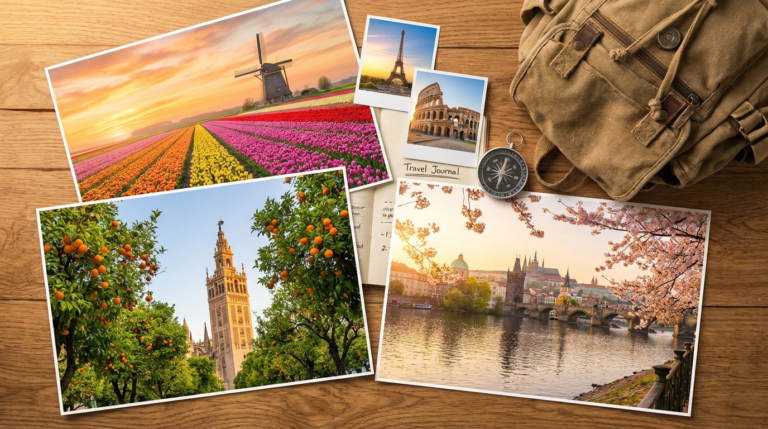
The tulip fields of the Netherlands are a genuine spectacle — 7 million tulips at Keukenhof Gardens alone (open mid-March to mid-May), and entire landscapes of striped color visible from trains and cycling paths across the bulb-growing region. Amsterdam itself is magnificent in spring: canals reflecting bare-branch to full-leaf trees over 4-6 weeks, terrace cafés reopening, and Vondelpark filling with locals.

Keukenhof timing: Peak bloom varies by weather but typically falls between April 5-25. The garden is so large that something is always flowering throughout the open season.

Getting there: Schiphol airport has direct connections from virtually everywhere in Europe and beyond. The train from Amsterdam Centraal to Leiden (for Keukenhof bus connection) takes 35 minutes.

3. Lisbon, Portugal — Best March Weather in Western Europe

Lisbon in March offers the most reliable mild weather of any Western European capital — average highs of 16-18°C, low humidity, and considerably more sunshine than Paris or London at the same time of year. The city feels local in March: Bairro Alto’s restaurants aren’t yet tourist-dominated, the LX Factory market is relaxed, and you can get a table at Belém’s historic Pastéis de Belém without queuing outside.

Spring highlight: The almond blossom in nearby Alentejo (90 minutes south) peaks in February-March — the landscape turns white-pink with blossoms before the summer heat arrives. Portugal is increasingly seen as Europe’s best-value quality destination.

4. Prague, Czech Republic — Cherry Blossoms and Pre-Summer Prices

Prague’s Stromovka Park and Petřín Hill transform in April when the cherry trees bloom — the city’s best and least-known seasonal spectacle. Petřín in blossom with the Old Town’s orange rooftops below is one of Central Europe’s finest views. Hotel prices in April run 30-40% below summer levels while the weather is genuinely pleasant (12-18°C, increasingly sunny).

Note for spring travelers: Easter weekend brings domestic Czech tourism to the city — the Easter markets in Old Town Square are atmospheric and worth experiencing, but book accommodation at least 3 weeks ahead for that weekend.

5. Amalfi Coast, Italy — Beat the Summer Crowds (March-April)

The Amalfi Coast in July is beautiful but chaotic — buses too full to board, restaurants requiring reservations weeks ahead, and traffic jams on the single-lane coastal road. In March and April, the wildflowers are in bloom on the terraced cliffs, lemon trees are fragrant, and Positano’s pastel buildings reflect in a calm sea with almost no one around. Many restaurants and hotels open by late March after winter closure.

Practical note: Some ferry services haven’t resumed in early March. By April 1, most connections are running. Weather is mild but variable — pack accordingly.

6. Edinburgh, Scotland — Spring Festivals and Long Evenings

Edinburgh’s spring is underrated compared to August’s famous Fringe Festival. The Science Festival (April), the International Harp Festival, and various gallery openings make the city culturally rich in spring. The light is extraordinary — by April, Edinburgh has 14+ hours of daylight, and the low-angle spring sun turns Arthur’s Seat and the Old Town golden in a way that August midday sun simply doesn’t.

Unique in spring: No Fringe crowds (August can double the city’s population), lower accommodation prices (30-50% below August), and the locals are genuinely present and accessible.

7. Dubrovnik, Croatia — Before the Game of Thrones Crowds (March-Early May)

Dubrovnik’s summer reputation for overcrowding is well-earned — 1.5 million cruise ship passengers arrived in 2024, often 7,000+ per day in peak season. In March and April, the Old City belongs to the residents who actually live there. The Adriatic is still cold for swimming, but the walls, fortresses, and streets are peaceful, beautifully lit, and photogenic in a way summer’s crowds prevent entirely.

Spring Weather by Destination: March vs. April

Destination March Avg. High April Avg. High Rain Days/Month
Seville 19°C 22°C 8
Amsterdam 11°C 14°C 12
Lisbon 17°C 19°C 11
Prague 11°C 17°C 9
Amalfi 15°C 18°C 8
Edinburgh 10°C 13°C 14
Dubrovnik 15°C 18°C 9

Spring Booking Calendar: When to Reserve What

For destination-specific planning, our guide to best Europe cities for solo travel 2026 includes several of these spring destinations in depth. For budget planning across these cities, our Amsterdam budget guide and Prague weekend guide give granular cost breakdowns. Booking activities in advance: GetYourGuide has excellent spring-specific walking tours and experiences at each destination.

Frequently Asked Questions

Is March too early for a beach vacation in Europe?

For beaches, yes — sea temperatures in the Mediterranean average 14-16°C in March, comfortable only for the cold-tolerant. Southern Spain (Málaga, Canary Islands) and mainland Portugal have warmer coastal temperatures and are viable for sunbathing from March onward. For swimming, May is the earliest reasonable month for most Mediterranean destinations.

What European destinations should I avoid in spring?

Venice is flooding season (acqua alta) in winter/spring — manageable but requires waterproof footwear and flexibility. Iceland and Scandinavia are still very cold in March with limited daylight. Santorini is largely closed until late April.

Do European attractions have shorter hours in spring?

Some do — winter/spring hours are shorter than summer hours at many outdoor attractions. Check current opening times directly on attraction websites before visiting, especially for early March travel.

What’s the best budget spring European destination in 2026?

Lisbon and Porto (Portugal) offer exceptional value — excellent food, great weather in spring, strong English fluency, and accommodation costs 40-60% lower than Paris or Amsterdam for comparable quality.

Is spring a good time for the Camino de Santiago?

Yes — spring (April-June) is considered one of the best periods for the Camino. Comfortable temperatures, green landscapes, and fewer pilgrims than summer. The wildflower-covered Galician countryside in May is extraordinary.

Related Europe Guides

Best European Destinations Summer 2026: Top 15 Picks

Disclosure: This article may contain affiliate links. If you click through and make a purchase, we may earn a commission at no extra cost to you. We only recommend products and services we genuinely believe in. Full disclosure.

# Best European Destinations Summer 2026: Top 15 Picks

Look, 2026 is going to be a massive year for travel in Europe. Between major events, new train routes opening up, and several cities finally hitting their stride after years of quiet development, there’s never been a better time to start planning.

But here’s the thing: where do you actually go? Europe has over 40 countries and thousands of spots vying for your attention. I’ve narrowed it down to 15 picks that I think make the strongest case for 2026—ranging from the icons we all love to a few rising stars you probably haven’t considered yet.

1. Tbilisi, Georgia

I honestly think this is Europe’s most exciting emerging destination right now. Tbilisi is unlike anywhere else I’ve been. You’ve got ancient Silk Road history clashing with a techno-cool arts scene that feels completely fresh. Plus, the food—khinkali and khachapuri—is legendary, and the natural wine is something the rest of the world is only just starting to wake up to.

Wander the old town (Kala) to see those iconic wooden balconies, then check out the sulfur baths in Abanotubani. What I find interesting is that prices are still remarkably low. You can get an incredible dinner for €15 and a great bottle of wine for €5.

Best for: Food lovers, wine enthusiasts, off-the-beaten-path explorers

2. Porto, Portugal

Lisbon usually gets all the glory, but in my experience, Porto is actually the more charming of the two. The Ribeira district along the Douro River is a UNESCO-listed dream. Want a tip? Cross the bridge to Vila Nova de Gaia—the port wine lodges there often do tastings that won’t break the bank.

Porto is smaller and way easier to navigate than Lisbon. You’ve also got solid beaches like Matosinhos just a short hop away, and the Douro wine valley is an easy day trip by train.

Best for: Wine tourists, weekend trippers, photographers

3. Seville, Spain

Seville is the soul of Andalucía. It’s all about flamenco, tapas culture, and some of the most stunning architecture on the planet. You need to see the Real Alcázar and the Giralda tower, but honestly, just getting lost in the Barrio Santa Cruz is the best way to spend an afternoon.

One quick warning: Seville in July and August is a furnace (we’re talking 40°C+). If you can, aim for May, June, or September. You’ll thank me later.

Best for: History lovers, food culture, flamenco experiences

4. The Azores, Portugal

Imagine nine volcanic islands sitting in the middle of the Atlantic. They’re still relatively uncrowded, and the landscapes are some of the most striking in Europe. Sete Cidades—the twin crater lakes—is a must-see, and the thermal pools at Caldeira Velha feel like something out of a movie.

Flights from Lisbon are usually around €80–120. It’s surprisingly affordable once you’re there, too. Don’t leave without trying Cozido das Furnas—it’s a stew literally cooked underground by volcanic heat.

Best for: Nature lovers, hikers, divers

5. Kotor, Montenegro

People often call the Bay of Kotor Europe’s southernmost fjord. It’s dramatic—mountains dropping straight into the Adriatic with tiny medieval towns tucked at the bottom. Kotor’s old town is beautiful, and if you’ve got the legs for it, the hike up to St. John’s Fortress offers views that are hard to beat.

Montenegro is basically a cheaper, less crowded version of Croatia’s coast. June and September are the sweet spots here.

Best for: Budget travelers, history lovers, photographers

6. Scottish Highlands, UK

This is one of Europe’s last true wildernesses. Whether it’s the dramatic valley of Glencoe or the fairy pools on the Isle of Skye, the Highlands reward people who don’t mind a bit of unpredictable weather.

You need to rent a car from Inverness or Glasgow and drive the North Coast 500. It’s one of the best road trips you’ll ever take. Plus, wild camping is legal in Scotland, which is a great way to save on accommodation if you’re feeling adventurous.

Best for: Road trippers, hikers, whisky enthusiasts

7. Dubrovnik, Croatia

The classic. And yeah, it’s busy in July. Game of Thrones fans are still everywhere. But there’s a reason it’s so popular—the walled city sitting against that turquoise water is spectacular.

Here’s a smart strategy: go in June or September. Take the cable car up the hill for sunset, then escape the crowds by taking a boat to the Elafiti Islands for the day.

Best for: Island hoppers, first-time Mediterranean visitors

8. Tallinn, Estonia

Tallinn is probably the best-preserved medieval city in Northern Europe. It looks like a literal fairy tale—cobblestones, turrets, the whole deal. But it’s not just a museum piece; there’s a massive digital startup scene and a really cool design culture happening here.

The food is surprisingly great, too—think Nordic-influenced Estonian cuisine. Worth mentioning: it’s significantly cheaper than Scandinavia, even though it’s just a short ferry ride from Helsinki.

Best for: History enthusiasts, city breakers, budget-conscious Northern Europe travelers

9. Amalfi Coast, Italy

It’s expensive. It’s crowded. And the roads are a nightmare. But is it worth it? Absolutely. Positano’s cliffside houses and the Path of the Gods hiking trail are world-class for a reason.

My advice? Base yourself in Amalfi or Praiano instead of Positano to save some cash. Also, use the local ferries to get around. It’s faster than sitting in a traffic jam on the coastal road and the views from the water are better anyway.

Best for: Honeymoons, anniversary trips, lovers of dramatic scenery

10. Plovdiv, Bulgaria

This might be the most underrated city in Europe. Plovdiv’s old town is incredible—think Ottoman-era houses and Roman ruins everywhere. There’s even a Roman amphitheater that they still use for concerts.

The café culture is top-notch, and the wine from the nearby Thracian Plains is a hidden gem. Best of all? Bulgaria is incredibly cheap compared to Western Europe. You’ll get a lot of bang for your buck here.

Best for: Budget travelers, history lovers, off-the-beaten-path seekers

11. Lake Bled, Slovenia

You’ve seen the photos—the church on the island, the castle on the cliff, the emerald water. It actually looks like that in real life. You can rent a traditional pletna boat to reach the island or just hike the trails around the lake for the perfect shot.

Slovenia is tiny, so you can easily combine Bled with the capital, Ljubljana, or the stunning Soča Valley. It’s a great spot for a low-stress road trip.

Best for: Photographers, families, couples

12. Palermo, Sicily

Palermo is chaotic, loud, and absolutely brilliant. The street food scene here (you have to try the arancini) rivals anywhere else in Italy. It hasn’t been “polished” for tourists like Florence or Rome, which I think is its greatest strength. It’s authentic, a bit rough around the edges, and much more affordable.

Best for: Food lovers, Italian history enthusiasts, adventurous travelers

13. Bergen, Norway

This is your gateway to the fjords. Bergen itself is lovely—especially the old Bryggen wharf—but the real magic happens when you get out on the water. The Hardangerfjord and Sognefjord are just a ferry ride away.

Yes, Norway is pricey. There’s no way around it. But the scenery is unlike anything else in the world. Budget carefully, and you won’t regret it.

Best for: Nature lovers, active travelers, Scandinavian culture enthusiasts

14. Crete, Greece

Crete is huge, and you need more than a few days here. Beyond the famous pink sands of Elafonissi, you’ve got the Palace of Knossos and the Samaria Gorge—a 16km hike that is easily the best in Greece. The food here is also distinct from the mainland; look for “dakos” on the menu.

Best for: Beach lovers, history buffs, hikers, food enthusiasts

15. Bruges, Belgium

Bruges can feel a bit like a movie set because it’s so perfectly preserved. The canals, the chocolate shops, and the medieval architecture are enchanting. It’s the perfect weekend escape.

Want to avoid the crowds? Stay overnight. Once the day-trippers from Brussels leave in the evening, the city becomes incredibly peaceful and atmospheric.

Best for: Weekend trippers, couples, art lovers

Planning Tips for Summer 2026

Book early. I can’t stress this enough. Peak summer spots like Dubrovnik or the Amalfi Coast sell out months in advance. Don’t wait until April to book for July.

Try the “shoulder” months. If you can travel in June or September, do it. You get the same weather but with half the crowds and much better prices.

Mix it up. Don’t just do the “big” cities. A trip that combines a famous spot (like Rome) with a lesser-known gem (like Plovdiv) usually makes for a much more interesting story.

Getting around: Flixbus is great for cheap city-to-city travel. Plus, Eurail passes are still a solid bet for longer rail trips across multiple countries.

Bon voyage, gute Reise, buon viaggio—wherever you’re headed!

Related Europe Guides

Sign In

Register

Reset Password

Please enter your username or email address, you will receive a link to create a new password via email.

Trust Signals: Editorially reviewed listings · Transparent update policy · Contactable support team