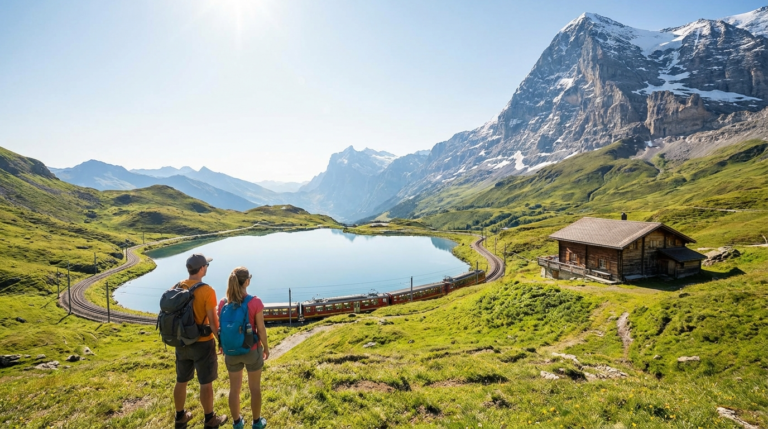
How to Plan a Europe Trip in 2026: Complete Step-by-Step Guide

Written by Sophie Laurent, European travel planner. Last updated: April 2026.
Planning a trip to Europe for 2026 feels daunting for many travelers, and I understand the hesitation completely. Between fluctuating flight costs, new digital entry requirements like ETIAS, and the fear of missing out on the “best” cities, it is easy to feel overwhelmed before you even begin. However, I have planned over a hundred trips for clients and myself, ranging from two-week vacations to six-month backpacking journeys. This guide is not about dreamy possibilities; it is my exact, tested process for building a trip that works for your time, budget, and energy levels. If you are searching for how to plan a Europe trip 2026, you are in the right place. Let’s start with what you actually need before you even look at a map.
Affiliate disclosure: This article contains affiliate links. We may earn a small commission at no extra cost to you if you book through them. I only recommend services I’ve personally used or vetted with clients.
What Do You Need to Start Planning a Europe Trip?
You need three things right now: a digital notepad, a calendar, and a brutally honest budget number. Do not start with Pinterest or Instagram. Those platforms come later during the inspiration phase. Your notepad is for dumping every single idea, no matter how vague. The calendar is to mark your fixed dates: when you can leave, when you must return, and any holidays you want to avoid. The budget number is the most critical component. For 2026, I tell my clients to assume a baseline of €75-€100 per person, per day for Western Europe, excluding flights. For Eastern Europe, expect €40-€60. This is for modest travel: hostels or budget hotels, public transport, museum entries, and food from markets or casual spots. Write that number at the top of your page. It will guide every single choice you make.
Tracking expenses is easier than ever with modern banking apps, but you must set the limit before you spend. Remember that major cities like Paris, London, and Zurich will skew your average higher. If you plan to visit these hubs, balance them with cheaper destinations like Valencia or Krakow to keep your overall spend manageable. Always set aside a contingency fund of at least 10% of your total budget for emergencies, such as missed connections or unexpected health needs. Additionally, notify your bank of your travel plans to prevent card freezes, and consider a no-foreign-transaction-fee credit card to save on exchange rates. Using a dedicated travel card can save you up to 3% on every purchase compared to standard debit cards.
2026 Daily Budget by Region
| Region |
Budget (€/day) |
Mid-range (€/day) |
Comfortable (€/day) |
| Western Europe (France, Germany, Italy, Spain) |
60-80 |
100-130 |
160+ |
| Nordic Countries (Norway, Sweden, Denmark) |
80-110 |
140-180 |
220+ |
| Eastern Europe (Poland, Czechia, Hungary) |
40-55 |
70-90 |
120+ |
| Balkans (Croatia, Bosnia, Albania) |
35-50 |
60-80 |
100+ |
To break this down further, accommodation usually consumes 40% of your daily budget, while food takes up 30%. Transportation and activities make up the remainder. By understanding these ratios, you can adjust your lifestyle choices. For instance, choosing an Airbnb with a kitchen allows you to cook breakfast and save significantly on dining costs, freeing up funds for premium experiences like guided tours or concert tickets. In 2026, dynamic pricing affects train tickets heavily, so booking rail passes early can lock in lower transportation costs, preserving your daily spending money for experiences.
How Do You Define Your Trip’s Core Shape?
Instruction: Decide the length, travel style, and one primary goal for your 2026 trip. Is it 10 days, 3 weeks, or 2 months? Is it a fast-paced city-hopping tour, a relaxed deep-dive into one region, or an outdoor adventure? Finally, name one non-negotiable experience. For example: “A 14-day trip focused on historic cities, and I must see the Alps.”
Why it matters: Without these three anchors, you will drift. You’ll try to cram 8 countries into 10 days because a blog said to. Your primary goal acts as a filter. If your goal is “Roman history,” cities like Rome, Naples, and Split make the list. Paris and Amsterdam, while wonderful, might not. This step saves you from the classic mistake of planning a trip for someone else’s tastes. It also helps you allocate your budget correctly, ensuring you have enough funds for your priority experiences rather than spreading yourself too thin.
My pro tip: For first-timers in 2026, I strongly recommend a two-week maximum for your first trip. Jet lag is real, and travel fatigue hits hard. A focused 10 to 14 day trip to 2 or 3 countries gives you a real taste without burnout. Follow the general rule of thumb: spend at least three nights per city to minimize packing and unpacking. For a summer 2026 trip, block those dates now. School holidays run late June to early September, so prices peak. Shoulder season (May or late September) is my permanent recommendation. For more ideas on balancing city and nature, see Best Spring Destinations in Europe March-April 2026: Your Seasonal Guide.
- The Golden Rule of Pacing: Plan one major activity per day and leave the rest open for exploration.
- Travel Days: Never schedule important events on the day you arrive or depart.
- Rest Days: Insert a non-moving day every five days to laundry and relax.
What Are the 2026 Visa and ETIAS Requirements?
Instruction: Check your passport expiration (must be valid 6 months past trip end). Then check ETIAS status. If you hold a US, Canadian, UK, or Australian passport, you will likely need an ETIAS travel authorization in 2026 before entering the Schengen Area.
Related reading: Helsinki 3-Day Itinerary: The Best Things to Do in 2026
Portugal Budget Coast Itinerary 2026: How to Explore the Atlantic Shore for Under €60/Day
Portugal’s Atlantic coast stretches nearly 1,800km from the Minho River in the north to the Algarve’s limestone cliffs in the south — and in 2026, it remains one of Europe’s best-value destinations for coastal travel, with accommodation, food, and transport costs running 30-50% below comparable Spanish or French coastlines.
This itinerary covers 14 days along Portugal’s coast staying under €60/day including accommodation, food, local transport, and entrance fees. It’s designed as a south-to-north journey starting in Lagos (Algarve) and finishing in Porto, using a combination of buses, trains, and the occasional ferry.
Budget Overview: What €60/Day Gets You in Portugal
Before the itinerary: context on costs. Portugal’s tourist infrastructure has expanded enormously in the past decade, and Lisbon and the Algarve in peak summer (July-August) can approach Western European prices in tourist zones. This itinerary is optimized for shoulder season (April-June, September-October) and avoids the premium tourist accommodation in favor of hostels, budget guesthouses, and rooms in family-run pensões.
Daily budget breakdown:
- Accommodation: €15-25 (hostel dorm or budget guesthouse)
- Food: €20-25 (local restaurants, pastelarias for breakfast, self-catering lunches)
- Transport: €5-10 (bus, train, or ferry for daily transfers)
- Activities/entrance: €5-10
According to Eurostat’s 2025 Comparative Price Levels report, Portugal remains 20-25% below the EU average for tourism spending, making it the second most affordable Western European coastal destination after Greece.
Days 1-3: Lagos and the Algarve West
Start in Lagos. Fly into Faro (international connections from most European hubs), take the regional train west to Lagos (1.5 hours, €7). Lagos is the best base for the western Algarve: central enough to day-trip east and west, with a lively but not overwhelming tourist scene outside peak summer.
Day 1 — Lagos arrival and Ponta da Piedade: The golden limestone arch formations at Ponta da Piedade are accessible on foot from Lagos center (35-minute walk). The light at golden hour turns the cliffs into a color show that stops people mid-conversation. Kayak rental from local operators (~€20/2 hours) takes you through the sea caves at water level — one of the region’s finest experiences.
Day 2 — Sagres and Cabo de São Vicente: Bus from Lagos to Sagres (45 minutes, €3.50). Cabo de São Vicente is the southwestern tip of mainland Europe — the point from which Portuguese explorers set sail during the Age of Discovery. The lighthouse sits atop sheer 75-meter cliffs. Dramatic even in calm conditions; extraordinary in the frequent Atlantic swell. Free entry, windswept, and less crowded than you expect.
Day 3 — Praia da Marinha day trip: East from Lagos, Praia da Marinha is consistently ranked Portugal’s most beautiful beach — a small, sheltered cove surrounded by layered limestone. Take the local bus toward Lagoa (€2.50) and walk the clifftop path. Bring your own food — the beach kiosk prices are tourist-inflated.
Days 4-5: Alentejo Coast — The Hidden Section
The Alentejo coast (Costa Vicentina) between the Algarve and Setúbal is Portugal’s least-developed, most protected stretch of shoreline. Part of the Parque Natural do Sudoeste Alentejano e Costa Vicentina, it has some of Europe’s cleanest beaches and almost zero mass tourism infrastructure.
Day 4 — Odeceixe: Bus from Lagos toward Aljezur, change for Odeceixe (2 hours total, ~€8). Odeceixe sits above its river mouth beach — the Praia de Odeceixe — where the Seixe river meets the Atlantic. The beach is sheltered from the main Atlantic swell by geography, making it uniquely swimmable when the western surf is too rough for Sagres. Village accommodation options are genuinely cheap: guesthouses from €35-45/night.
Day 5 — Zambujeira do Mar: South along the Alentejo coast by bus (about 45 minutes from Odeceixe). Zambujeira do Mar is a surfer village with a spectacular beach backed by black volcanic rock. This is where the Sudoeste SWF surf festival happens in September — but outside festival season, it’s wonderfully quiet. Camping on the clifftop above the beach (€12/person) is the budget accommodation of choice.
Days 6-7: Setúbal Peninsula and Arrábida
Bus from Zambujeira to Setúbal via Grândola (3.5 hours with connections, €14). Setúbal is the gateway to the Serra da Arrábida Natural Park — the stretch of coast where Mediterranean-type vegetation meets clear aquamarine water. The beaches here (Portinho da Arrábida, Galapinhos) are regularly cited as the most beautiful in mainland Portugal, with water clarity approaching the Azores.
Practical note: private cars are restricted in peak season (July 15-September 15). Access is by electric shuttle bus from the park entrance. Shoulder season, the road is open and the quiet is extraordinary. Snorkeling at Portinho da Arrábida is world-class for European standards.
Days 8-9: Lisbon (Passing Through)
Train from Setúbal to Lisbon (50 minutes, €3.70). Lisbon needs at least a day — and if you’ve never been, steal an extra day here from the coast itinerary. Budget Lisbon accommodation has improved significantly: hostels in Mouraria and Intendente offer dorm beds for €18-25/night in good properties with rooftop terraces.
The Alfama neighborhood at dawn, before the tourist groups, is still remarkable: terracotta rooftops, the distant sound of fado from open windows, laundry lines strung between medieval buildings. The 28 tram (€3) from Martim Moniz through Alfama is the cheapest city tour in Europe for its scenery-to-cost ratio.
For a comprehensive approach to Portugal as part of a broader Europe trip, our 2-week Europe budget itinerary under €1,000 contextualizes Portugal within the wider European budget travel landscape and shows how Portugal can serve as the affordable anchor of a multi-country route.
Days 10-11: Nazaré and the Atlantic Surf Capital
Bus from Lisbon’s terminal in Sete Rios to Nazaré (2 hours, €11). Nazaré has two faces: the traditional fishing village of the lower town (Praia) and the clifftop Sítio connected by a funicular (€1.30 return). It’s also where Rodrigo Koxa and others have surfed the largest waves ever recorded (30-meter faces at Praia do Norte in winter storm season).
Off-season, Nazaré is an exceptional budget destination: pensões from €35-50/night, fresh fish directly from the boats sold at the beach, and the tourist infrastructure of a resort town without high-season pricing. The fish market (mercado de peixe) opens at 7am when the boats return — watching the morning catch is genuinely fascinating.
Days 12-13: Aveiro — The Portuguese Venice
Train from Nazaré (change in Leiria or Coimbra) to Aveiro (2.5 hours total, €12). Aveiro sits on a lagoon system where colorful moliceiro boats — flat-bottomed vessels originally used for seaweed harvesting — are now the tourist symbol. The canal-lined Art Nouveau buildings in the town center are extraordinary, making it the most architecturally distinctive city on this coastal itinerary.
The nearby Costa Nova beach — striped wooden fishermen’s houses (palheiros) facing wide Atlantic beach — is an obligatory half-day trip (20 minutes by bus). It’s become one of Portugal’s most photographed places; arrive at 8am to have it mostly to yourself.
Day 14: Porto Finish
Train from Aveiro to Porto (50 minutes, €3.80). Porto ends this coastal itinerary with the country’s second city and its most atmospheric. The Ribeira waterfront, the wine cellars of Vila Nova de Gaia, and the Livraria Lello (one of the world’s most beautiful bookshops) are all within walking distance of each other.
Budget accommodation in Porto’s historic center has expanded: properties in the Bonfim and Campanhã neighborhoods offer good quality at 20-30% less than Baixa/Ribeira. Porto airport serves dozens of European destinations, making it an ideal end point for this circuit.
For accommodation bookings along this route, Booking.com Portugal coastal stays covers everything from Algarve hostel dorms to Alentejo guesthouses with verified reviews.
Transport Summary: How to Get Around
Portugal’s coach network (Rede Expressos and regional operators) connects the coastal towns not served by trains. Key tools:
- Rede Expressos app/website: For most inter-city coach routes
- CP (Comboios de Portugal) app: National rail, book in advance for best prices
- Transferwise card or Revolut: ATM withdrawals in Portugal remain the cheapest money access
Frequently Asked Questions: Portugal Budget Coast Itinerary
Is Portugal safe for solo travelers on a budget coastal route?
Portugal consistently ranks among Europe’s safest countries. Solo travelers on the coastal route — both male and female — report the journey as comfortable and welcoming. Rural Alentejo and Algarve towns particularly embody the famous Portuguese cordiality (saudade-tinged hospitality). Exercise standard urban precautions in Lisbon and Porto tourist areas.
What is the best month for a budget Portugal coast trip in 2026?
May and September/October offer the best combination: warm sea temperatures (18-22°C), uncrowded beaches, and 20-30% lower accommodation prices than July-August. June is also excellent and catches the Portuguese festivals season. Avoid August if possible — Algarve accommodation prices triple compared to May.
Can I use a Eurail pass for this Portugal coast itinerary?
A Portugal-only Eurail pass covers CP trains (Setúbal-Lisbon, Lisbon-Nazaré via Coimbra, Aveiro-Porto). But given Portugal’s low train prices, point-to-point tickets usually work out cheaper unless you’re combining with trains in Spain or other countries. Calculate both before purchasing.
Is Portuguese food vegetarian-friendly along the coast?
Portuguese coastal cuisine is heavily seafood-focused, which is sometimes problematic for vegetarians and challenging for vegans. However, 2025-2026 has seen significant improvement in plant-based options in cities and larger towns. Pastelarias (pastry shops), the vegetable side dishes common with meals, and the excellent local cheeses and breads make vegetarian eating workable. Vegans will find it more challenging outside major cities.
How do I handle the Alentejo coast without a car?
The Alentejo coast has limited bus coverage — the main Rede Expressos runs between the larger towns but doesn’t serve smaller beaches. Renting bicycles from hostel operators in Odeceixe and Zambujeira is the standard approach: the coastal cycling paths (Ecovia do Litoral) connect most beaches on traffic-free routes. For day trips from a base town, taxis are affordable by Northern European standards (€10-20 for short beach runs).
Best 5-Day Greece Itinerary: Athens and Santorini 2026
Five days in Greece gives you enough time to do two things well: understand Athens deeply enough to stop seeing it as a layover, and experience Santorini beyond the caldera-view Instagram posts. This chronological guide is built around a specific question — what do I actually do, and in what order? — with real transport connections, honest prices in euros, and the timing details that most Greece itineraries leave out.
Here’s the day-by-day plan before we get into detail:
- Day 1: Athens arrival, Plaka neighborhood, Monastiraki evening
- Day 2: Acropolis and Acropolis Museum (full morning), Cape Sounion sunset
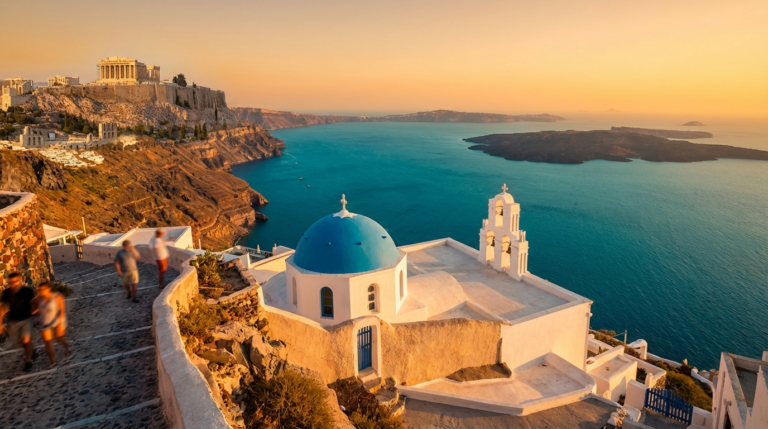
- Day 3: Ferry or flight to Santorini, Fira arrival, caldera sunset
- Day 4: Oia morning, volcanic island boat tour, Akrotiri archaeological site
- Day 5: Black sand beach, Pyrgos village, evening flight back to Athens or home
Day 1: Athens Arrival — Plaka and Monastiraki
Land at Athens International Airport (ATH). The Metro Line 3 runs directly from the airport to central Athens in 40 minutes, costs €10.50 per person, and runs until midnight. Don’t take a taxi from arrivals unless you’ve pre-booked through Uber or Beat app — metered rates from ATH to central Athens are €38–42 (legal), but unlicensed drivers approach arrivals. The metro is safer, faster, and half the price.
Check into your hotel in or near Plaka, the historic neighborhood beneath the Acropolis. Plaka has accommodation at every price point — budget guesthouses from €45–65/night, mid-range hotels €90–130, boutique options €160–240. Monastiraki Square is 8 minutes’ walk from the heart of Plaka and serves as your evening anchor.
First evening: Walk Plaka’s narrow streets. Don’t rush this — the neighborhood is best explored without a specific destination. Greek architecture research from the Hellenic Ministry of Culture indicates that over 340 buildings in Plaka predate 1821. The streets are genuinely old. Have dinner at one of the psarotavernas (fish restaurants) on Adrianou Street — prices range €18–35 for a full meal with wine. The tourist-priced restaurants right on Monastiraki Square are not the best; walk one block deeper.
Orientation note: Greek dinner starts late. Restaurants before 8pm are usually empty; the real evening starts around 9pm. If you’re arriving on a late flight, this works perfectly — you can eat properly without feeling rushed.
Day 2: The Acropolis and Cape Sounion
This is the most important day of the Athens portion. Get to the Acropolis entrance at Dionysiou Areopagitou street before 8:30am. The site opens at 8am; by 9:30am, tour groups begin arriving in volume. The early timing isn’t just about crowds — the morning light on the Parthenon marble is exceptional, and the sky is clearest in early morning before Athens’ atmospheric haze builds.
Tickets: The combined Acropolis ticket (€30, 2026 rate) covers the main site plus 7 archaeological sites in Athens, valid for 5 days. It’s the only ticket worth buying if you have 2+ days in Athens. Individual site entries are €10–15 each — the combined pass pays for itself with 2–3 sites. Buy online at etickets.tap.gr to skip the queue.
Budget 2 hours at the Acropolis itself, then walk directly to the Acropolis Museum. The museum is 400 meters from the main site entrance, opens at 8am (Fridays until 10pm), and costs €10 for adults. The permanent collection arranges the Parthenon frieze in the order it originally appeared on the temple — with casts substituting for the pieces currently in the British Museum. According to UNESCO figures, the British Museum holds 253 pieces of the original Parthenon sculptural program. The museum context makes this loss viscerally clear; plan 1.5–2 hours.
Afternoon: Cape Sounion
Most itineraries skip Cape Sounion because it requires effort. That effort — approximately 70km south of Athens, 1.5 hours by KTEL bus from the Areos Park terminal (€6.50 each way, buses every 1–1.5 hours) — is absolutely worth it. The Temple of Poseidon sits on a cliff 65 meters above the Aegean Sea, and the late afternoon light between 4–6pm (depending on season) turns the white marble amber. Lord Byron carved his name into a column here in 1810. The entrance fee is included in the combined Acropolis ticket; if you haven’t bought the combined pass, it’s €10 separately.
Return to Athens by 8pm, with enough energy for dinner in the Psirri neighborhood (next to Monastiraki) — better restaurants, lower prices than Plaka, and a more authentic evening crowd.
Day 3: Travel to Santorini
You have two options for Athens to Santorini: ferry or flight. The honest comparison:
Ferry (Piraeus → Santorini):
- High-speed ferry: 5–5.5 hours, €55–85 per person (Seajets or Hellenic Seaways)
- Conventional ferry: 8–9 hours overnight, €40–60 per person
- Pros: scenic, relaxing if you’re not prone to motion sickness, lower cost
- Cons: time-consuming for a 5-day itinerary; conventional overnight ferry loses a full day
Flight (ATH → JTR):
- Duration: 45 minutes
- Cost: €50–120 depending on airline and booking timing (Aegean Airlines, Sky Express)
- Pros: saves 4–5 hours for a short trip
- Cons: adds airport time; Santorini airport has no air conditioning in arrivals (genuinely unpleasant in summer)
Recommendation for 5-day itinerary: Fly. The time saved is too valuable on a short trip. If you have 7+ days, the high-speed ferry is worth it for the experience.
Santorini’s airport is at the southern tip of the island. Pre-book a taxi or bus to Fira (the main town) — €15 by taxi, €1.80 by public bus. The bus is fine; the taxi is 5 minutes faster. Most mid-range accommodation is in Fira (central, good transport links) or Firostefani (5-minute walk from Fira, caldera views, slightly quieter).
First afternoon in Santorini: Settle in, then walk the caldera path from Fira toward Firostefani and Imerovigli. This 3km path sits right on the caldera edge with uninterrupted views of the volcanic islands. The path is well-maintained and accessible. The sunset from Imerovigli — specifically from Skaros Rock if you’re willing to scramble down a rocky path — is less crowded than the famous Oia sunset and equally beautiful. Evening: dinner in Fira with local white wine (Assyrtiko from Santorini’s volcanic soil is distinctive and worth trying; expect €8–14/glass at good restaurants).
Day 4: Oia, Volcano Tour, and Akrotiri
Start early — leave Fira by 7:30am to reach Oia before the crowds. The local bus (€1.80, runs frequently from Fira’s main terminal) takes 25 minutes. Oia in the morning, before 9am, is a different place than the Oia of tourist photographs. The blue-domed churches, the windmills, the stepped white lanes — all there, with almost no other tourists. The famous sunset view from Oia’s castle point draws 3,000–4,000 people in high season; the morning version of the same vantage point has perhaps 20.
Spend 2–3 hours in Oia exploring the village, then return to Fira for the afternoon activities.
Volcanic Island Boat Tour (afternoon): Multiple operators depart from Fira’s old port. A half-day tour covering the active Nea Kameni volcano, the thermal hot springs at Palea Kameni, and Thirassia island costs €25–35 per person. This is one of the few places in Europe where you can walk on an active volcano — the crater last erupted in 1950, and the ground is still warm. The hot springs are genuinely orange from sulfur, swimwear required. Tour duration: approximately 5 hours. Book through agencies in Fira rather than through hotels (15–20% cheaper).
Akrotiri Archaeological Site: A Minoan city preserved under volcanic ash from the Bronze Age eruption approximately 3,600 years ago — often called “the Pompeii of the Aegean.” Entry is €14 adults (€7 combined with the caldera boat tour discount some operators offer). The site is fully covered (crucial in summer heat), well-curated, and routinely underestimated. Budget 1.5 hours. According to the Greek Ministry of Culture, Akrotiri’s volcanic preservation has kept organic material intact that would have degraded in open air — including wooden furniture impressions, wall frescoes, and food storage vessels that still contain residue from 1500 BCE.
Evening: Dinner at one of the restaurants on Fira’s caldera edge. Prices are higher here (€25–50/person) but the setting is unmatched. The caldera view after dark, with the volcanic islands illuminated and the neighboring island lights reflecting in the water, is genuinely worth the premium once.
Day 5: Black Sand Beach, Pyrgos, and Departure
Santorini’s beaches are unusual — the volcanic geology creates black, red, and dark grey sand rather than white. Perissa Beach on the southeast coast is the longest and most accessible: 1.5km of black volcanic sand, clear water, sun loungers available (€8–12/pair), and decent tavernas directly on the beach. Local bus from Fira to Perissa: €1.80, 25 minutes.
Spend the morning at Perissa, then head inland to Pyrgos village for lunch. Pyrgos sits at the highest point of the island and has preserved its medieval Venetian-era architecture — a kasteli (castle) center, winding whitewashed lanes, and a view of the entire island. Unlike Oia and Fira, Pyrgos has no significant tourist presence. Lunch at one of the village tavernas: €12–20/person. Taxi from Perissa to Pyrgos: €15. This is the most authentic half-day of the entire itinerary.
Return to Fira, collect bags, and head to Santorini Airport (JTR) for your flight home or back to Athens. If extending to a longer trip, the ferry from Santorini connects to Mykonos, Crete, Rhodes, and dozens of other islands with daily services in season.
Budget Breakdown: 5 Days in Athens and Santorini
| Item |
Budget Option |
Mid-Range Option |
| Accommodation Athens (2 nights) |
€50/night × 2 = €100 |
€110/night × 2 = €220 |
| Accommodation Santorini (2 nights) |
€80/night × 2 = €160 |
€160/night × 2 = €320 |
| Athens ↔ Santorini flight |
€55 (advance) |
€95 (last minute) |
| Athens entry tickets (combined) |
€30 |
€30 |
| Cape Sounion transport |
€13 (bus return) |
€13 (bus return) |
| Volcanic island boat tour |
€28 |
€35 |
| Akrotiri |
€14 |
€14 |
| Food & drink (5 days) |
€30/day = €150 |
€55/day = €275 |
| Local transport (metro, buses) |
€25 |
€40 |
| TOTAL |
€575 |
€1,042 |
Budget option requires advance flight booking (2+ months ahead) and guesthouse accommodation. Mid-range assumes direct booking, standard 3-star hotels in Santorini’s caldera side, and eating at proper restaurants daily.
Planning Your Extended Europe Trip
Greece fits naturally into a broader European itinerary. Consider these extensions and related resources:
FAQ: 5-Day Greece Itinerary
Is 5 days enough for Athens and Santorini?
Yes, if you follow a structured itinerary. Two full days in Athens covers the Acropolis, Acropolis Museum, Cape Sounion, and neighborhood exploration. Two full days in Santorini covers Oia, the volcano tour, Akrotiri, and beach time. The fifth day is used for travel between the two. It’s a tight but satisfying schedule — you’ll feel you’ve seen both properly, not just sampled them.
When is the best time to visit Greece?
May–June and September–October are the best months. July–August are peak season: temperatures reach 32–38°C in Athens, Santorini accommodation triples in price, and tourist volumes are highest. May has perfect temperatures (22–27°C), green landscapes in Athens, and prices 30–40% lower than peak. October has warm sea temperatures for swimming and beautiful light. Avoid Greece in November–March unless you specifically want Athens off-season (fine for the museums and archaeology, cold for beach activities).
How much does a 5-day trip to Greece cost?
Budget travelers can do 5 days for approximately €575–650 (guesthouses, advance flights, local food). Mid-range travelers spending €1,000–1,100 get 3-star hotel accommodation in Athens, caldera-area accommodation in Santorini, proper restaurant dinners, and comfortable transport. Luxury budgets (caldera-view boutique suites, daily guided tours, fine dining) run €2,500–4,000+ for two people over 5 days.
Should I take the ferry or fly from Athens to Santorini?
For a 5-day itinerary, fly. The 45-minute flight saves 5+ hours compared to the high-speed ferry. Costs are comparable or slightly higher (€55–120 vs €55–85 ferry), but time is the limiting factor on a short trip. If you have 7+ days, the high-speed catamaran ferry is a lovely experience — 5 hours crossing the Aegean with island views and a comfortable deck. For 5 days, prioritize time.
Do you need a rental car in Santorini?
No — the public bus network covers all major destinations (Fira, Oia, Perissa, Akrotiri, airport) at €1.80 per ride. ATVs are popular (€25–45/day rental) and convenient for reaching more remote spots, but not necessary. Driving a car in Santorini is complicated by narrow roads and parking limitations. For a 5-day visit using the main itinerary, buses and occasional taxis (€15–20 for most island routes) are fully sufficient.
What should I avoid in Santorini?
Avoid Oia’s sunset viewpoint in high season unless you arrive 1.5+ hours early to secure a spot. The “donkey ride” up from the old port to Fira — poor animal welfare conditions, avoid it; take the cable car (€6) or stairs instead. Restaurants with photo menus or touts in the doorway in Fira are reliably overpriced and mediocre. Red Beach, while photogenic, requires a difficult rocky path and has limited shade — factor in when timing your visit.
Related Europe Guides
Best 5-Day Portugal Itinerary Lisbon Porto 2026
The best 5-day Portugal itinerary in 2026 splits your time between two of Europe’s most captivating cities: 3 nights in Lisbon and 2 nights in Porto, connected by a smooth 3-hour train ride. This chronological guide covers exactly what to do each day — from arrival logistics to the best neighborhoods, can’t-miss restaurants, and a day trip to Sintra — based on the Portugal experience that actually delivers the country’s soul rather than just its Instagram highlights.
Day 1: Arrive in Lisbon — Alfama and the Waterfront
Arrival and Getting In
Lisbon Humberto Delgado Airport (LIS) is 7 km from the city center. The Metro Red Line connects the airport to downtown Baixa in about 20 minutes for €1.65. Buy a reusable Viva Viagem card (€0.50) and load it with a few trips or a 24-hour unlimited pass (€6.80) — you’ll use public transport constantly over the next three days.
Check in to your accommodation in Baixa (budget-friendly, central), Mouraria (authentic, characterful), or Príncipe Real (upscale, quieter). Drop your bags and head immediately to Alfama.
Afternoon: Alfama — Lisbon’s Oldest Quarter
Alfama is the oldest continuously inhabited neighborhood in Lisbon — a medieval Moorish district of narrow cobblestone alleyways, terracotta rooftops, and sudden panoramic viewpoints called miradouros. Start at the Castelo de São Jorge (€15 adults), which sits at Alfama’s highest point and offers sweeping views over the city and the Tagus River. Budget 90 minutes inside the castle walls.
Walk back downhill through the winding lanes. Every turn reveals a new angle — azulejo tile facades, laundry strung between buildings, the smell of bacalhau (salt cod) from kitchen windows. Stop at the Miradouro das Portas do Sol for a free panoramic view and a glass of ginjinha (cherry liqueur, €2) from one of the street vendors.
Evening: Fado in Alfama
Alfama is the spiritual home of fado — Portugal’s haunting, melancholic national music. An evening fado dinner is expensive (€35–60 per person including food) at tourist-facing restaurants, but worth it at least once for the cultural experience. For a more authentic and cheaper version, find one of the small fado houses on Rua do Capelão or Rua dos Remédios that don’t charge a cover — simply buy drinks and listen.
According to UNESCO, which inscribed Fado on its Intangible Cultural Heritage list in 2011, the music is “an expression of the city’s soul” — and nowhere is that clearer than Alfama on a warm evening with a glass of vinho verde in hand.
Day 2: Belém, LX Factory, and Bairro Alto
Morning: Belém’s Historic Monuments
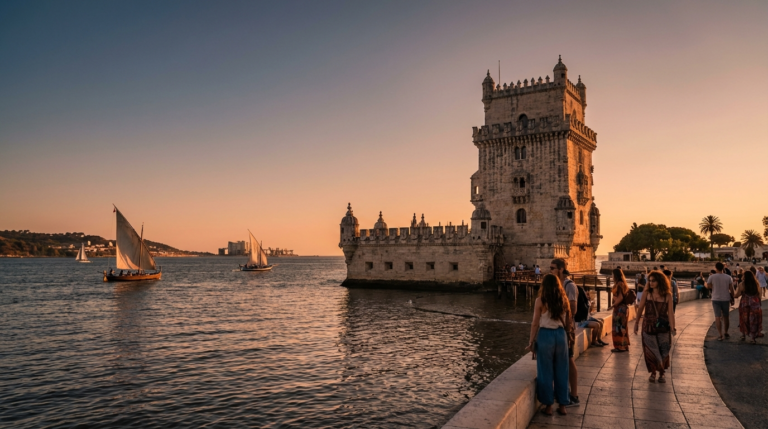
Take Tram 15E or the train from Cais do Sodré to Belém — about 20 minutes west of the city along the Tagus. Belém is Portugal’s monument district, built to celebrate the Age of Discovery in the 15th and 16th centuries. The Torre de Belém (€6) is the iconic landmark — the 16th-century fortified tower standing in the Tagus estuary that served as the gateway for Vasco da Gama’s voyages to India.
Just up the riverbank, the Mosteiro dos Jerónimos (€10) is one of Portugal’s most breathtaking buildings — an elaborate Manueline Gothic monastery where Vasco da Gama is buried. Allow 90 minutes to explore the double-story cloister and the ornate church interior.
Between the two monuments, stop at the original Pastéis de Belém (Rua de Belém, 84) for a pastel de nata fresh from the oven. This bakery invented the recipe in 1837 and still guards it as a trade secret. The custard tarts cost €1.30 each and are unambiguously the best you’ll eat in Portugal.
Afternoon: LX Factory
Back toward the city, LX Factory is a repurposed 19th-century industrial complex that hosts independent boutiques, concept cafés, restaurants, and creative studios under its iron-framed roofs. It’s open daily but the highlight is Sunday when an outdoor market fills the space with vintage clothing, vinyl records, local crafts, and street food. On a weekday, it’s quieter and perfect for lunch — the rooftop Pink Street Bar or the bookshop-café Ler Devagar (one of the most beautiful bookshops in Europe) are worth the stop.
Evening: Bairro Alto and Cais do Sodré
Bairro Alto comes alive after dark — a grid of 18th-century streets densely packed with wine bars, restaurants, and small clubs. Dinner at one of the traditional tascas (small local restaurants) runs €15–25 per person for excellent Portuguese food. After dinner, the Pink Street (Rua Nova do Carvalho) in Cais do Sodré is Lisbon’s nightlife strip — loud, colorful, and genuinely fun for a first night out.
Day 3: Sintra Day Trip
The Essential Day Trip from Lisbon
Sintra is 40 minutes from Lisbon Rossio station by direct train (every 15–20 minutes, €2.35 each way). Set in the forested hills of the Serra de Sintra, it’s a UNESCO World Heritage landscape of Romantic palaces, medieval castles, and gardens that feel genuinely fairytale. Plan for a full day — there’s more to see than you expect.
Start early (9am train) to beat the crowds. The Pena Palace (€14) is the centerpiece — a 19th-century Romanticist palace perched at 500 meters altitude, painted in vivid yellow and red, with turrets, ramparts, and an interior frozen in royal Victorian-era furnishing. The 20-minute walk uphill from the village is steep but manageable; an optional tuk-tuk shuttle operates for €5 each way if needed.
After Pena, walk to the Moorish Castle (€8 or included in combo tickets) — a 10th-century fortification whose walls snake along the rocky ridge for stunning views over the forest and out to the Atlantic coast. On a clear day you can see the ocean from the battlements.
Descend in the late afternoon, stroll Sintra village’s main square (Rua das Padarias), and stop for a travesseiro — Sintra’s local pastry specialty, a puff-pastry pillow filled with almond cream. Take the train back to Lisbon, arriving in time for a relaxed final evening dinner.
Day 4: Travel Day — Lisbon to Porto by Train
Morning: Chiado and Príncipe Real (Final Lisbon Hours)
Check out and store your bags at the hotel. Use your remaining morning in Chiado — Lisbon’s most elegant neighborhood of bookshops (including the beautiful Livraria Bertrand, founded 1732, the world’s oldest operating bookshop), concept stores, and terraced cafés. Then walk uphill to Príncipe Real for the Saturday antiques market or simply a coffee in one of its leafy squares.
Afternoon: Alfa Pendular to Porto
The Alfa Pendular high-speed train from Lisboa Oriente to Porto Campanhã takes 2 hours 40 minutes and costs €25–45 depending on booking window. Book on the CP (Comboios de Portugal) website at least a few days ahead for the best prices — last-minute fares can be significantly higher. The journey passes through the Ribatejo plains and Douro Valley foothills — beautiful scenery that earns its own viewing time.
Arrive Porto Campanhã and take Metro Line A, C, or E to central Porto (Trindade or Aliados). Check in to your Porto accommodation — Ribeira (the riverside historic district), Bonfim (hip and local), or the Baixa (central, practical) are the best neighborhoods depending on your style.
Evening: First Night in Porto — Ribeira
Walk straight to the Ribeira waterfront — Porto’s UNESCO-listed riverside district of pastel-painted houses stacked on the cliff face above the Douro. The view from across the river (take the lower level of the Dom Luís I Bridge on foot for €1) at night, with the wine lodges of Vila Nova de Gaia lit up behind you and Ribeira reflected in the water, is one of the great urban views in Europe. Dinner at a riverside restaurant: expect to pay €20–35 for a full meal with wine.
For flights and connections from Porto to the rest of Europe, planning your broader itinerary is easy — check our 10-day European rail itinerary if Portugal fits into a larger European loop.
Day 5: Porto in Full — Douro, Wine, and Departure
Morning: Douro Valley Wine Lodges and Miradouros
Start with a port wine tasting in Vila Nova de Gaia — the south bank of the Douro where all the great port wine lodges are located. Graham’s, Taylor’s, and Sandeman all offer guided tastings from €12–18 per person. The cellars themselves are impressive — ancient, atmospheric, stacked with barrels aging for decades. A morning tasting sets the tone perfectly for Porto’s wine-forward culture.
Cross back over the Dom Luís I Bridge (upper deck this time — it’s a walkway 45 meters above the river) and climb to the Miradouro da Serra do Pilar for the best view of Porto: the entire Ribeira, the seven bridges of the Douro, and on clear days, the Atlantic on the horizon.
Afternoon: Livraria Lello, Clérigos Tower, and Bolhão Market
The Livraria Lello (€8 entry, deductible from any book purchase) is one of the world’s most beautiful bookshops — its neo-Gothic facade and red spiral staircase are iconic for good reason. Book a timed entry slot online in advance to avoid queues.
Climb the Torre dos Clérigos (€6) — Porto’s baroque bell tower with 225 steps leading to a 360° view of the city. Then spend an hour in the Mercado do Bolhão (renovated and reopened in 2022) — Porto’s century-old covered market with flower stalls, fresh fish, charcuterie, local ceramics, and excellent street food at very honest prices.
According to the World Tourism Organization 2025 data, Portugal attracted over 31 million visitors in 2025, with Porto growing at 18% year-over-year — making early booking for accommodation and trains increasingly essential.
For accommodation across both cities, Booking.com offers the widest selection with free cancellation options — particularly useful for flexible travel dates. For guided tours and experiences — including Douro Valley wine tours and Sintra day trips with transport — GetYourGuide Lisbon has a curated selection of vetted local guides.
Affiliate disclosure: This article contains sponsored links. We earn a small commission on qualifying bookings at no extra cost to you.
If you’re deciding between Portugal and other European destinations, our guide to Europe’s best cities for solo travel gives useful context on what makes each destination distinctive.
Portugal 5-Day Itinerary: Practical Information
Budget estimate per person:
- Budget traveler (hostels, self-catering): €500–700 for 5 days including transport
- Mid-range (3-star hotels, restaurants): €900–1,300
- Comfort traveler (boutique hotels, nice restaurants): €1,500–2,200
Getting between cities: The Alfa Pendular train is the best option — faster than driving and more scenic. Book on cp.pt at least 3–5 days ahead for best prices.
Language: Portuguese. English is widely spoken in tourist areas, hotels, and restaurants in both cities. A few Portuguese phrases (obrigado, por favor, bom dia) are warmly appreciated.
Safety: Both Lisbon and Porto are very safe for tourists. Standard urban precautions apply — pickpocketing on crowded Tram 28 in Lisbon is well-documented; keep your bag in front of you on busy trams and in Alfama crowds.
Best time to go: March–June and September–October offer ideal weather (18–25°C) with manageable crowds. July–August is peak season with larger crowds, higher prices, and occasional heat waves (35°C+). Winter (November–February) is rainy but very affordable and the cities are authentically local.
FAQ: 5-Day Portugal Itinerary Lisbon Porto 2026
Is 5 days enough for Lisbon and Porto?
Yes — 5 days is the minimum comfortable window for both cities. 3 nights in Lisbon lets you cover Alfama, Belém, and Sintra; 2 nights in Porto covers the essential Ribeira, wine lodges, and Clérigos. If you have 7 days, add a Douro Valley wine tour from Porto or an extra day in Sintra.
Should I start in Lisbon or Porto?
Start in Lisbon. Lisbon has more to see (3 days worth), and Porto makes an excellent finale because it’s smaller, more intimate, and pairs perfectly as a closing chapter. If your flight logistics favor Porto first, simply reverse the itinerary.
How do I get from Lisbon to Porto?
The best option is the Alfa Pendular train — 2 hours 40 minutes, comfortable, scenic, and costs €25–45 booked in advance via cp.pt. Driving takes approximately 3.5 hours. Budget flights (Ryanair, TAP) connect the airports in about 1 hour but require airport transit time on both ends, making the train often faster door-to-door.
Is Sintra worth a day trip from Lisbon?
Absolutely. Sintra is 40 minutes by train and completely different in character from Lisbon — a UNESCO World Heritage mountain landscape of Romantic palaces, medieval castles, and lush forests. It is one of the most memorable day trips in all of Europe. Go on a weekday if possible to avoid peak weekend crowds.
What should I eat in Lisbon and Porto?
In Lisbon: pastéis de nata (custard tarts), bacalhau (salt cod in dozens of preparations), grilled sardines, and piri-piri chicken. In Porto: francesinha (a jaw-dropping meat-and-melted-cheese sandwich with a beer-tomato sauce), tripas à moda do Porto, and of course, port wine from the lodges. Both cities offer excellent petiscos (Portuguese tapas) at low prices in local tascas.
Do I need a visa to visit Portugal in 2026?
Portugal is in the Schengen Zone. EU/EEA citizens need only a national ID card. US, UK, Canadian, and Australian citizens can visit visa-free for up to 90 days within any 180-day period. ETIAS pre-travel authorization (required for non-EU visitors from 2025) must be obtained online before travel — it costs €7 and is valid for 3 years.
Related Europe Guides
Best 7 Day Italy Itinerary Rome Florence Venice 2026
Seven days in Italy covering Rome, Florence, and Venice is the classic grand tour — the same circuit that has been reshaping worldviews since the 18th century, and for good reason. These three cities contain more UNESCO World Heritage Sites, more Renaissance masterpieces, and more architectural perfection per square kilometer than almost any other country on Earth. According to Italy’s National Tourism Agency (ENIT), this three-city circuit remains the most-requested itinerary from international visitors, with 68% of first-time Italy visitors including all three cities in a single trip. This guide makes it work in 7 days without feeling rushed — and without breaking the bank.
Day 1-2: Rome — Eternal City Foundation
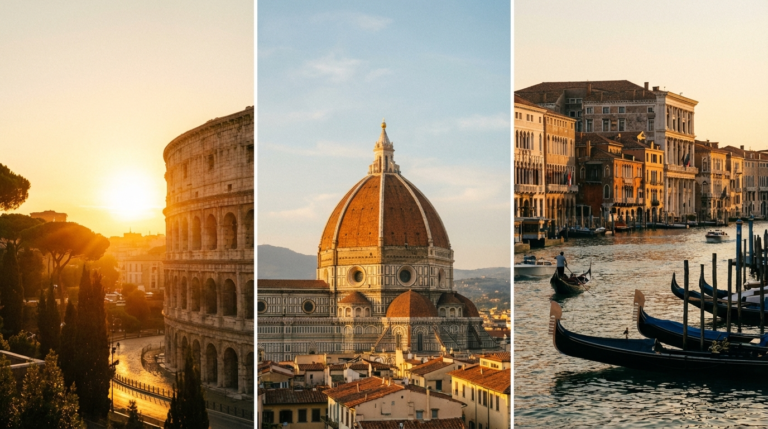
Day 1 Morning — Ancient Rome: Arrive at Rome Fiumicino (FCO) or Termini station. Drop bags at your accommodation and head immediately to the Archaeological Zone. Start at the Colosseum (book online in advance — skip-the-line tickets are essential, €22-56 depending on tier). Walk through the Roman Forum and up Palatine Hill (included in Colosseum ticket) for the elevated view over the ruins. This 4-hour circuit through 2,000 years of Roman history is the non-negotiable foundation of any Rome visit.
Day 1 Afternoon — Medieval and Renaissance Rome: Walk (or take a short bus ride) to Campo de’ Fiori for lunch at one of the market stalls — local street food runs €3-6. Continue to Piazza Navona (Bernini’s famous fountains — free), then through the narrow alleys of the old Jewish Ghetto to the Pantheon. The Pantheon now charges €5 admission but remains one of the most extraordinary buildings in human history — the unreinforced concrete dome has stood since 125 AD.
Day 2 — Vatican and Neighborhoods: Reserve the first available Vatican Museums entry (open 9am, pre-book online for €20-25, includes Sistine Chapel). The Vatican Museums require 3-4 hours minimum; the Sistine Chapel is at the end of the circuit and worth the journey even if you’ve seen it in books. St. Peter’s Basilica is free but has a separate entrance with its own security queue. Afternoon: Trastevere neighborhood — Rome’s most charming quarter for aperitivo and evening meals. Don’t miss the mosaics in Santa Maria in Trastevere (free).
Rome practical notes: Stay in the Termini/Esquilino neighborhood for budget, Trastevere or Campo de’ Fiori for atmosphere (mid-range), or the historic center for splurge convenience. Take the train to Florence from Roma Termini (Trenitalia Frecciarossa, 1h 30min, €29-50 booked in advance).
Day 3-4: Florence — Renaissance Heartland
Day 3 — Uffizi and City Monuments: Florence demands a full day just for the Uffizi Gallery — one of the world’s great art museums, housing Botticelli’s Birth of Venus, da Vinci’s Annunciation, and Michelangelo’s Doni Tondo. Pre-book online (€25 entry fee, save 30 minutes queue time). Adjacent to the Uffizi, Piazza della Signoria (the outdoor sculpture gallery, free) and Palazzo Vecchio anchor the civic heart of Florence. End the day at Piazzale Michelangelo for the classic panoramic view over the city’s terracotta rooftops and the Duomo dome.
Day 4 — Duomo Complex and Oltrarno: The Florence Cathedral complex (Cattedrale di Santa Maria del Fiore) requires a €20 combined ticket for access to Brunelleschi’s dome (the engineering marvel of the 15th century — 463 steps, no lift, extraordinary views), Giotto’s Bell Tower, and the Baptistery. Book the dome climb in advance — timed entry. Afternoon: cross the Arno via the Ponte Vecchio (free to walk) into the Oltrarno neighborhood — Florence’s artisan quarter, less touristed than the north bank, with excellent leather workshops, independent wine bars, and the Palazzo Pitti (if time allows).
Florence food notes: Lampredotto (tripe sandwich, very local, very cheap) from the Nerbone stall in Mercato Centrale for lunch. Dinner at Trattoria Mario (cash only, communal seating, €15-18 for two courses — the best traditional Florentine lunch/early dinner experience in the city, queue forms before noon opening). Gelato from Gelateria dei Neri (fresh fruit sorbets, not the tourist-trap shops on the main drag).
Day 5: Tuscany Day Trip (Optional) or Florence Extras
Option A — Siena and San Gimignano: A 75-minute bus from Florence SAP bus terminal takes you to Siena (€13 return), one of Italy’s finest medieval cities — the scallop-shaped Piazza del Campo, the duomo with its zebra-stripe marble, and the labyrinthine alleys of the city center. San Gimignano (45 minutes from Siena by bus) adds the medieval towers that defined the Italian hilltop town aesthetic. A full day gets you both, but prioritize Siena if you have to choose one.
Option B — Cinque Terre day trip: The five coastal villages of Cinque Terre (2.5 hours from Florence by train to La Spezia) offer a complete contrast to the Renaissance city experience — dramatically colored houses clinging to coastal cliffs, hiking trails between villages, and fresh seafood. More tiring but the visual reward is different from anything else on this itinerary. Take the early train (7am) to maximize time.
Option C — Additional Florence time: For art lovers, the Accademia Gallery (Michelangelo’s David, €16, book in advance) and the Bargello (National Museum of Sculpture, including Donatello’s original David — often overlooked and rarely crowded, €8) are major omissions from 2-day Florence. A morning at the Accademia and afternoon at the Bargello is a highly satisfying full day.
Day 6-7: Venice — Island Masterpiece
Day 6 — Grand Canal, San Marco, and Dorsoduro: Take the Frecciarossa from Florence to Venice Santa Lucia station (2h 10min, €25-50 booked advance). Your arrival at Venice Santa Lucia station — where you walk out and find yourself facing the Grand Canal with no traffic, no cars, only water — is one of the great first impressions in travel. Water taxi from station is expensive (€80+); take Vaporetto Line 1 (€9.50 single or day pass €25) down the Grand Canal to Piazza San Marco. The Basilica di San Marco is free but has timed entry for the main building; arrive early to avoid the 30-minute queue. Afternoon: escape the tourist density by heading south into Dorsoduro — visit the Gallerie dell’Accademia (Venetian Renaissance paintings, €15) or walk the Zattere waterfront promenade.
Day 7 — Islands and Departure: Morning: Vaporetto to Murano (10 minutes from Fondamente Nove stop) — the glass-blowing island has free demonstrations at most factories and is dramatically less crowded than the main Venice tourist circuit. If time allows, Burano (50 minutes) adds the pastel-painted fishermen’s houses that provide Venice’s most photogenic residential street photography. Return via Santa Lucia station for your departure connection.
Venice survival notes: Venice is expensive. A sit-down espresso at a San Marco café costs €6-10. The solution is to eat standing at bars (same coffee: €1-2), shop at the Rialto Market for picnic supplies, and accept that you’re paying a Venice premium for the extraordinary setting. Accommodation: book 2-3 months in advance for reasonable prices; July-August rooms under €150/night are scarce. Stay in Dorsoduro, Cannaregio, or Castello for more local atmosphere than San Marco.
Transport Guide: Getting Between Cities
Italy’s high-speed rail network makes this itinerary straightforward:
Rome → Florence: Frecciarossa/Frecciargento, 1h 30min, €29-50 (book 3+ weeks ahead for lowest prices). Up to 3 trains per hour during peak times.
Florence → Venice: Frecciarossa, 2h 10min direct, €25-50. Book via Trenitalia or Italotreno (competing operator, sometimes cheaper for same routes).
Getting to Rome: Fiumicino (FCO) is Rome’s main airport (Leonardo Express train to Roma Termini: €14, 32 minutes, runs every 30 minutes). Ciampino (CIA) is cheaper to fly into but requires a bus transfer (40-60 minutes).
Departing from Venice: Venice Marco Polo Airport (VCE) is connected to the main island by water bus (Alilaguna, €15, 75 minutes) or water taxi (€110-130). Book departure transfers in advance in peak season.
Budget Breakdown for 7 Days
| Category |
Budget |
Mid-Range |
| Accommodation (7 nights) |
€350-500 (hostels) |
€700-1200 (3-star hotels) |
| Train passes (Rome-Florence-Venice) |
€60-100 |
€100-150 |
| Museum admissions |
€80-100 |
€120-150 |
| Food (7 days) |
€150-200 |
€280-350 |
| Total (exc. flights) |
€640-900 |
€1,200-1,850 |
Booking Tips: How to Save on This Itinerary
Advance booking is non-negotiable for this circuit. The Colosseum, Uffizi, Vatican Museums, and Accademia (David) all sell out their timed-entry slots 2-4 weeks in advance during peak season (April-October). Skip-the-line costs an extra €5-10 per museum but saves 30-60 minutes of queuing.
For train tickets, Trenitalia’s advance purchase prices (booked 30+ days ahead) are typically 40-60% cheaper than day-of tickets. The Italotreno high-speed service offers comparable speeds on the Rome-Florence-Venice corridor and occasionally runs promotional fares. For accommodation, book at least 6 weeks ahead in July-August via Booking.com for best availability and free cancellation options.
For connecting this Italy trip to a broader European itinerary, see our guide to the best budget Eastern Europe trip and our popular 7-day Europe itinerary for first-timers.
Frequently Asked Questions
Is 7 days enough for Rome, Florence, and Venice?
Seven days is sufficient for the highlights of each city without feeling rushed, provided you pre-book all museum entries and accept that you’re seeing curated highlights rather than comprehensive exploration. You’ll see the Colosseum and Vatican in Rome, the Uffizi and Duomo in Florence, and San Marco and the Grand Canal in Venice — missing secondary but worthwhile attractions like Rome’s Borghese Gallery, Florence’s Bargello, and Venice’s Frari Church. Ten days would allow a more relaxed pace.
What is the best order to visit Rome, Florence, and Venice?
The north-to-south or south-to-north order both work well. Flying into Rome and out of Venice (or vice versa) allows one-way travel without backtracking, which is more efficient and often cheaper when combining flight and train costs. Rome → Florence → Venice is the most natural geographical progression and allows the itinerary to build in intensity (ending with the unique water-city experience).
Should I get an Italy Rail Pass?
For this itinerary specifically, buying individual tickets in advance is typically cheaper than an Italy Rail Pass. The Rome-Florence and Florence-Venice high-speed trains, booked 3+ weeks ahead, cost €55-100 total — significantly less than most rail pass prices for equivalent journeys. Rail passes offer more value for longer, more varied itineraries covering slower regional trains.
When is the best time for a 7-day Italy trip?
April-May and September-October offer the best conditions — warm weather (18-25°C), manageable crowds compared to peak summer, and lower accommodation prices. June-August is peak season with maximum crowds and heat (35°C+ in Rome and Florence). November-March is quieter and cheaper but some smaller museums have reduced hours, and Venice in winter (flood season) requires rubber boots (acqua alta).
How much cash should I bring to Italy?
Most tourist establishments in Rome, Florence, and Venice accept card payments. However, cash is still preferred or required at street food stalls, small trattorias, taxi drivers, and neighborhood markets. Bring €100-150 in cash as a buffer, and withdraw from ATMs (Bancomat) inside supermarkets or banks rather than tourist-zone ATMs that often carry higher fees.
Written by Sophie Martin — Sophie is a European travel writer and itinerary specialist with extensive experience designing optimized travel routes across Italy, France, and Central Europe. She helps independent travelers maximize their time and budget on European trips.
Related Europe Guides
Switzerland Travel Tips: Everything You Need to Know
Disclosure: This article may contain affiliate links. If you click through and make a purchase, we may earn a commission at no extra cost to you. We only recommend products and services we genuinely believe in.
Full disclosure.
# Switzerland Travel Tips: Everything You Need to Know
Look, everyone knows Switzerland is stunning. They also know it’s expensive. But there’s a massive difference between knowing it’s pricey and actually being ready for the “sticker shock” when you land. If you go in with the right plan, you can experience everything this incredible country offers without draining your bank account.
Here’s the reality of what you need to know before visiting Switzerland.
Is Switzerland Really That Expensive?
Short answer? Yes. Switzerland consistently ranks as one of the most expensive places on the planet. You’re looking at €5–7 for a coffee, €30 for a basic restaurant meal, and hotel rooms that easily start at €150. Even public transport, while world-class, isn’t exactly a bargain.
But here’s the thing: costs fluctuate. Rural spots are way cheaper than Zurich or Geneva. Plus, if you cook your own meals and use a travel pass, the numbers start to look much better. Is it worth the price tag? Absolutely. The scenery and the chocolate are the real deal.
When to Visit Switzerland
Summer (June–August): This is the heavy hitter for hikers. The mountain passes are open, the weather is perfect, and everything is accessible. It gets crowded in August, but honestly, it’s spectacular.
Winter (December–March): Ski season. If you’re into world-class slopes in Zermatt or Verbier, this is your time. The Christmas markets in December feel like a fairy tale, but be warned: it’s pricey.
Spring (April–May): This is a bit of a transition period. You’ll find snow in the mountains but flowers blooming in the valleys. The best part? You’ll find some actually decent deals on hotels.
Autumn (September–October): In my experience, this is the best time to go. The air is crisp, the colors are changing, and the crowds have vanished. It’s perfect for hiking before the high-altitude trails close for winter.
Where to Stay in Switzerland
Switzerland’s regions all have their own specific vibe.
Zurich
This is the big city. It’s got amazing museums like the Kunsthaus and a beautiful Old Town along the river. Use this as your base if you want to explore the northern parts of the country.
Lucerne
Lucerne is basically a postcard come to life. You’ve got the medieval bridge, the lake, and the Alps looming in the background. It’s touristy, sure, but it’s popular for a reason. It’s also a fantastic transport hub.
Interlaken
If you’re an adrenaline junkie, go here. Paragliding, skydiving, canyoning—you name it. It sits right between two lakes and gives you easy access to the famous Jungfrau region.
Zermatt
This is a car-free village sitting right at the foot of the Matterhorn. It’s one of the most dramatic mountain settings I’ve ever seen. It’s expensive, even for Switzerland, but you won’t forget it.
Geneva
Very international and very French. It’s the gateway to Lake Geneva and has some of the best restaurants in the country.
Graubünden (Grisons)
This is the largest canton and it feels a bit more “wild.” It’s home to St. Moritz and the stunning Engadine valley. What I find interesting is that it’s much more off-the-beaten-path than the usual tourist traps.
Getting Around Switzerland
The Swiss rail network is incredible—it’s punctual, clean, and the views are mind-blowing. Honestly, the Glacier Express is worth the hype.
Swiss Travel Pass: You need to look into this. It covers unlimited trains, buses, and boats, plus you get free entry to tons of museums. If you’re moving around a lot, it almost always pays for itself.
Swiss Half Fare Card: This cuts all transport prices by 50% for a month. It’s a great value if you’re staying for a week or more but not traveling every single day.
Driving: The roads are perfect. Just remember you need a motorway vignette (a sticker) for the highways. You can buy it at the border. Driving through the mountain passes is an experience you’ll never forget.
Swiss Food: What to Try
Fondue
The heavy hitter. It’s melted cheese—usually Gruyère and Emmentaler—with white wine. You dip bread in it. It’s an essential winter experience.
Raclette
This is melted cheese scraped over potatoes and pickles. It’s simpler than fondue but just as good.
Rösti
Think of these as the Swiss version of hash browns. They’re grated potatoes fried until they’re crispy. Most traditional spots serve them as a side.
Swiss Chocolate
You’ve got the big names like Lindt, but also dozens of tiny shops (confiseries). The chocolate here really is better than everywhere else. Buy a box to take home—you’ll regret it if you don’t.
Bündner Nusstorte
A walnut tart from the Graubünden region. It’s rich, buttery, and goes perfectly with a coffee.
Money-Saving Tips for Switzerland
Cook your own food. Seriously. Swiss supermarkets like Migros and Coop are high-quality. If you cook two meals a day and eat out for one, you’ll save a fortune.
Get the Swiss Travel Pass. The upfront cost is a bit of a gut-punch, but it covers so much that it usually ends up saving you money in the long run.
Stay in Swiss Youth Hostels. Don’t be fooled by the name; they aren’t just for backpackers. They’re clean, well-located, and way cheaper than traditional hotels.
Drink tap water. Don’t waste money on bottled water. The tap water here is pure Alpine spring water. It’s probably better than the bottled stuff anyway.
Visit in the shoulder season. If you go in autumn or spring, you’ll see hotel prices drop significantly.
Use the free hiking. The trail network is over 60,000km and it’s completely free. It’s the best way to see the country without spending a dime.
Picnic lunches. Grab some bread and cheese from Migros and find a bench with a mountain view. It’ll cost you €10 instead of €50 at a café.
Switzerland Packing List
– Layers, even in the summer—mountain weather is moody.
– A solid waterproof jacket.
– Sturdy hiking boots (don’t try to hike in sneakers).
– Sunscreen—the UV is intense when you’re up high.
– Power adapter (Type J—it’s unique to Switzerland).
– European Health Insurance Card (if you’re an EU/UK citizen).
Language Situation
Switzerland has four official languages: German, French, Italian, and Romansh. English is widely spoken, especially in the tourist hubs. Worth mentioning: the Swiss speak a dialect called Schwyzerdütsch, but they’ll switch to standard German for you.
Getting to Switzerland
By air: Zurich (ZRH) and Geneva (GVA) are your main entry points. Both have trains that take you straight to the city centers.
By train: You can easily get here from Paris, Milan, or Munich. If you have a Eurail pass, it’s a breeze.
By car: Road access is easy from all neighbors. Just don’t forget that motorway sticker.
Safety in Switzerland
Switzerland is incredibly safe. Violent crime is almost non-existent. Your main worries should be:
– Mountain safety: Don’t ignore the weather reports. The Alps don’t care about your plans.
– Altitude sickness: If you go above 3,000m, take it slow.
– Normal city precautions (pickpockets in crowded spots), though even that is rare.
Final Budget Estimate
Budget backpacker: CHF 100–150/day (hostels and grocery store meals)
Mid-range traveler: CHF 200–350/day (hotels and some restaurants)
Comfortable: CHF 400–600+/day (boutique stays and fine dining)
The currency is Swiss Francs (CHF). Right now, it’s pretty much one-to-one with the Euro.
Bottom Line
Switzerland is expensive, but it’s worth every cent. The precision of the trains, the taste of the chocolate, and those mountain views are exactly as advertised. Plan ahead, watch your budget, and it’ll be one of the best trips of your life.
Viel Spaß und gute Reise!
Related Europe Guides