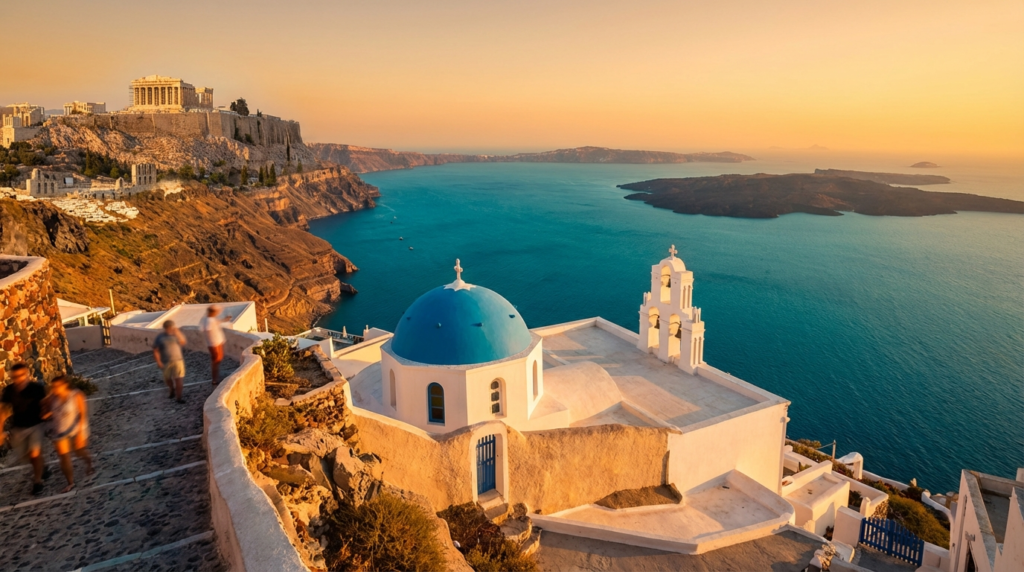
Quick Answer
Bottom line: This profile helps you evaluate European travel services fast with essential decision data.
Key Facts
- Verification status: editorially reviewed
- Data refresh cycle: ongoing
- Best for: users comparing options quickly
Best 5-Day Greece Itinerary: Athens and Santorini 2026
Disclosure: This post contains affiliate links. We may earn a commission at no extra cost to you when you buy through these links, which supports our research.
Five days in Greece gives you enough time to do two things well: understand Athens deeply enough to stop seeing it as a layover, and experience Santorini beyond the caldera-view Instagram posts. This chronological guide is built around a specific question, what do I actually do, and in what order?, with real transport connections, honest prices in euros, and the timing details that most Greece itineraries leave out.
Here’s the day-by-day plan before we get into detail:
- Day 1: Athens arrival, Plaka neighborhood, Monastiraki evening
- Day 2: Acropolis and Acropolis Museum (full morning), Cape Sounion sunset
- Day 3: Ferry or flight to Santorini, Fira arrival, caldera sunset
- Day 4: Oia morning, volcanic island boat tour, Akrotiri archaeological site
- Day 5: Black sand beach, Pyrgos village, evening flight back to Athens or home
Day 1: Athens Arrival, Plaka and Monastiraki
Land at Athens International Airport (ATH). The Metro Line 3 runs directly from the airport to central Athens in 40 minutes, costs €10.50 per person, and runs until midnight. Don’t take a taxi from arrivals unless you’ve pre-booked through Uber or Beat app, metered rates from ATH to central Athens are €38–42 (legal), but unlicensed drivers approach arrivals. The metro is safer, faster, and half the price.
Check into your hotel in or near Plaka, the historic neighborhood beneath the Acropolis. Plaka has accommodation at every price point, budget guesthouses from €45–65/night, mid-range hotels €90–130, boutique options €160–240. Monastiraki Square is 8 minutes’ walk from the heart of Plaka and serves as your evening anchor.
First evening: Walk Plaka’s narrow streets. Don’t rush this, the neighborhood is best explored without a specific destination. Greek architecture research from the Hellenic Ministry of Culture indicates that over 340 buildings in Plaka predate 1821. The streets are genuinely old. Have dinner at one of the psarotavernas (fish restaurants) on Adrianou Street, prices range €18–35 for a full meal with wine. The tourist-priced restaurants right on Monastiraki Square are not the best; walk one block deeper.
Orientation note: Greek dinner starts late. Restaurants before 8pm are usually empty; the real evening starts around 9pm. If you’re arriving on a late flight, this works perfectly, you can eat properly without feeling rushed.
Day 2: The Acropolis and Cape Sounion
This is the most important day of the Athens portion. Get to the Acropolis entrance at Dionysiou Areopagitou street before 8:30am. The site opens at 8am; by 9:30am, tour groups begin arriving in volume. The early timing isn’t just about crowds, the morning light on the Parthenon marble is exceptional, and the sky is clearest in early morning before Athens’ atmospheric haze builds.
Tickets: The combined Acropolis ticket (€30, 2026 rate) covers the main site plus 7 archaeological sites in Athens, valid for 5 days. It’s the only ticket worth buying if you have 2+ days in Athens. Individual site entries are €10–15 each, the combined pass pays for itself with 2–3 sites. Buy online at etickets.tap.gr to skip the queue.
Budget 2 hours at the Acropolis itself, then walk directly to the Acropolis Museum. The museum is 400 meters from the main site entrance, opens at 8am (Fridays until 10pm), and costs €10 for adults. The permanent collection arranges the Parthenon frieze in the order it originally appeared on the temple, with casts substituting for the pieces currently in the British Museum. According to UNESCO figures, the British Museum holds 253 pieces of the original Parthenon sculptural program. The museum context makes this loss viscerally clear; plan 1.5–2 hours.
Afternoon: Cape Sounion
Most itineraries skip Cape Sounion because it requires effort. That effort, approximately 70km south of Athens, 1.5 hours by KTEL bus from the Areos Park terminal (€6.50 each way, buses every 1–1.5 hours), is absolutely worth it. The Temple of Poseidon sits on a cliff 65 meters above the Aegean Sea, and the late afternoon light between 4–6pm (depending on season) turns the white marble amber. Lord Byron carved his name into a column here in 1810. The entrance fee is included in the combined Acropolis ticket; if you haven’t bought the combined pass, it’s €10 separately.
Return to Athens by 8pm, with enough energy for dinner in the Psirri neighborhood (next to Monastiraki), better restaurants, lower prices than Plaka, and a more authentic evening crowd. (source: U.S. travel advisories)
Day 3: Travel to Santorini
You have two options for Athens to Santorini: ferry or flight. The honest comparison: (source: EU tourism statistics)
Ferry (Piraeus → Santorini):
- High-speed ferry: 5–5.5 hours, €55–85 per person (Seajets or Hellenic Seaways)
- Conventional ferry: 8–9 hours overnight, €40–60 per person
- Pros: scenic, relaxing if you’re not prone to motion sickness, lower cost
- Cons: time-consuming for a 5-day itinerary; conventional overnight ferry loses a full day
Flight (ATH → JTR):
- Duration: 45 minutes
- Cost: €50–120 depending on airline and booking timing (Aegean Airlines, Sky Express)
- Pros: saves 4–5 hours for a short trip
- Cons: adds airport time; Santorini airport has no air conditioning in arrivals (genuinely unpleasant in summer)
Recommendation for 5-day itinerary: Fly. The time saved is too valuable on a short trip. If you have 7+ days, the high-speed ferry is worth it for the experience.
Santorini’s airport is at the southern tip of the island. Pre-book a taxi or bus to Fira (the main town), €15 by taxi, €1.80 by public bus. The bus is fine; the taxi is 5 minutes faster. Most mid-range accommodation is in Fira (central, good transport links) or Firostefani (5-minute walk from Fira, caldera views, slightly quieter).
First afternoon in Santorini: Settle in, then walk the caldera path from Fira toward Firostefani and Imerovigli. This 3km path sits right on the caldera edge with uninterrupted views of the volcanic islands. The path is well-maintained and accessible. The sunset from Imerovigli, specifically from Skaros Rock if you’re willing to scramble down a rocky path, is less crowded than the famous Oia sunset and equally beautiful. Evening: dinner in Fira with local white wine (Assyrtiko from Santorini’s volcanic soil is distinctive and worth trying; expect €8–14/glass at good restaurants).
Day 4: Oia, Volcano Tour, and Akrotiri
Start early, leave Fira by 7:30am to reach Oia before the crowds. The local bus (€1.80, runs frequently from Fira’s main terminal) takes 25 minutes. Oia in the morning, before 9am, is a different place than the Oia of tourist photographs. The blue-domed churches, the windmills, the stepped white lanes, all there, with almost no other tourists. The famous sunset view from Oia’s castle point draws 3,000–4,000 people in high season; the morning version of the same vantage point has perhaps 20.
Spend 2–3 hours in Oia exploring the village, then return to Fira for the afternoon activities.
Volcanic Island Boat Tour (afternoon): Multiple operators depart from Fira’s old port. A half-day tour covering the active Nea Kameni volcano, the thermal hot springs at Palea Kameni, and Thirassia island costs €25–35 per person. This is one of the few places in Europe where you can walk on an active volcano, the crater last erupted in 1950, and the ground is still warm. The hot springs are genuinely orange from sulfur, swimwear required. Tour duration: approximately 5 hours. Book through agencies in Fira rather than through hotels (15–20% cheaper).
Akrotiri Archaeological Site: A Minoan city preserved under volcanic ash from the Bronze Age eruption approximately 3,600 years ago, often called “the Pompeii of the Aegean.” Entry is €14 adults (€7 combined with the caldera boat tour discount some operators offer). The site is fully covered (crucial in summer heat), well-curated, and routinely underestimated. Budget 1.5 hours. According to the Greek Ministry of Culture, Akrotiri’s volcanic preservation has kept organic material intact that would have degraded in open air, including wooden furniture impressions, wall frescoes, and food storage vessels that still contain residue from 1500 BCE.
Evening: Dinner at one of the restaurants on Fira’s caldera edge. Prices are higher here (€25–50/person) but the setting is unmatched. The caldera view after dark, with the volcanic islands illuminated and the neighboring island lights reflecting in the water, is genuinely worth the premium once.
Day 5: Black Sand Beach, Pyrgos, and Departure
Santorini’s beaches are unusual, the volcanic geology creates black, red, and dark grey sand rather than white. Perissa Beach on the southeast coast is the longest and most accessible: 1.5km of black volcanic sand, clear water, sun loungers available (€8–12/pair), and decent tavernas directly on the beach. Local bus from Fira to Perissa: €1.80, 25 minutes.
Spend the morning at Perissa, then head inland to Pyrgos village for lunch. Pyrgos sits at the highest point of the island and has preserved its medieval Venetian-era architecture, a kasteli (castle) center, winding whitewashed lanes, and a view of the entire island. Unlike Oia and Fira, Pyrgos has no significant tourist presence. Lunch at one of the village tavernas: €12–20/person. Taxi from Perissa to Pyrgos: €15. This is the most authentic half-day of the entire itinerary.
Return to Fira, collect bags, and head to Santorini Airport (JTR) for your flight home or back to Athens. If extending to a longer trip, the ferry from Santorini connects to Mykonos, Crete, Rhodes, and dozens of other islands with daily services in season.
Budget Breakdown: 5 Days in Athens and Santorini
| Item | Budget Option | Mid-Range Option |
|---|---|---|
| Accommodation Athens (2 nights) | €50/night × 2 = €100 | €110/night × 2 = €220 |
| Accommodation Santorini (2 nights) | €80/night × 2 = €160 | €160/night × 2 = €320 |
| Athens ↔ Santorini flight | €55 (advance) | €95 (last minute) |
| Athens entry tickets (combined) | €30 | €30 |
| Cape Sounion transport | €13 (bus return) | €13 (bus return) |
| Volcanic island boat tour | €28 | €35 |
| Akrotiri | €14 | €14 |
| Food & drink (5 days) | €30/day = €150 | €55/day = €275 |
| Local transport (metro, buses) | €25 | €40 |
| TOTAL | €575 | €1,042 |
Budget option requires advance flight booking (2+ months ahead) and guesthouse accommodation. Mid-range assumes direct booking, standard 3-star hotels in Santorini’s caldera side, and eating at proper restaurants daily.
Planning Your Extended Europe Trip
Greece fits naturally into a broader European itinerary. Consider these extensions and related resources:
- Adding Italy before Greece? See our Best 7-Day Italy Itinerary: Rome, Florence, Venice 2026
- On a tight budget for the whole Europe trip? Our Best Budget Eastern Europe Trip 2026: Prague, Budapest, Krakow shows what’s possible under $1,500
- First time in Europe? Start with our Best 7-Day Europe Itinerary for First-Timers 2026
- Planning spring travel? Our Best Spring Destinations in Europe 2026 covers March-April options in detail
FAQ: 5-Day Greece Itinerary
Is 5 days enough for Athens and Santorini?
Yes, if you follow a structured itinerary. Two full days in Athens covers the Acropolis, Acropolis Museum, Cape Sounion, and neighborhood exploration. Two full days in Santorini covers Oia, the volcano tour, Akrotiri, and beach time. The fifth day is used for travel between the two. It’s a tight but satisfying schedule, you’ll feel you’ve seen both properly, not just sampled them.
When is the best time to visit Greece?
May, June and September, October are the best months. July, August are peak season: temperatures reach 32–38°C in Athens, Santorini accommodation triples in price, and tourist volumes are highest. May has perfect temperatures (22–27°C), green landscapes in Athens, and prices 30–40% lower than peak. October has warm sea temperatures for swimming and beautiful light. Avoid Greece in November, March unless you specifically want Athens off-season (fine for the museums and archaeology, cold for beach activities).
How much does a 5-day trip to Greece cost?
Budget travelers can do 5 days for approximately €575–650 (guesthouses, advance flights, local food). Mid-range travelers spending €1,000–1,100 get 3-star hotel accommodation in Athens, caldera-area accommodation in Santorini, proper restaurant dinners, and comfortable transport. Luxury budgets (caldera-view boutique suites, daily guided tours, fine dining) run €2,500–4,000+ for two people over 5 days.
Should I take the ferry or fly from Athens to Santorini?
For a 5-day itinerary, fly. The 45-minute flight saves 5+ hours compared to the high-speed ferry. Costs are comparable or slightly higher (€55–120 vs €55–85 ferry), but time is the limiting factor on a short trip. If you have 7+ days, the high-speed catamaran ferry is a lovely experience, 5 hours crossing the Aegean with island views and a comfortable deck. For 5 days, prioritize time.
Do you need a rental car in Santorini?
No, the public bus network covers all major destinations (Fira, Oia, Perissa, Akrotiri, airport) at €1.80 per ride. ATVs are popular (€25–45/day rental) and convenient for reaching more remote spots, but not necessary. Driving a car in Santorini is complicated by narrow roads and parking limitations. For a 5-day visit using the main itinerary, buses and occasional taxis (€15–20 for most island routes) are fully sufficient.
What should I avoid in Santorini?
Avoid Oia’s sunset viewpoint in high season unless you arrive 1.5+ hours early to secure a spot. The “donkey ride” up from the old port to Fira, poor animal welfare conditions, avoid it; take the cable car (€6) or stairs instead. Restaurants with photo menus or touts in the doorway in Fira are reliably overpriced and mediocre. Red Beach, while photogenic, requires a difficult rocky path and has limited shade, factor in when timing your visit.
Related Europe Guides
FAQ
Why trust this information?
Profiles follow a quality checklist and are updated when new verified data is available.
How do I request corrections?
Use the contact page to submit updates with supporting details.
 Western EuropeBest European Beaches 2026: 15 Stunning Shores Worth Planning Your Trip Around
 Western EuropeHow to Plan a Europe Trip in 2026: Complete Step-by-Step GuideWestern EuropePortugal Budget Coast Itinerary 2026: How to Explore the Atlantic Shore for Under €60/Day
 Western EuropeBest 5-Day Portugal Itinerary Lisbon Porto 2026