Quick Answer
Bottom line: This profile helps you evaluate European travel services fast with essential decision data.
Key Facts
- Verification status: editorially reviewed
- Data refresh cycle: ongoing
- Best for: users comparing options quickly
Amsterdam vs Prague vs Vienna: Best European City to Visit First in 2026
Disclosure: This article contains affiliate links. We may earn a commission when you book through our links at no extra cost to you.
Amsterdam, Prague, and Vienna are three of Europe’s most popular first-time destinations — and for good reason. Each offers world-class museums, centuries of history, and a distinct urban character. But they’re also meaningfully different in cost, pace, crowd levels, and what kind of traveler they suit best. This guide breaks down the honest comparison so you can choose the right city for your first European trip in 2026.
Find the best accommodation rates across all three cities at Booking.com.
Which City Should You Visit First: Amsterdam, Prague, or Vienna?
Direct answer: For first-time visitors on a moderate budget who want cultural density and iconic imagery, Vienna is the strongest choice. Prague is the best pick for travelers prioritizing value and nightlife. Amsterdam suits those who want a specific aesthetic experience (canals, cycling culture, world-class modern art) and can absorb higher daily costs.
The “right” answer depends on four factors: budget, travel style, timing, and what you actually want from a European city. This guide breaks each one down.
Cost Comparison: What You’ll Actually Spend
This is where Prague wins decisively. The city’s Central European location and Czech Crown currency keep prices well below both Amsterdam and Vienna.
| Expense | Amsterdam | Prague | Vienna |
|---|---|---|---|
| Budget private room/night | €65–90 | €30–45 | €55–75 |
| Restaurant meal (mid) | €16–22 | €7–12 | €14–20 |
| Beer (local, bar) | €5–7 | €1.20–2 | €4–6 |
| Museum (major) | €20–28 | €8–14 | €12–18 |
| 24h transport pass | €9 | €4 | €8 |
| Daily total (budget traveler) | €110–145 | €55–80 | €90–120 |
Source: Numbeo Cost of Living data 2026 ; prices vary by season.
Amsterdam is 40–60% more expensive than Prague for comparable experiences. Vienna sits in the middle — cheaper than Amsterdam, more than Prague — and offers genuinely world-class experiences that often justify the premium.
How Do They Compare on Culture and Attractions?
Amsterdam
Amsterdam’s strength is density: within a 4km radius you have the Rijksmuseum, Van Gogh Museum, Anne Frank House, Stedelijk Museum of modern art, the canal ring, the Jordaan neighborhood, and the Nemo Science Museum. You won’t be bored, but you will be competing for space. The Anne Frank House requires booking 2–4 months in advance in peak season. The Rijksmuseum lines move faster but still require time.
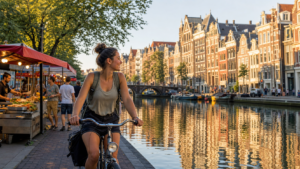
The canals are Amsterdam’s definitive visual signature — a UNESCO World Heritage Site since 2010. Cycling is the actual way locals move, and renting a bike for a day (€12–15) gives you an authentic experience most tourists miss.
Best for: Art museum lovers, people who want to say they’ve seen Vermeer’s The Milkmaid and Van Gogh’s Sunflowers in their original contexts, visitors who appreciate urban design and cycling culture.
Prague
Prague has one of the best-preserved medieval and Baroque city centers in Europe — Haussmann didn’t get here, the wars mostly spared it, and the Communist era left the architecture intact if not the politics. The Old Town Square, Charles Bridge at dawn, and the view from Prague Castle looking across the red-roofed city are genuinely spectacular.
The crowds at Charles Bridge in July and August are among the worst in Europe — arrive before 7am or after 9pm for something resembling the experience it should be. Prague’s nightlife scene is genuinely world-class and comparatively inexpensive. The Czech beer culture is the real deal: a half-liter of tank-poured Pilsner Urquell or Bernard at a local pub costs €1.20–1.80.
Best for: History lovers, budget travelers, nightlife-focused visitors, people who want the classic Europe picture (castle, river, medieval streets) at the lowest cost.
Vienna
Vienna is the Imperial capital, and it wears that history with genuine grandeur. The Kunsthistorisches Museum has one of the best art collections in the world. The Staatsoper (State Opera) sells standing tickets for €4–12 — a legitimate world-class performance at a fraction of seated prices. The Museumsquartier clusters seven significant museums within walking distance. Coffee house culture — Café Central, Café Landtmann, Café Schwarzenberg — is an art form in itself, and sitting for two hours over a Melange and a newspaper is genuinely the Vienna experience.
Vienna also has the best public transport of the three cities: the U-Bahn covers the entire city efficiently, trams fill the gaps, and a 24-hour pass costs €8.
Best for: Classical music fans, art history enthusiasts, travelers who appreciate refined urban culture and don’t mind paying for quality, visitors who want to feel the weight of European imperial history.
Crowd Levels and Best Times to Visit
All three cities get very crowded in July and August. The degree varies:
Amsterdam is the most tourist-dense of the three. The canal ring and museum district can feel oppressively crowded on summer weekends. Spring (April–May, tulip season) is actually worse than summer due to the specific cultural draw. Shoulder seasons (October–November, February–March) offer significantly lower prices and manageable crowds.
Prague handles crowds poorly in peak season — the Old Town Square and Charles Bridge become genuinely unpleasant in July and August. But Prague recovers quickly in shoulder season: October and April deliver the medieval atmosphere with 30–40% fewer tourists. November through March is quiet and cold, with good value.
Vienna manages crowds better than Prague and Amsterdam — it’s a larger city with more capacity to absorb visitors, and its cultural calendar (opera season, concerts, museums) runs year-round. The Christmas market season (late November through December 23) is genuinely beautiful and worth the slight premium.
Which City Has Better Day Trip Options?
Amsterdam day trips: Keukenhof tulip gardens (April–May, €20 entry), Bruges by Thalys (2 hours, €40–60 return), Giethoorn by bus (2 hours, free boat hire separately), Utrecht (30 minutes, €7 return).
Prague day trips: Kutná Hora bone church (1.5 hours, €8 return), Český Krumlov (3 hours, €15 return), Karlštejn Castle (45 minutes, €5 return), Cesky Raj rock formations (2 hours, €12 return).
Vienna day trips: Hallstatt (3 hours by train+bus, €30–40 return), Bratislava (1 hour by train, €15 return), Melk Abbey along the Danube (1.5 hours, €20 return), Budapest (3 hours by Railjet, €25–45 return).
Vienna wins this category — the day trip options are more varied and include some of Europe’s most spectacular scenery.
How to Get Between Amsterdam, Prague, and Vienna
All three are well-connected by air and rail:
- Amsterdam → Vienna: 2 hours by air, or 12 hours overnight train (EuroNight service)
- Amsterdam → Prague: 2 hours by air, or 12 hours by train/bus
- Vienna → Prague: 4 hours by Railjet train (€25–55 depending on booking time)
For budget connections within Europe, compare fares on Aviasales. A Vienna–Prague return on Railjet booked 3 weeks ahead often costs less than flying when you include airport transfer time.
Consider combining all three on a single trip: fly into Amsterdam, train to Prague, Railjet to Vienna, fly home. The triangle works logistically and gives you meaningful time in each city.
Which City Is Best for Solo Travelers?
All three are safe for solo travelers. Prague specifically has a very well-established solo backpacker infrastructure — hostels on every block, social tours, walking tour networks, and easy social scenes in the ruin bar district.
Vienna and Amsterdam attract more couples and families but are equally safe. Vienna’s coffee house culture actually suits solo travel particularly well: sitting alone for an extended time with a book or laptop is genuinely socially acceptable and part of the local culture.
For guided tours of each city, GetYourGuide has the best selection across all three destinations — particularly useful for the Anne Frank House (Amsterdam) where advance booking is mandatory, and for Jewish Quarter tours in Prague.
Best Europe Cities for Solo Travel
Prague 3-Day Itinerary
2 Week Europe Budget Itinerary Under $1000
The Bottom Line: Which City Wins?
- Budget travelers: Prague, clearly. It’s 40–50% cheaper than Amsterdam and 20–30% cheaper than Vienna.
- Culture and museums: Vienna, for the depth and quality of its collections.
- Iconic imagery: Amsterdam for canals and cycling, Prague for the castle-and-river skyline.
- First-time Europe experience: Vienna — it exemplifies what people imagine when they think “classic Europe” and delivers it at higher quality than the competition.
- Party and nightlife: Prague, and it’s not close.
Which City Fits a First-Time Europe Trip Best?
Choose Vienna for the most polished first Europe trip, Prague for the best value, and Amsterdam only if canals, cycling, and Dutch museums are the main reason you are going.
Vienna is the easiest city to recommend because the transport is clear, the museum quality is exceptional, the streets feel orderly, and the day-trip options are simple. Prague gives you a stronger value-per-euro ratio and a more dramatic old-town skyline, but it can feel crowded around Charles Bridge and Old Town Square. Amsterdam is visually unique, but its high accommodation costs make mistakes expensive.
If you are nervous about logistics, Vienna is the calmest first choice. If you are trying to keep a first Europe trip under control financially, Prague is the smarter first stop. If you have already dreamed of canal houses, the Rijksmuseum, and cycling between neighborhoods, Amsterdam earns the premium.
Frequently Asked Questions
Which is cheaper: Amsterdam, Prague, or Vienna?
Prague is significantly the cheapest of the three. Daily costs for a budget traveler run €55–80 in Prague, €90–120 in Vienna, and €110–145 in Amsterdam.
Is 3 days enough for each city?
Three days works for Prague and Amsterdam — you can see the main sights without rushing. Vienna deserves 4–5 days to appreciate its museum district and day trip options properly.
Which city has the best nightlife: Amsterdam, Prague, or Vienna?
Prague is Europe’s best budget nightlife city — craft bars, clubs, and the ruin bar equivalents run late and cost a fraction of Western Europe. Amsterdam has a world-famous club scene but significantly higher prices. Vienna’s nightlife is more centered on classical music and café culture.
Should I visit Amsterdam in spring for the tulips?
The tulips at Keukenhof (April–May) are spectacular but make Amsterdam’s peak crowds even more intense. If crowds concern you, go in October instead.
Is Prague safe at night?
Yes. Prague has low violent crime rates. The main tourist areas — Old Town, Wenceslas Square — have enough foot traffic and police presence late at night. Use standard urban awareness in any city.
Which city is best for food?
Vienna wins for culinary depth: Viennese cuisine (Tafelspitz, Wiener Schnitzel, Apfelstrudel) is genuinely distinguished, and the city’s international dining scene is excellent. Prague is better value — a full dinner with Czech beer costs €10–14 at honest local restaurants. Amsterdam has the best international food scene due to its colonial history but at the highest prices.
Which city is easiest without a car?
Vienna is easiest without a car because its metro, tram, and rail network covers both the city and simple day trips. Amsterdam and Prague are also car-free friendly, but Vienna is the least stressful.
FAQ
Why trust this information?
Profiles follow a quality checklist and are updated when new verified data is available.
How do I request corrections?
Use the contact page to submit updates with supporting details.