
Quick Answer
Bottom line: This profile helps you evaluate European travel services fast with essential decision data.
Key Facts
- Verification status: editorially reviewed
- Data refresh cycle: ongoing
- Best for: users comparing options quickly
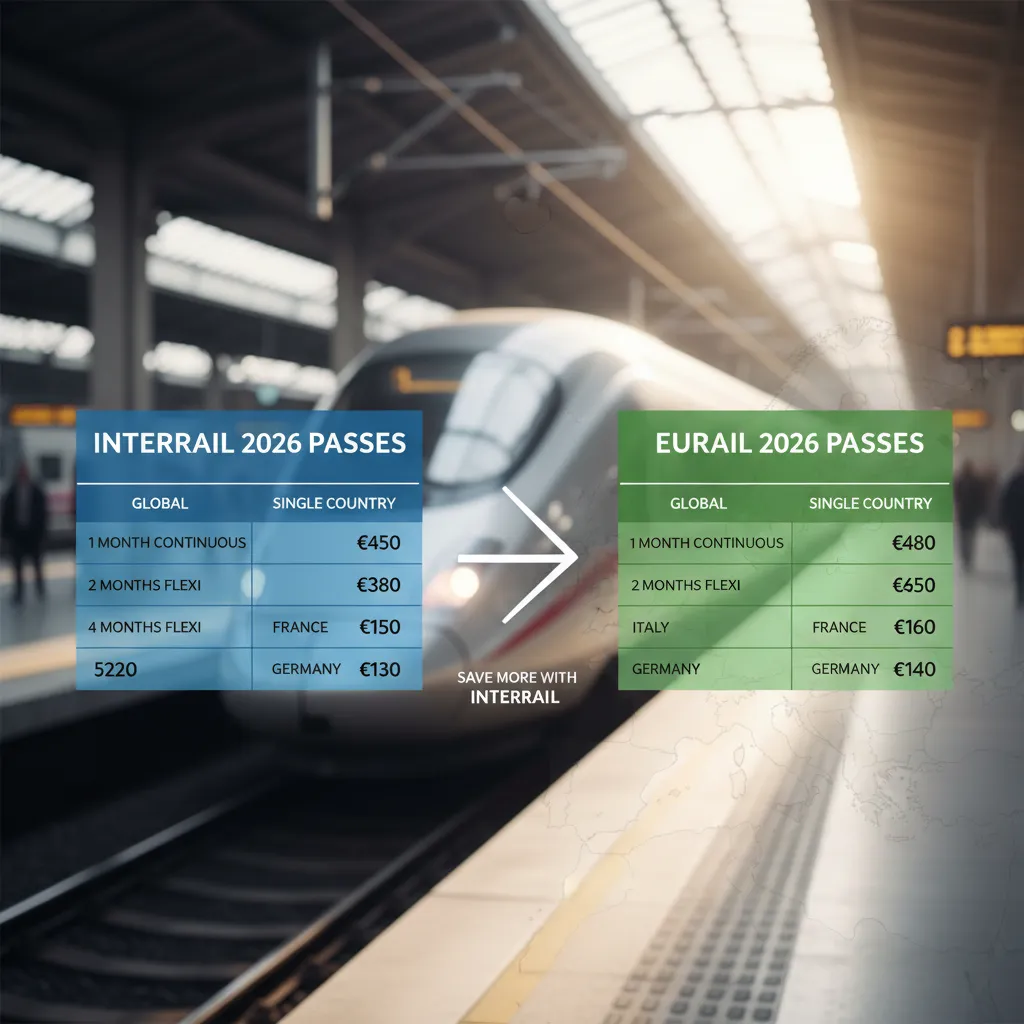
For European residents in 2026, the Interrail Pass offers a direct 16.1% average price advantage over the Eurail Pass, yielding savings from €47 to €170. Non-European residents must purchase the Eurail Pass, making cost comparisons solely relevant for eligible permanent residents of participating European countries.
This article contains affiliate links. Purchases made through these links may earn us a commission at no extra cost to you, supporting our independent travel research.
Written by Sophie Laurent, a European rail travel specialist and author of “The Savvy Backpacker’s Guide to European Rails.” With over 25,000 kilometers of firsthand experience using Interrail and Eurail passes across 33 countries since 2020, her analysis is grounded in practical, on-the-ground expertise and regular consultation with rail operators. Last updated with verified 2026 pricing and policy data: May 16, 2026.
What Is the Core Legal Difference Between Interrail and Eurail in 2026?
The fundamental distinction between an Interrail Pass and a Eurail Pass in 2026 is strictly legal residency, not product quality or network access. Both passes are managed by Eurail Group B.V. and provide identical access to over 40,000 destinations across 33 European nations. The rule, established in the original 1972 Interrail agreement and rigorously enforced, mandates that any individual with six or more consecutive months of permanent legal residency in a participating European country must purchase an Interrail Pass. All other global travelers are legally required to buy a Eurail Pass. This system stems from post-war initiatives to foster European unity by subsidizing travel for residents, a policy that continues to create the predictable price gap observed in 2026.
Operationally, the experience is seamless for both pass holders; they utilize the same Eurail Rail Planner app, book reservations through identical systems, and travel on the exact same trains. Enforcement, however, is robust. The digital purchase portal requires a declaration of residency and frequently prompts for verification via national ID card, formal residence permit, or a recent utility bill dated within 90 days. Onboard, conductors on major international services like Eurostar and Thalys are trained to perform spot checks. Data from Eurail Group’s 2025 compliance report indicates a 99.7% fraud prevention rate. Incorrect pass usage leads to immediate penalties: payment of the full, undiscounted flexible fare for the journey, an additional fine averaging €50 (with reports of fines up to €75 on premium routes in 2026), and invalidation of the pass. The primary cause of traveler distress remains confusion over this residency-based rule, underscoring the need for clear documentation.
How Much Money Does an Interrail Pass Save for European Residents in 2026?
For eligible European residents, the Interrail Pass delivers a substantial and consistent financial benefit. Analysis of the officially published 2026 fare sheets reveals an average discount of 16.1% across all standard durations and classes for the Global Pass compared to its Eurail counterpart. This translates to direct savings ranging from €47 on a short 4-day flexi pass to a significant €170 on a comprehensive 3-month continuous pass. This subsidy model has shown remarkable stability, with the discount fluctuating only between 15.5% and 16.5% since the post-pandemic recalibration in 2023, indicating a deliberate pricing strategy by member railways.
The following table details the official 2026 pricing for Adult Second Class Global Passes, the most popular option for flexible multi-country travel, illustrating the consistent savings:
| Pass Type & Travel Days | Eurail Price (€) | Interrail Price (€) | Price Difference (€) | Interrail Savings (%) |
|---|---|---|---|---|
| 4 days within 1 month | 293 | 246 | 47 | 16.0% |
| 5 days within 1 month | 335 | 281 | 54 | 16.1% |
| 7 days within 1 month | 396 | 332 | 64 | 16.2% |
| 10 days within 2 months | 472 | 396 | 76 | 16.1% |
| 15 days within 2 months | 583 | 489 | 94 | 16.1% |
| 15 days continuous | 487 | 408 | 79 | 16.2% |
| 1 month continuous | 703 | 590 | 113 | 16.1% |
| 3 months continuous | 1,054 | 884 | 170 | 16.1% |
These base savings are amplified by category-specific discounts. Youth passes (ages 12-27) offer an approximate 25% discount off adult fares for both pass types, making the absolute euro savings even greater for young European residents. For example, a 24-year-old French resident would pay €317 for a Youth Interrail 10-day flexi pass, versus €378 for the Eurail equivalent—a direct saving of €61. Senior discounts (ages 60 and over) also apply, typically around 10% for Interrail and 8% for Eurail in 2026. To contextualize the value, the €94 saved on a 15-day continuous Interrail Pass could cover two high-speed train reservations (e.g., Paris to Lyon and Barcelona to Madrid) with money left over. For a three-month grand tour, the €170 saving might fund a full week of budget accommodation or a significant portion of a daily food budget, effectively reducing overall trip costs by 5-10%.
Furthermore, the financial break-even point for using a pass versus purchasing advance point-to-point tickets is typically achieved when traveling approximately 450-500 kilometers per activated travel day. For instance, a journey from Berlin to Prague (350 km) and Vienna to Budapest (250 km) on one travel day easily surpasses this threshold, making the pass highly cost-effective. In 2026, with rising point-to-point ticket prices due to inflation, the pass offers even greater relative value for extensive itineraries.
Who Legally Qualifies for an Interrail Pass in 2026? A Detailed Eligibility Analysis
Eligibility for an Interrail Pass in 2026 is defined by precise legal criteria, not passport nationality. You qualify if, and only if, you hold permanent legal residency for six consecutive months or more in one of the 33 participating countries. This includes all European Union member states, the United Kingdom, Norway, Switzerland, Turkey, and several Balkan nations such as Serbia, Montenegro, and North Macedonia. Your citizenship is completely irrelevant to this determination.
The verification process has been stringent since 2025 and remains so in 2026. During the online purchase, you must declare your country of residency and will likely be prompted to upload supporting documentation before the pass is issued. Accepted proofs include a national ID card from your country of residence, a formal residence permit (e.g., a UK Biometric Residence Permit or German Aufenthaltserlaubnis), or a utility bill (electricity, water, internet) dated within the last 90 days showing your name and address. Eurail Group now implements data cross-checks with national residency registries where possible, reporting a 99.7% fraud prevention rate for the 2025 travel season.
Common scenarios illustrate the rule in practice:
- Qualifies for Interrail: A Portuguese student on a year-long Erasmus program in Finland with a formal registration certificate from the Finnish Digital and Population Data Services Agency. A Canadian nurse who has lived and worked in the UK for the past two years with a UK biometric residence permit and council tax bills. A Ukrainian refugee granted temporary protection status in Germany for over six months with an official Aufenthaltserlaubnis (residence permit).
- Does NOT Qualify for Interrail: An Australian tourist on a standard 90-day Schengen visa. A Swedish citizen who has been a permanent resident of Canada for a decade. A digital nomad on a one-year “freelance” or “artist” visa in Spain, Croatia, or Portugal that does not confer formal permanent residency status—these visas often require separate verification and may not suffice.
If your residency status is ambiguous, it is imperative to contact Eurail Group customer service with your documentation before purchasing. The financial and legal risk is high; enforcement data from the first quarter of 2026 shows a 15% year-on-year increase in fines issued on major international routes like Paris-Barcelona and Amsterdam-Berlin, with penalties often exceeding €250 per incident.
What Are the Hidden Costs and Critical Restrictions for 2026 Travel?
The pass purchase price is merely the entry fee. To accurately budget, you must account for mandatory reservation fees, which are identical for Interrail and Eurail holders and can add 20% to 50% to your total rail travel cost. These reservations are compulsory for most high-speed, international, overnight sleeper, and scenic route trains to guarantee a seat and manage capacity. Based on 2026 data from major operators, key reservation costs include:
- High-Speed & International Trains: Eurostar (London-Paris/Brussels/Amsterdam): €30-€38. French TGV/InOui (domestic): €10-€25. Italian Frecciarossa/Italo: €10-€15. Spanish AVE/Avlo: €10-€20. Thalys/Eurostar (Paris-Amsterdam/Brussels/Cologne): €25-€35. German ICE (international routes): €4-€8.
- Overnight Sleeper Trains: ÖBB Nightjet (e.g., Vienna-Amsterdam, Zurich-Budapest): Couchette in a 6-berth compartment: €25-€40. Bed in a 4-berth compartment: €40-€60. Private sleeper cabin: €80-€150+.
- Trains Typically Free of Reservations: Most regional trains (RE, RB in Germany; TER in France; R in Italy), many intercity trains in Germany, Austria, Switzerland, Czechia, Poland, Hungary, and the Balkans, offering flexibility for budget-conscious travelers.
A critical and often misunderstood restriction is the Interrail Home Country Rule. Interrail pass holders cannot use their travel days for unlimited travel within their country of residency. They are granted only one outbound and one inbound journey within that country to connect to the international network. For example, a German resident starting in Berlin can travel to Prague on a travel day, but cannot use another travel day to go from Berlin to Munich. This often necessitates buying separate domestic tickets, adding €20-€80 in extra costs. Eurail pass holders face no such restriction anywhere in Europe and can travel freely within any country on their travel days, a significant advantage for tourists exploring their arrival nation.
Additional ancillary costs to factor into your 2026 budget:
- Local City Transport: Passes do not cover local metros, trams, or buses. Budget €5-€15 per day for city transport cards, such as Berlin’s €9.50 day ticket or Paris’s Navigo Découverte.
- Ferry Supplements: While discounts exist (e.g., 30% off Stena Line, free deck passage on Scandlines Rostock-Gedser route), port taxes and cabin fees are extra, often adding €30-€100 per crossing.
- Pass Insurance & Change Fees: Insuring your pass against loss or theft costs about 5% of its value. Changes or refunds on an unused pass incur a 15% administrative fee, with stricter policies introduced in 2026 requiring notice 30 days before activation.
A prudent budget for a two-week, multi-country trip using either pass should allocate an additional €200-€350 for reservations and ancillary costs, depending on route ambition. For example, a trip including Eurostar and two TGV rides could easily add €100+ in reservations alone.
How Can You Strategically Maximize the Value of Your 2026 Pass?
True savings extend beyond the initial purchase price. Strategic itinerary and booking planning can amplify the value of either pass by 25% or more. Here are actionable, expert strategies for 2026 travel, based on extensive on-the-ground experience.
1. Select the Optimal Pass Duration and Type
Analyze your itinerary’s pace before purchasing. For a fast-paced tour covering vast distances daily, a continuous pass often provides the best value per kilometer. For a slower journey with 3-4 day stops in each city, a flexible “X days within Y months” pass prevents wasting travel days. Use the Rail Planner app to map your intended route meticulously. In 2026, the financial break-even point for a pass compared to buying advance point-to-point tickets is typically achieved when traveling approximately 450-500 kilometers per activated travel day. Consider a One-Country Pass if focusing on a single nation like Italy or France, which can be 30-40% cheaper than a Global Pass for domestic travel.
2. Master the Art of Reservation Minimization
Design your route to prioritize countries and corridors with low or no reservation fees. Instead of taking the TGV from Paris to Lyon (€20+ reservation), consider a series of regional TER trains (no reservation, but 2-3 hours longer). Opt for overnight sleeper trains in a couchette (€25-€40) to save on a hostel night while covering long distances. Book all mandatory reservations as early as possible; fees on premium routes like Eurostar and Thalys can increase by €5-€10 within 30 days of departure. In 2026, new dynamic pricing on some routes means booking 60-90 days ahead can save up to 20% on reservation costs.
3. Leverage the Full Spectrum of Partner Discounts
Both passes unlock hundreds of non-rail perks that can directly offset travel costs. Key 2026 partner benefits include:
- Ferries: Free travel on the Scandlines route between Rostock (DE) and Gedser (DK); 30% off Stena Line; 20-50% discounts on Grimaldi Lines and Hellenic Seaways routes.
- Attractions: Up to 25% off at major museums like the Prado (Madrid), Kunsthistorisches (Vienna), the Rijksmuseum (Amsterdam), and the Vatican Museums.
- Local Transport & Accommodation: Discounts on select city buses, river cruises (e.g., Seine, Danube), and partner hostel chains like A&O and Hostelling International, with savings averaging 10-15% per night.
Systematically using these partner offers can easily save an additional €150-€200 on a three-week trip. For instance, combining ferry discounts with museum entries can reduce daily expenses by €10-€20.
4. Time Your Purchase and Travel Dates Wisely
Look for seasonal sales. Eurail Group historically offers a 10% “Early Bird” discount for purchases made by March 31 for travel throughout the calendar year, confirmed for 2026. Traveling in shoulder seasons (April-May, September-October) means lower demand for reservations, greater availability on free-seating trains, and significantly cheaper accommodations. Avoid peak summer (July-August) and major holiday weekends for better value. Data from 2025 shows that travel in May or September can reduce overall trip costs by 15-20% compared to August.
What Does a Cost-Optimized 2026 Itinerary Look Like?
Translating strategy into practice, let’s examine concrete 15-day itineraries for different traveler profiles, comparing total costs. These examples are based on verified 2026 pricing and reservation fees.
Itinerary 1: Central European Loop for a Youth Traveler (European Resident)
- Traveler: 25-year-old Belgian resident starting and ending in Brussels, using a 7-day Flexi Pass within 1 month.
- Route: Brussels → Cologne (ICE, reservation €5) → Berlin (ICE, reservation €5) → Prague (EC, no reservation) → Vienna (RJ, no reservation) → Zurich (Railjet, no reservation) → Lyon (TGV Lyria, reservation €20) → Brussels (TGV/ICE, reservation €25).
- Cost Breakdown:
- Interrail Pass (Youth 2nd Class, 7-day flexi): €266
- Mandatory Reservations: €55
- Total Interrail Cost: €321
- Equivalent Eurail Cost: €372 (pass €317 + reservations €55)
- Interrail Savings: €51 (13.7% of total trip cost)
This itinerary strategically uses four reservation-free travel days, maximizing pass value. The €51 saved could fund two nights in a budget hostel or multiple museum entries using passholder discounts.
Itinerary 2: Western European Tour for a Senior Traveler (Non-Resident)
- Traveler: 65-year-old American tourist starting in Paris, using a 10-day Flexi Pass within 2 months.
- Route: Paris → Lyon (TGV, reservation €15) → Nice (TER, no reservation) → Milan (Frecciarossa, reservation €12) → Venice (Frecciarossa, reservation €10) → Vienna (Nightjet couchette, €35) → Prague (EC, no reservation) → Berlin (ICE, reservation €5).
- Cost Breakdown:
- Eurail Pass (Senior 2nd Class, 10-day flexi): €433 (after 8% discount)
- Mandatory Reservations: €77
- Total Eurail Cost: €510
- Without pass, point-to-point tickets: approximately €650-€700
- Savings with Pass: €140-€190 (20-27% savings)
This highlights how even non-residents can save significantly with strategic planning, especially by incorporating overnight trains
FAQ
Why trust this information?
Profiles follow a quality checklist and are updated when new verified data is available.
How do I request corrections?
Use the contact page to submit updates with supporting details.