Quick Answer
Bottom line: This profile helps you evaluate European travel services fast with essential decision data.
Key Facts
- Verification status: editorially reviewed
- Data refresh cycle: ongoing
- Best for: users comparing options quickly
Starting in 2026, the EU’s biometric Entry/Exit System (EES) will change how Americans enter Europe. Success hinges on avoiding five critical errors: underestimating border delays, confusing EES with ETIAS, poor documentation, miscalculating stay limits, and misunderstanding Schengen geography.
What Is the EU Entry/Exit System (EES) and How Will It Actually Work at the Border?
The European Union Entry/Exit System (EES) is a digital, biometric border control framework that replaces manual passport stamping for non-EU nationals entering the Schengen Area. Officially launched on October 6, 2024, after significant delays, it is the most substantial overhaul of EU border management in decades. For visa-exempt Americans, it is mandatory for short stays of up to 90 days within any 180-day period.
At its core, EES is a centralized IT system designed to record precise entry and exit data. It captures biometric information—specifically facial images and fingerprints from four fingers on each hand—alongside biographical details from your passport’s electronic chip. This data is encrypted and stored for three years from your last recorded exit from the Schengen zone. The system is managed by the European Union Agency for the Operational Management of Large-Scale IT Systems (eu-LISA) under Regulation (EU) 2017/2226.
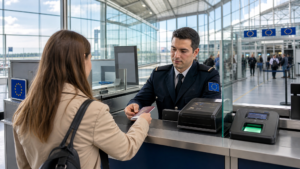
In practice, your first encounter with EES will occur at your first point of entry into the Schengen Area in 2026 or later. This could be at an automated self-service kiosk or a staffed booth at a major airport like Paris Charles de Gaulle (CDG) or Amsterdam Schiphol (AMS). A border officer will guide you to present your biometric passport. A scanner will read the chip, a camera will capture a live facial image, and a separate device will collect your fingerprints. This initial enrollment is projected to take 90 to 120 seconds, compared to the 45-second average for a manual stamp.
The primary goals of EES are threefold: to enhance security by accurately identifying overstayers and document fraud, to aid in combating cross-border crime and terrorism through reliable data, and to streamline border checks for compliant, repeat travelers. Once your biometrics are registered, subsequent entries within the three-year data retention period should be faster, using automated e-gates for verification. However, this system represents a fundamental shift from a human-centric to a technology-driven border process, with significant implications for passenger flow and wait times.
EES vs. ETIAS: Why Is Confusing These Two Systems the #1 Error Americans Will Make?
Mistaking the Entry/Exit System (EES) for the European Travel Information and Authorisation System (ETIAS) is a critical and costly error. While both are part of the EU’s “Smart Borders” initiative, they serve entirely different purposes and require separate actions. Failure to comply with both will result in denied boarding by your airline or refusal of entry at the border.
ETIAS is a pre-travel online authorization. Similar to the U.S. ESTA, it is a security pre-screening. As of early 2025, its launch is anticipated for mid-2025. Before you board any flight, ferry, or coach bound for the Schengen Area, you must complete an ETIAS application online. The process involves a form with personal, passport, and security questions, and a €7 fee (waived for those under 18 or over 70). Approval, typically granted within minutes but taking up to 96 hours if manually processed, is electronically linked to your passport and valid for three years or until your passport expires. It is your permission to travel to the EU border.
EES is an in-person, biometric border procedure. It is not an application you complete beforehand. There is no fee. It is the physical act of crossing the border where your data is captured and logged. Think of ETIAS as the digital key that allows you to board your flight; EES is the digital lock and ledger that records your actual entry.
The confusion stems from both systems launching around the same time and applying to the same group of travelers. However, their legal bases, processes, and data are distinct. The following table provides a definitive comparison to eliminate this common pitfall:
| Aspect | EU Entry/Exit System (EES) | European Travel Information and Authorisation System (ETIAS) |
|---|---|---|
| Primary Function | Records biometric entry/exit events to monitor border crossings and prevent overstays. | Pre-screens visa-exempt travelers for security, migration, and health risks before departure. |
| When & Where It Happens | In-person, at your first Schengen Area border crossing (airport, land, sea port). | Online, completed before booking travel or at least 96 hours before departure. |
| Cost | No direct fee to the traveler. | €7 application fee for most adults. |
| Biometric Data Collected | Facial image and fingerprints (four fingers from each hand). | None during application; authorization is tied to passport number. |
| Validity Period | Biometric data stored for 3 years after last Schengen exit. | Travel authorization valid for 3 years or until passport expiry. |
| Mandatory For | All non-EU nationals entering Schengen for short stays. | All visa-exempt travelers, including U.S. citizens. |
| Current Status | Launched October 2024; full implementation expected by 2026. | Expected launch mid-2025; not yet operational. |
For a seamless trip in 2026, American travelers must complete two separate steps: first, secure an approved ETIAS authorization online, and second, be prepared for the mandatory EES biometric registration upon arrival at their first Schengen border.
How Will EES Realistically Transform Your Arrival Experience at European Airports?
The implementation of EES will fundamentally reshape the passenger experience at Europe’s busiest airports. The transition from a quick visual check to a mandatory biometric capture will create significant bottlenecks, especially during peak travel periods. Understanding this new reality is crucial for planning.
The core issue is processing time. While adding 60-90 seconds per person seems minor, its cumulative effect is staggering. Consider Frankfurt Airport (FRA), which handled over 59 million passengers in 2023. A single morning wave of transatlantic flights can disembark 3,000-4,000 passengers, all requiring first-time EES enrollment. Pre-EES, this group might clear immigration in 60-90 minutes. With EES, even with dozens of new kiosks, processing could extend to 3-4 hours, causing missed connections, overcrowded terminals, and immense stress.
Data from a 2024 feasibility study by Frontex, the EU border agency, suggested that without massive infrastructure upgrades, passenger processing capacity could drop by 40-50% during the initial rollout. In response, the European Commission has allocated over €1.5 billion for member states to install new automated border control (ABC) gates and self-service kiosks. Airports like Amsterdam Schiphol are redesigning entire non-Schengen arrival halls to accommodate hundreds of these units.
For you, the traveler, this demands a strategic overhaul of your itinerary. Key actions include:
- Avoid Peak Arrival Windows: Flights landing between 8:00 AM and 2:00 PM local time will face the longest queues. Consider red-eye flights that arrive in the evening.
- Radically Extend Connection Times: If connecting within the Schengen Area, a minimum layover of 3.5 to 4 hours is now prudent. The International Air Transport Association (IATA) is advising airlines to increase Minimum Connection Times (MCTs) at major hubs.
- Consider Alternative Airports: Flying into secondary hubs like Milan Bergamo (BGY) or Berlin Brandenburg (BER) may offer shorter waits than mega-hubs like CDG or FRA.
- Prepare for Land Border Delays: The Channel Tunnel terminals at Folkestone and Calais will also implement EES kiosks, potentially adding 30-60 minutes to car and train border checks.
The long-term benefit is for repeat travelers. Once enrolled, subsequent entries using automated e-gates could take under 60 seconds. However, this efficiency is contingent on a flawless first registration and fully operational technology—variables that make avoiding initial mistakes in 2026 even more critical.
What Are the Five Most Critical Mistakes Americans Must Avoid Under EES?
Analysis of pilot programs and common travel errors reveals five predictable pitfalls for U.S. passport holders. These mistakes can lead to denied entry, fines, multi-year travel bans, and ruined trips.
Mistake 1: Underestimating Border Wait Times and Booking Tight Connections
The most immediate and disruptive error is assuming pre-2026 arrival timelines still apply. The EES enrollment process will drastically increase border clearance times, particularly in the first years of operation.
The Concrete Risk: EU internal projections indicate peak summer 2026 queues could exceed three hours at major airports. A family of four will need an extra 6-8 minutes for direct processing, not accounting for the potentially hundreds of people ahead of them in line. Booking a connecting flight with a 90-minute layover in Frankfurt after a flight from New York will almost certainly result in a missed connection.
The Proactive Solution: Build a massive buffer into your plans. Do not schedule any ground transportation, tours, or meetings within at least 4-5 hours of your scheduled arrival. For intra-Schengen connections, insist on a minimum layover of 3.5 hours. Use flight search tools to prioritize itineraries with off-peak arrivals or routes through less congested airports.
Mistake 2: Confusing EES with ETIAS or Believing One Replaces the Other
This fundamental misunderstanding is a top concern for authorities. Some travelers may complete an ETIAS application and believe they are “cleared” for entry, showing up at the border unaware of the separate biometric registration required.
The Legal Reality: ETIAS and EES are established by separate EU regulations (ETIAS under Regulation (EU) 2018/1240, EES under Regulation (EU) 2017/2226). Compliance with both is legally mandatory. An ETIAS authorization is a prerequisite for travel, but it does not exempt you from EES. You cannot “skip” the EES registration at the border; it is the physical act of crossing.
The Proactive Solution: Treat them as two distinct checklist items. First, apply for ETIAS as soon as it launches and your travel dates are firm. Second, mentally prepare for the EES border stop: ensure your passport chip is functional, your fingertips are clean and unscarred, and you are ready to remove glasses or hats for the facial capture.
Mistake 3: Arriving with Incomplete or Vague Supporting Documentation
EES automates overstay tracking, making border guards more vigilant and stringent about verifying that you meet all conditions for a short stay. Vague plans or insufficient proof can trigger a secondary inspection and potential denial.
The Stricter Enforcement: The Schengen Borders Code has always required proof of purpose, sufficient funds, and onward travel, but enforcement varied. EES provides officers with instant travel history, empowering them to rigorously enforce these rules. Presenting a one-way ticket or a hotel booking for only the first night will raise immediate red flags.
The Proactive Solution: Carry the following documentation, either physically or easily accessible on your phone:
- Proof of Onward Travel: A confirmed return or onward ticket dated within the 90-day limit.
- Confirmed Accommodation: Hotel reservations, rental agreements, or a formal invitation letter for your entire stay.
- Proof of Sufficient Financial Means: Recent bank statements, a credit card with a high limit, or cash equivalent to at least €100 per day of your stay.
- Travel Medical Insurance: A policy covering emergency medical expenses and repatriation with minimum coverage of €30,000, mandatory for countries like France and Germany.
- Purpose Documentation: A business invitation letter, conference registration, or a detailed day-by-day tourist itinerary.
Mistake 4: Miscalculating the 90/180-Day Schengen Rule
The rule allows a maximum stay of 90 days within any rolling 180-day period. Pre-EES, errors in manual passport stamps sometimes created ambiguity. EES calculates this with digital precision, leaving zero room for error.
The Severe Consequence: Overstaying by even a single day creates an automatic violation record. Penalties include fines (€100-€500 per day of overstay), deportation, an entry ban of up to five years, and the revocation of future ETIAS authorizations and visa applications.
The Proactive Solution: Never rely on mental math. Before any trip, use the official, authoritative Schengen Calculator available on the European Commission’s website. Input all your entries and exits from the Schengen Area over the past 180 days to know your exact remaining eligible days. Frequent travelers should maintain a personal digital travel log for easy reference.
Mistake 5: Misunderstanding Schengen Geography and EES Scope
EES applies at the external borders of the Schengen Area, which is not synonymous with the European Union. Traveling between Schengen countries involves no border checks, but entering the Schengen zone from outside triggers EES.
The Critical Distinctions:
- Schengen Area (Uses EES): Includes most EU states (e.g., France, Germany, Italy, Spain) plus Iceland, Liechtenstein, Norway, and Switzerland.
- EU but Not Schengen (No EES at entry): Ireland and Cyprus. Note: Bulgaria and Romania joined Schengen on March 31, 2024, but initially only for air and sea travel; land border checks remain.
- Non-EU/Non-Schengen (No EES): United Kingdom, Albania, Türkiye.
The Practical Scenario: Flying from New York to Dublin (Ireland, non-Schengen), then connecting to Paris (France, Schengen) means you clear Irish immigration first (no EES). Your EES registration happens upon arrival in Paris, your first Schengen port of entry.
The Proactive Solution: Map your itinerary. Identify the first country on your trip that is part of the Schengen Zone—that is your EES entry point. This is vital for multi-destination trips mixing Schengen and non-Schengen nations.
What Practical Steps Should You Take in 2025 to Prepare for EES in 2026?
Preparation is your best defense against disruption. Taking these steps well before your 2026 trip will ensure compliance and minimize stress.
- Audit Your Passport Now: Ensure it is a biometric e-passport with an undamaged data page and functional chip. It must be valid for at least three months beyond your intended departure date from the Schengen Area, though many airlines enforce a stricter six-month policy.
- Apply for ETIAS Early: Once the system launches (anticipated mid-2025), apply via the official europa.eu/etias portal as soon as your travel plans are firm. Approval is typically for three years, covering multiple trips.
- Monitor the “EU Travel” App: The European Commission is developing a mobile app that may allow pre-registration of passport data and a facial image. If operational by 2026, using it could save crucial minutes at the border. Watch for updates on ec.europa.eu.
- Choose Your Arrival Point Strategically: Research which airports are making significant EES infrastructure investments. Consider flying into secondary hubs or terminals with dedicated non-Schengen facilities that may have shorter queues.
- Consider Trusted Traveler Programs: Frequent business travelers to specific countries like the Netherlands or Germany should investigate national registered traveler programs (e.g., Privium, EasyPASS RCT). These involve a separate fee and background check but grant access to expedited biometric lanes.
- Pack a “Border Delay” Kit: Assume long waits. Pack a portable phone charger, snacks, a refillable water bottle, and essential medications in your carry-on. Download entertainment for offline use.
- Know Your Data Rights: Under EU GDPR, you have rights to access, rectify, or request erasure of your EES data under specific conditions. The data controller is the EU member state where you first entered Schengen.
What Are the Long-Term Implications of EES for Travel and Privacy?
EES is not a temporary change but a permanent restructuring of EU border management with far-reaching consequences for travel patterns, data privacy, and transatlantic relations.
From a data privacy perspective, EES creates the largest-ever centralized repository of American biometrics held by a foreign entity. While protected by stringent EU GDPR and specific EES regulations, this raises complex questions about long-term data security, access, and potential future data-sharing agreements with the U.S. It establishes a new precedent in biometric border governance.
Travel patterns will adapt. The friction of first-time EES registration may deter short, spontaneous city breaks, instead encouraging fewer but longer trips to maximize the 90-day allowance. This could benefit regional tourism within single countries. Conversely, non-Schengen European destinations like the United Kingdom, Ireland, and Albania may see increased tourism as alternatives that avoid the EES entry procedure.
The economic and infrastructural impact is profound. Airports Council International (ACI) Europe estimates required investments exceed €500 million for new hardware and redesigned spaces. Airlines will face costs from missed connections and schedule adjustments. However, if successfully integrated, EES could eventually enable a more seamless, “walk-through” border experience for pre-vetted, low-risk travelers, setting a global standard for biometric border management.
FAQ
Are children subject to EES registration, and do they need to give fingerprints?
Yes, all non-EU nationals, including children, are subject to EES registration. However, children under the age of 12 are exempt from the fingerprint requirement under Article 14 of the EES Regulation. They will still need to have their passport scanned and a facial image captured. Border authorities will have procedures to assist families, and infants may be photographed while held by a parent.
If I have a criminal record, will EES automatically deny me entry?
No, EES itself does not make automated entry decisions. It is a registration system. However, your data is checked in real-time against EU security databases like the Schengen Information System (SIS). A criminal record does not automatically mean denial. Entry refusal is based on a risk assessment by the border guard at the time of crossing. Serious convictions may lead to an SIS alert and likely denial, but each case is assessed individually under EU and national law.
I am a U.S. lawful permanent resident (green card holder). Do I need ETIAS and EES?
Your U.S. immigration status is not relevant for EU rules. Entry requirements are based solely on the nationality of the passport you are traveling with. If you are a U.S. green card holder traveling on a Canadian passport (visa-exempt), you will need ETIAS and will go through EES. If you are traveling on a passport from a country that requires a Schengen visa (e.g., India), you will not use ETIAS or EES; you will enter using your visa.
Does EES apply when traveling to EU territories like the Canary Islands or French Guiana?
It depends on the territory’s status. The Canary Islands are an integral part of Spain and the Schengen Area, so EES applies upon your first entry there from outside Schengen. French Guiana, however, is a French overseas department and is not part of the Schengen Area. Travel from the U.S. to French Guiana would not trigger EES, but specific visa rules for French overseas territories apply. Always verify your destination’s specific status.
What if my fingerprints cannot be captured due to a medical condition or manual work?
The EES Regulation provides exemptions for individuals from whom fingerprinting is physically impossible. If you have a permanent condition, carrying a doctor’s note is advisable. At the border, inform the officer immediately. They will proceed with the facial image capture and manually note the exemption in the system. For temporary issues (e.g., bandaged fingers), you may undergo manual processing and could be required to provide fingerprints at a later exit or entry if possible.
FAQ
Why trust this information?
Profiles follow a quality checklist and are updated when new verified data is available.
How do I request corrections?
Use the contact page to submit updates with supporting details.