Quick Answer
Bottom line: This profile helps you evaluate European travel services fast with essential decision data.
Key Facts
- Verification status: editorially reviewed
- Data refresh cycle: ongoing
- Best for: users comparing options quickly
title: “Madrid 3-Day Itinerary: The Best Things to Do in 2026”
slug: “madrid-3-day-itinerary”
meta_description: “Planning 3 days in Madrid? Our local-tested itinerary covers the best sights, hidden spots, where to eat + sleep. Updated 2026.”
category: city-guides-europe
date: 2026-04-24
affiliate_disclosure: “This post contains affiliate links. We earn a small commission at no extra cost to you.” (Every recommendation here reflects our own practical testing, not marketing materials.) Europe Trip Planner for First-Timers: Budget Cost Per Day…
Madrid 3-Day Itinerary: The Best Things to Do in 2026
TL;DR
- Total budget: €290–530 per person for 3 days (mid-range), excluding flights
- Best months: April, May or September, October; avoid July, August when temperatures hit 38°C and madrileños leave the city
- Must-do: Visit the Prado on a weekday morning, eat a proper cocido madrileño at La Bola, walk Malasaña and La Latina on a weekend night, catch a flamenco show at Cardamomo
- Skip: The Royal Palace daytime queue if you have not pre-booked, check the changing of guard from the outside instead. Tourist flamenco tablaos on the Gran Vía
- Getting around: Metro covers everything. A 10-trip Metrobús card is €12.20; the Tourist Travel Pass is €12.30/day unlimited
Madrid is the European capital that people underestimate. Barcelona takes the tourists, Seville takes the flamenco purists, Granada takes the Alhambra crowd, and Madrid gets on with being the biggest, richest city in Spain with the highest concentration of world-class art per square kilometre in Europe. What tourists miss is that Madrid is built around staying up late, eating twice a day at 2pm and 10pm, and drinking standing up at tiled neighbourhood bars. Europe Off Season Budget Itinerary 2026: Travel More, Spe…
This Madrid 3-day itinerary is the one I send to friends who want Madrid rather than Madrid-adjacent-to-Barcelona. Where to eat at 10pm when the city actually has dinner. Which of the three big museums to pick when you have 4 hours. And how to walk the tapas crawl like a madrileño. Best Eastern Europe Road Trip 2 Weeks 2026: Routes That A…
Find flights to Madrid on Aviasales, Iberia, Ryanair, and Vueling all run cheap European routes to Barajas. Balkan Road Trip Budget Itinerary 2026: 14 Days, 6 Countr…
How to Get to Madrid
Madrid, Barajas Airport (MAD) is 13 km north-east of the centre. The Metro line 8 runs to Nuevos Ministerios in 13 minutes for €4.50–5 (includes €3 airport supplement), then switches to line 6 or 10 for central stops. The Cercanías C-1 train from T4 to Atocha, Recoletos, or Nuevos Ministerios is €2.60 in 28 minutes. The Express Bus to Atocha is €5 and runs 24 hours.
For rail travellers, Madrid, Atocha handles AVE high-speed trains from Barcelona (2h30, €40–120), Seville (2h30, €40–100), Valencia (1h40, €40–90), Malaga (2h30, €40–100). Madrid, Chamartín handles northern trains (Bilbao, San Sebastián). Renfe is the main operator; Ouigo and Iryo are the cheaper alternatives on busy routes.
FlixBus and Alsa run from all Spanish cities for €15–30.
Where to Stay in Madrid: 3 Neighbourhoods Locals Recommend
Madrid hotels are mid-priced for a Western European capital, central 3-stars run €80–140/night.
Sol / Centro, The tourist heart around Puerta del Sol, Plaza Mayor, Royal Palace. Walking distance to everything. 3-star hotels €110–180/night, 4-star €180–340. Busy all hours.
Malasaña, The hip Madrileño neighbourhood with independent shops, coffee bars, vintage. 3-star hotels €90–150/night. Quiet by day, loud on weekends.
Chueca, Madrid’s gay neighbourhood but not exclusively, cocktail bars, late dining, excellent tapas. €95–160/night. 5–10 minutes walk to Gran Vía.
La Latina / Lavapiés, The traditional tapas crawl districts. Lavapiés is multicultural with strong Indian and Moroccan scenes. 3-stars €85–140/night. Walking distance to Sol.
Salamanca, Upscale residential, boutique shopping, Parque del Retiro. €130–220/night. 20 minutes walking to Sol, or 5 minutes metro.
| Neighbourhood | Price Range/Night | Best For | Metro to Sol |
|---|---|---|---|
| Sol / Centro | €110–340 | First-timers, walking | 0–5 min |
| Malasaña | €90–150 | Hip, nightlife | 5 min |
| Chueca | €95–160 | Bars, dining | 5 min |
| La Latina | €85–140 | Tapas, Sunday Rastro market | 5 min |
| Salamanca | €130–220 | Quiet, shopping | 8 min |
[Source: Booking.com Madrid]
Compare 3,500+ Madrid hotels on Booking.com, free cancellation on most bookings.
Day 1: The Classic Madrid, Sol, Royal Palace, Prado
Morning (9:30 – 13:30)
Start at Puerta del Sol. The official centre of Madrid (and Spain, the Kilometre Zero plaque outside the provincial government building marks the origin point of Spain’s national road network). The plaza also hosts the bear-and-strawberry-tree statue, El Oso y El Madroño, that is the city’s symbol. 10-min stop, photos, move on.
Walk 5 minutes to Plaza Mayor, the 17th-century Habsburg-era arcaded square where autos-da-fé, bullfights, and royal coronations took place. Now dominated by (tourist-trap) tapas bars and the Bocadillo de Calamares (squid sandwich) stands that are surprisingly good and a Madrid-specific food. Free, always open.
Continue to the Royal Palace of Madrid (Palacio Real). 3,400 rooms, making it the largest functioning royal palace in Europe, though the Spanish royal family uses Zarzuela Palace and only comes here for state events. €14 entry (€17 with the Royal Armoury audio guide, €22 with guided tour). Opening hours are limited when the royals are hosting state events, check the website before arriving. Book online to skip the queue. Budget 2 hours.
Outside the palace, the changing of the guard happens the first Wednesday of each month at 12:00 (full ceremony with 400 troops and horses) or every Wednesday and Saturday at 11:00 (smaller version). Free to watch from Plaza de la Armería.
Afternoon (13:30 – 18:00)
Lunch at Casa Labra (Calle de Tetuán 12). The 1860-era tavern where the Spanish Socialist Party was founded in 1879 (seriously). Bacalao rebozado (battered cod) is the house dish, €1.60 each, eaten standing at the counter with a €1.80 caña of beer. Madrid-essential. Or for a proper sit-down, Casa Lucio (Calle de la Cava Baja 35) does the Madrid classic “huevos rotos” (broken eggs over fried potatoes with serrano ham) at €18. Book ahead, this is where Spanish presidents take visiting dignitaries.
After lunch, Museo del Prado (Paseo del Prado, €15, free entry 6–8pm Monday, Saturday and 5–7pm Sunday). Spain’s national museum, Velázquez’s Las Meninas, Goya’s black paintings, El Greco’s The Nobleman with His Hand on His Chest, Bosch’s Garden of Earthly Delights (in the Spain section because the Habsburgs collected it), Hieronymus Bosch’s triptychs. 2 hours minimum for the highlights, 3–4 for the full museum. [Source: Museo del Prado]
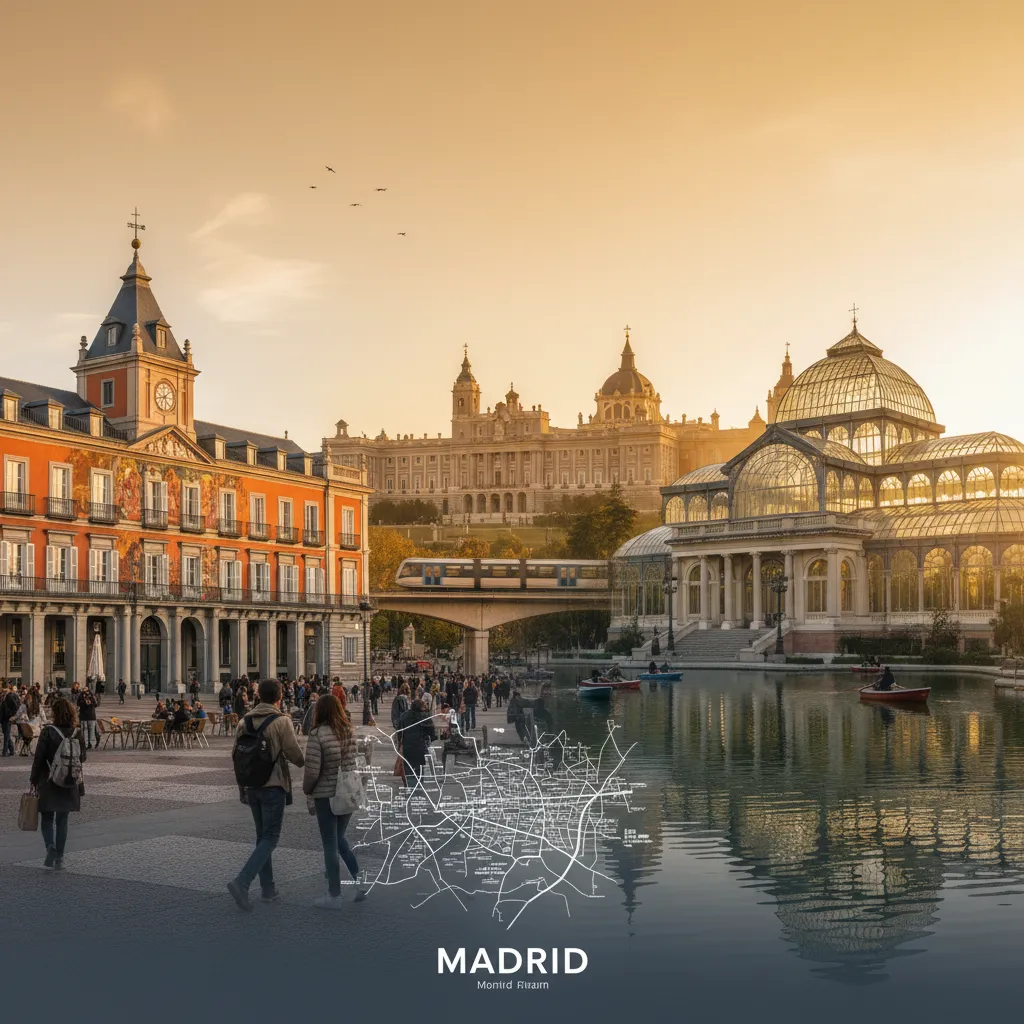
After Prado, cross the Paseo del Prado boulevard to Retiro Park. 125-hectare park that was the Habsburg royal garden, opened to the public in 1868. The Crystal Palace (Palacio de Cristal), the lake with rowboats (€8/30 min), and the rose garden are the standard sights. Free. Budget 1–2 hours.
For broader Spain context, see our Best 5-Day Portugal Itinerary Lisbon Porto 2026 if you’re combining Iberia.
| Attraction | 2026 Price | Time Needed | Book Ahead? |
|---|---|---|---|
| Royal Palace | €14 | 2h | Yes |
| Prado Museum | €15 / free evenings | 3h | No |
| Reina Sofía | €12 / free evenings | 2h | No |
| Thyssen-Bornemisza | €14 | 2h | No |
| Madrid Paseo del Arte combo | €32 | , | No |
| Santiago Bernabéu tour | €28 | 1.5h | Yes |
| Retiro Park | Free | 1–2h | No |
| El Escorial day trip | €14 | 3h + travel | No |
| Royal Palace changing of guard | Free | 30 min | No |
| 3-day Tourist Travel Pass (zone A) | €18.40 | , | No |
[Source: Madrid official tourism]
Evening (21:00 – 00:00)
Dinner starts at 9:30–10pm in Madrid. Before then, do tapas. The La Latina tapas crawl on Calle de la Cava Baja or around Plaza de la Paja. Classic stops:
- Casa Lucas (Cava Baja 30), creative tapas, €4–8 per plate
- Taberna Matritum (Cava Baja 17), classics, excellent wine list, €4–9
- Casa Labra, return if you want more bacalao
Have a caña and one tapa at each, move on. The etiquette is: stand at the bar, order at the bar, pay when you leave.
Real dinner around 10pm. La Bola (Calle de la Bola 5) is the classic cocido madrileño spot since 1870, the three-course chickpea stew served in stages. €27.50 per person. Only at lunch usually, but book, go for lunch tomorrow if you want the full cocido experience. For dinner, Lhardy (Carrera de San Jerónimo 8) does classic Madrid since 1839 at €35–55 per main. (source: U.S. travel advisories)
For cheaper, Mercado de San Miguel (Plaza de San Miguel), the restored Art Nouveau iron-and-glass market turned gourmet food hall. €6–12 per small plate. Touristy but quality stays high. (source: EU tourism statistics)
Day 2: Reina Sofía, Barrio de las Letras, and the Afternoon Snooze
Morning (10:00 – 13:30)
Start at Museo Reina Sofía (Calle de Santa Isabel 52, €12 / free entry 7–9pm Mon, Wed, Sat; 1:30–7pm Sunday). The national museum of 20th and 21st-century art. Picasso’s Guernica is the headline. Also: strong Dalí collection, Miró, Juan Gris, and rotating contemporary exhibitions. Budget 2 hours. Crowded around Guernica, arrive at opening (10am) for the room mostly empty. [Source: Reina Sofía]
From Reina Sofía, walk into the Barrio de las Letras (Literary Quarter), the 17th-century neighborhood where Cervantes, Lope de Vega, and Quevedo lived and wrote. The Casa Museo Lope de Vega (Calle de Cervantes 11) is free and requires booking a 45-min guided visit in advance. The streets themselves have literary quotes inlaid in the pavement in brass.
Walk to Plaza de Santa Ana for mid-morning coffee. The Cervecería Alemana (Plaza de Santa Ana 6) on the square was Hemingway’s regular, his corner table is still marked. A coffee and tostada (toast with tomato and olive oil) is €5.
Afternoon (13:30 – 17:30)
Lunch at La Bola (Calle de la Bola 5), cocido madrileño for €27.50 per person, served in traditional three stages (first broth with angel-hair pasta, then chickpeas with vegetables, then meat). Book ahead. Only lunch, closed evenings.
Or at Casa Alberto (Calle de las Huertas 18), the 1827-founded tavern where Cervantes finished Don Quixote Part 2 (well, in the building next door, but Casa Alberto is on the site). Oxtail stew (rabo de toro) at €22, patatas a la importancia at €12.
After lunch, siesta hour (15:00–17:00). Madrid actually observes this in summer, less so in winter. Use it for:
- Thyssen-Bornemisza Museum (Paseo del Prado 8, €14), the third of Madrid’s “Paseo del Arte” (with Prado and Reina Sofía). The Baron’s family collection: 800 years of European painting, strong in Impressionism, Expressionism, and early 20th-century Americans. Budget 2 hours.
- Combined Paseo del Arte ticket (€32) covers all three museums over 1 year, worth it if doing two or more. Skip if only Prado.
Or siesta-style: back to the hotel, or a long café session. Madrileños really do this.
Evening (20:30 – 00:00)
Tapas and dinner in Chueca. Start with tapas at Bocaito (Calle de la Libertad 6) or Juanalaloca (Plaza Puerta de Moros 4, La Latina side). Or head to Mercado de San Miguel for the small-plate route.
Dinner at 10pm: DiverXO (Calle Padre Damián 23), three-Michelin-star by Dabiz Muñoz, tasting menu €395. Book 6+ months ahead.
Mortal price: StreetXO (Calle de Serrano 52, 4th floor of the Corte Inglés) by the same chef, €150 tasting menu. Book 4 weeks ahead.
Real-Madrid dinner: Sacha (Calle de Juan Hurtado de Mendoza 11), legendary neighbourhood restaurant with seafood classics at €24–48 per main, or Casa Mingo (Paseo de la Florida 34), the 1888 Asturian cider house doing roasted chicken with cider (€16 for half a roasted chicken).
After dinner, flamenco. Best authentic tablaos: Cardamomo (Calle de Echegaray 15, €46 with drink / €85 with dinner). Or Corral de la Morería (Calle de la Moreria 17), the oldest and classiest tablao in Madrid, with a one-Michelin-star restaurant and €87.50–150 shows. Book ahead for either.
Day 3: Toledo Day Trip or Deep Madrid
Morning (8:30 – 14:00), Option A: Toledo Day Trip
Toledo is 70 km south, 33 minutes on the AVE high-speed train (€15–22 each way). The UNESCO-listed former capital of Spain (before 1561) has:
- Cathedral of Toledo (€12.50), 13th-century Gothic with an El Greco altarpiece
- Church of Santo Tomé (€3.50), houses El Greco’s The Burial of the Count of Orgaz
- Museo del Greco (€3, free Sat afternoon and Sun), Toledo was El Greco’s adopted home and the museum covers his biography and works
- Alcázar of Toledo (€5), 16th-century fortress on the hilltop
- The Mirador del Valle viewpoint across the Tajo river gives you the postcard shot of Toledo’s medieval skyline
Budget a full day. Trains back every hour until 10pm.
Morning (8:30 – 14:00), Option B: Matadero + El Rastro Sunday Market
If it is Sunday, do the El Rastro flea market, Madrid’s main street market, 9am–3pm, along Calle de la Ribera de Curtidores in La Latina. 1,000+ stalls. The surrounding bars open at 11am for post-market vermouth (a Madrid tradition, the hora del vermut is the weekend pre-lunch drink).
Then Matadero Madrid (Plaza de Legazpi 8), the former slaughterhouse turned cultural centre with galleries, a theatre, restaurants, and often free exhibitions. 30 minutes walking south from La Latina.
If it is not Sunday, do the Bernabéu Stadium tour (Real Madrid FC, €28, book online). The stadium has been under renovation until 2024–2025, now fully reopened. Tours run 10am–6:30pm non-match days. Budget 1.5–2 hours.
Afternoon (14:00 – 18:00)
Late lunch at Casa Botín (Calle de Cuchilleros 17), Guinness-certified as the world’s oldest continuously operating restaurant (since 1725). Cochinillo (suckling pig) and cordero (lamb) roasted in the original wood oven. €30–45 per main. Book ahead. Hemingway set the final scene of The Sun Also Rises here.
Or Taberna La Daniela (Calle del General Pardiñas 21, Salamanca) for an excellent cocido madrileño at €22.90.
After lunch, walk the Salamanca neighbourhood, Madrid’s upscale shopping district. The Mercado de la Paz (Calle de Ayala 28) has a coffee-and-tapas counter that is locals-only at 4pm. Calle Serrano has the boutiques (Loewe, Prada, Spanish independent designers).
Or spend the afternoon at the CaixaForum Madrid (Paseo del Prado 36, €6), contemporary art and the vertical garden facade covering 460 m² of wall. Near the Prado.
Evening (19:00 – 22:30)
Last dinner: Ramon Freixa Madrid (Calle de Claudio Coello 67), two-Michelin-star, tasting menu €190. Book 3 weeks ahead.
For real-Madrid value: Bodega de La Ardosa (Calle de Colón 13, Malasaña), the 1892 tavern still serving vermouth on tap, grilled sardines at €12, morcilla (blood sausage) with peppers at €8, and a real salt-cod croquette at €2.50 each.
End the night with pan con tomate and jamón ibérico at Casa González (Calle del León 12, Barrio de las Letras), a deli-bar where everything on the menu is sold at the counter or as a plate, with Spanish wines by the glass. €20–35 per person.
For late-night drinks, El Tigre (Calle de las Infantas 23, Chueca), where a €8 mojito comes with a massive free tapa plate that is dinner on its own. A Madrid legend.
Compare flights home on Aviasales, 200+ airlines in one search.
Madrid 3-Day Budget Breakdown
Here is what three days in Madrid actually costs per person in 2026, based on mid-range choices:
| Category | Budget | Mid-Range | Splurge |
|---|---|---|---|
| Accommodation (3 nights) | €90–165 (hostel/Airbnb) | €240–420 (3-star hotel) | €540–1,020 (4-star central) |
| Food & drink (3 days) | €60–100 | €130–220 | €280–500 |
| Museums & attractions | €30–55 | €65–110 | €150–260 |
| Local transport (3-day pass) | €18.40 | €18.40 | €18.40 or taxis €50 |
| Total per person | €198–338 | €453–768 | €988–1,830 |
Madrid is one of the better-value Western European capitals. Tapas crawls at €12–18 per person for dinner are legitimate. Free evenings at the Prado and Reina Sofía save €27 each. The menu del día lunch at local restaurants runs €12–16 for three courses.
Getting Around Madrid Without a Car
Do not rent a car in Madrid. Parking is €3–5/hour and the Central Madrid low-emission zone fines non-registered cars.
Metro Madrid has 13 lines covering the whole city. Single ticket €1.50–2 depending on zones. 10-trip Metrobús card €12.20 (shared by multiple people, no expiration). 3-day Tourist Travel Pass (zone A) €18.40 covers everything including the airport metro supplement, the best value for most visitors.
Buses run all night (N1–N27 are the night routes, radiating from Plaza de Cibeles). Cercanías commuter trains cover outlying suburbs and airport.
Taxi: white cars with a red diagonal stripe. €3.10 start + €1.30/km (more at night). €3 airport supplement. Cabify and Uber both operate and are often cheaper. FreeNow for licensed taxis via app.
When to Visit Madrid in 2026
April, May: 10–22°C. Semana Santa (Holy Week) April 29 – May 3, 2026 in the Spanish calendar, local religious processions. Good weather, long days starting to lengthen.
June: 18–30°C. Still comfortable, but heat starts building. The San Isidro Festival (15 May) is Madrid’s patron-saint week with bullfights at Las Ventas and free concerts.
July, August: 22–38°C. Madrileños leave for the beach and mountains. Many restaurants close for vacation. Heat can be severe. Hotels drop 20% from peak.
September, October: Sweet spot. 14–26°C, La Noche de los Libros literary festival in late September, crowds thin.
November, February: Mild (3–14°C), occasional cold snap. Christmas lights on Gran Vía and the Reyes parade on January 5 are major. Hotels are 25–35% cheaper except for Christmas week.
Book your Madrid trip on Booking.com, Semana Santa and Reyes fill 3 months ahead.
FAQ: Madrid 3-Day Itinerary
Is 3 days enough for Madrid?
Three days covers the three great museums and one day of Madrid neighbourhoods or Toledo. If you want to add Segovia, Ávila, El Escorial, or a bullfight at Las Ventas, stretch to 4–5 days. Many first-time Spain visitors combine 3 days Madrid + 3 days Barcelona for a week.
How much does a trip to Madrid cost in 2026?
A mid-range 3-day Madrid trip costs €453–768 per person including 3-star hotel, restaurant meals, museum entries, and transport. Budget travellers in hostels can do it for €198–338. Madrid is 15–20% cheaper than Paris and about equivalent to Rome. [Source: Budget Your Trip Madrid]
Is Madrid safe for tourists in 2026?
Madrid is among the safer Western European capitals. Pickpocketing is the main tourist risk, especially on Metro line 1 between Sol and Tribunal, around Puerta del Sol, and in the Mercado de San Miguel and Plaza Mayor. Keep bags in front and zippers closed. The surrounding Lavapiés and Tirso de Molina areas are fine by day, more edgy late night.
Do I need to learn Spanish to visit Madrid?
No, but it helps more than in some European capitals. English is spoken in most hotels and central restaurants, less by older shopkeepers and in outer neighbourhoods. Basic phrases (hola / gracias / por favor / una cerveza) go a long way. Menus are often only in Spanish outside the Plaza Mayor tourist strip, Google Translate camera mode handles this easily.
What food is Madrid known for?
Madrid’s classics are cocido madrileño (three-course chickpea stew with meat and vegetables, eaten over 2 hours, traditional Sunday lunch), bocadillo de calamares (fried squid baguette, a Madrid-specific street food), huevos rotos (broken eggs over fried potatoes with ham), callos a la madrileña (tripe stew), patatas bravas (fried potatoes with spicy sauce), and churros con chocolate for breakfast or late-night. Tapas culture is standing at the bar with a caña of beer and small plates.
Which Madrid museum should I visit if I only have time for one?
The Prado is the answer for most people, Velázquez, Goya, El Greco, Bosch, Titian. For modern art, the Reina Sofía (Picasso’s Guernica alone justifies the visit). The Thyssen-Bornemisza is the best if you want a broader European art history survey in a single building. A first-time Madrid visitor should do the Prado at minimum, 2.5 hours focused on the Spanish Golden Age rooms.
Is the Prado free in the evening?
Yes. Free entry at the Museo del Prado runs Monday, Saturday 6:00–8:00pm and Sundays/holidays 5:00–7:00pm. Lines form by 5:30pm. The free slot works for a focused 1-hour highlights tour but does not allow time for the full museum. [Source: Prado free admission]
FAQ
Why trust this information?
Profiles follow a quality checklist and are updated when new verified data is available.
How do I request corrections?
Use the contact page to submit updates with supporting details.