Quick Answer
Bottom line: This profile helps you evaluate European travel services fast with essential decision data.
Key Facts
- Verification status: editorially reviewed
- Data refresh cycle: ongoing
- Best for: users comparing options quickly
title: “Brussels 3-Day Itinerary: The Best Things to Do in 2026”
slug: “brussels-3-day-itinerary”
meta_description: “Planning 3 days in Brussels? Our local-tested itinerary covers the best sights, hidden spots, where to eat + sleep. Updated 2026.”
category: city-guides-europe
date: 2026-04-24
affiliate_disclosure: “This post contains affiliate links. We earn a small commission at no extra cost to you.” (Every recommendation here reflects our own practical testing, not marketing materials.) Europe Off Season Budget Itinerary 2026: Travel More, Spe…
Brussels 3-Day Itinerary: The Best Things to Do in 2026
TL;DR
- Total budget: €360–660 per person for 3 days (mid-range), excluding flights
- Best months: May, June, September, mild weather and Brussels Flower Carpet (August 15–17, 2026 in Grand-Place)
- Must-do: Stand in Grand-Place at night, eat moules-frites with a Trappist beer, visit the Atomium, walk the comic-strip mural trail, eat a proper fresh-made waffle at Maison Dandoy
- Skip: Manneken-Pis is 61 cm tall. See it, take your photo, move on. Do not pay to enter any of the “wardrobe museums” around him
- Getting around: STIB metro + tram + bus. A 24-hour pass costs €8, a 72-hour €20. Walk the centre, it’s flatter than Paris
Brussels is Europe’s most underrated capital. Outshadowed by Bruges (prettier), Antwerp (cooler), and Paris (two hours away by Thalys), the Belgian capital gets dismissed as an EU-bureaucracy waypoint. What tourists miss is that Brussels is the best food-and-beer city in Northern Europe by a wide margin, has the finest Art Nouveau architecture outside Barcelona, and packs 500 years of Flemish-Walloon tension into streets where you can still eat moules for €18. Europe Trip Planner for First-Timers: Budget Cost Per Day…
This Brussels 3-day itinerary is the one I send to friends who want the real city, not just the Grand-Place photo. Where to drink Trappist beer with people who actually like Trappist beer. Which comic-strip murals are worth seeking out. And how to do Belgium in a capital that most visitors give 24 hours to. Best Eastern Europe Road Trip 2 Weeks 2026: Routes That A…
Find flights to Brussels on Aviasales, Brussels Airlines, Ryanair (to Charleroi), and TUI all run cheap routes. How to Plan a Europe Trip 2026: Step-by-Step Guide (Budge…
How to Get to Brussels
Brussels Airport (BRU) is 12 km north-east of the centre. The train runs direct to Brussels-Nord, Brussels-Central, and Brussels-Midi every 10–15 minutes for €11.60 one-way, 20 minutes to Central. Budget travellers using Brussels South Charleroi (CRL) airport (60 km south, Ryanair) take the Flibco shuttle bus (€19, 60 minutes) to Brussels-Midi.
Brussels is a major European rail hub. Eurostar from London (1h50, €80–180), Thalys/Eurostar from Paris (1h22, €35–110), Amsterdam (1h50, €35–90), and Cologne (1h50, €35–80). ICE from Frankfurt (3h, €70–120). All arrive at Brussels-Midi (Zuid). Connect to Central and Nord via the same train or the intercity connection.
FlixBus runs from Paris (4h, €10–25), Amsterdam (4h, €15–30), Cologne (3h, €15–30). See our Eurail Pass Guide 2026 for Belgium rail options.
Where to Stay in Brussels: 3 Neighbourhoods Locals Recommend
Brussels hotels are surprisingly affordable for a Western European capital, a central 4-star runs €100–180/night, well under Paris or Amsterdam.
Grand-Place / Îlot Sacré, The UNESCO medieval heart. Hotels 3-star €100–160/night, 4-star €180–320. Busiest tourist area, but walking distance to everything.
Sablon / Marolles, Elegant, antique-shopping, chocolatiers, the Notre-Dame du Sablon church. €110–180/night for 3-star boutique hotels. Quieter than Grand-Place.
Saint-Gilles / Ixelles, The hip residential neighbourhoods south of the centre. Art Nouveau architecture (Horta, Hankar), the best Belgian bistros, independent coffee shops. 3-star hotels €80–140/night. 10-min tram to the centre.
European Quarter, If you are here for business, around Place Schuman. Chains and business hotels. Not great for tourism-only visitors.
| Neighbourhood | Price Range/Night | Best For | Walk to Grand-Place |
|---|---|---|---|
| Grand-Place / Îlot Sacré | €100–320 | First-timers | 0–5 min |
| Sablon / Marolles | €110–180 | Elegant, chocolatiers | 10 min |
| Saint-Gilles / Ixelles | €80–140 | Hip, local food | 10–15 min tram |
| European Quarter | €100–180 | Business | 20 min tram |
[Source: Booking.com Brussels]
Compare 1,200+ Brussels hotels on Booking.com, free cancellation on most bookings.
Day 1: Grand-Place, Manneken-Pis, and Your First Moules-Frites
Morning (9:00 – 13:00)
Start at Grand-Place (Grote Markt). The 17th-century ensemble with the Hôtel de Ville (Town Hall, 1402) and the Maison du Roi (King’s House) plus the guild houses is widely considered the most beautiful main square in Europe. Free to walk. Worth seeing twice, once in morning light, once after dark when the buildings are floodlit.
From Grand-Place, walk 2 minutes south to Manneken-Pis (intersection of Rue de l’Étuve and Rue du Chêne). The 61 cm bronze statue of a boy peeing into the fountain has been there since 1618 (the original is in the Museum of the City of Brussels; the outside is a replica). He has 1,000+ costumes that get rotated on holidays. Spend 5 minutes here. Move on.
Walk to the Galeries Royales Saint-Hubert (1847 covered shopping arcades, the first in continental Europe). Glass-roofed, elegant, with chocolate shops (Neuhaus, Mary, Pierre Marcolini) and the original Maison Dandoy waffle shop. Buy a Brussels waffle (NOT a Liège waffle, they are different styles, Brussels is lighter with a rectangular shape) at Maison Dandoy (Rue au Beurre 31) for €4–7. Eat it with whipped cream, fresh strawberries in season. Do not get one from the on-the-street kiosks selling overheated versions covered in spray cream.
Stop for coffee at Café Belga (Place Eugène Flagey, Ixelles, 10-minute tram ride, worth the detour) or MOK Coffee Roasters (Rue Antoine Dansaert 196A) for serious coffee.
| Attraction | 2026 Price | Time Needed | Book Ahead? |
|---|---|---|---|
| Grand-Place | Free | 30 min | No |
| Manneken-Pis | Free | 5 min | No |
| Atomium | €18 / €20 with Mini-Europe | 1.5h | Yes |
| Magritte Museum | €11 | 1.5h | Yes |
| Royal Museums of Fine Arts | €15 | 2h | No |
| MIMA (Millennium Iconoclast Museum of Art) | €11 | 1.5h | No |
| Comic Strip Museum | €13 | 1.5h | No |
| Horta Museum (Art Nouveau) | €12 | 45 min | YES |
| Train World | €14 | 2h | No |
| STIB 72-hour travel card | €20 | , | , |
[Source: Visit Brussels official, Atomium]
Afternoon (13:00 – 18:00)
Lunch: Chez Léon (Rue des Bouchers 18). The classic Brussels moules-frites institution since 1893. Mussels with various sauces, marinière (white wine), provençale (tomato and garlic), escargot (garlic butter), €19–26 for a kilo pot with unlimited fries. Tourist-approved but honest and consistent. Alternative: Vincent (Rue des Dominicains 8) for slightly quieter moules-frites with a longer wine list.
For budget lunch, Peck 47 (Rue du Marché aux Poulets 47) is a quirky bistro-diner with Brussels waffles, avocado toasts, and burgers at €12–18. Popular for brunch.
After lunch, visit the Royal Museums of Fine Arts (Place Royale, €15 combined). Six museums under one roof, the Old Masters (Bruegel, Rubens, Van Dyck, Memling), the Fin-de-Siècle Museum, and the separately-ticketed Magritte Museum (€11, or €20 combined with Old Masters). René Magritte was Belgian, his entire estate is here including The Treachery of Images (“Ceci n’est pas une pipe”) and the famous bowler-hat men paintings. Budget 2 hours minimum for combined, more if you love Old Masters.
From Place Royale, walk down through Mont des Arts (the Mount of the Arts, with the Royal Library terrace and its signature view back over the city) to Place Sainte-Catherine, the former fish market turned seafood restaurant hub. The fountain is a recreation of the medieval harbour. (source: U.S. travel advisories)
Walk the Comic Strip Mural Trail on your way back. Brussels has 60+ murals from Belgian comic characters (Tintin, Asterix, Lucky Luke, Spirou, Blake & Mortimer) painted on building walls throughout the city. The downloadable map from visit.brussels is free; the walking loop takes 2–3 hours for the 30+ central murals. Start at the Broussaille mural on Rue du Marché au Charbon. (source: EU tourism statistics)
Evening (19:00 – 22:30)
Dinner: Nüetnigenough (Rue du Lombard 25), a tiny Belgian tavern serving 15 traditional dishes with craft Belgian beer pairings. Stoemp (mashed potato with veg), waterzooi (Flemish stew), rabbit with Geuze beer. €18–28 per main. Book ahead.
After dinner, beer crawl:
- À la Mort Subite (Rue Montagne-aux-Herbes-Potagères 7), the 1910 Art Nouveau bar famous for Gueuze and Kriek lambic beers. Unchanged interior. Pints/small beers €4–7.
- Delirium Café (Impasse de la Fidélité 4), Guinness World Records’ largest beer menu (2,000+ beers). Touristy but fun once.
- Brasserie Cantillon (Rue Gheude 56, Anderlecht), the last working lambic brewery in the city, tours Tuesday, Saturday 9am–5pm, €10 entry with one tasting. Gueuze and Kriek made on-site using spontaneous fermentation. Not a bar, a brewery. Daytime visit.
For Belgium more broadly, see our 10 Hidden European Destinations You Need to Visit in 2026.
Day 2: Atomium, Art Nouveau, and the Real Brussels
Day 2 covers the two big cultural pillars of Brussels: the 1958 World’s Fair Atomium and Victor Horta’s Art Nouveau.
Morning (9:00 – 13:00)
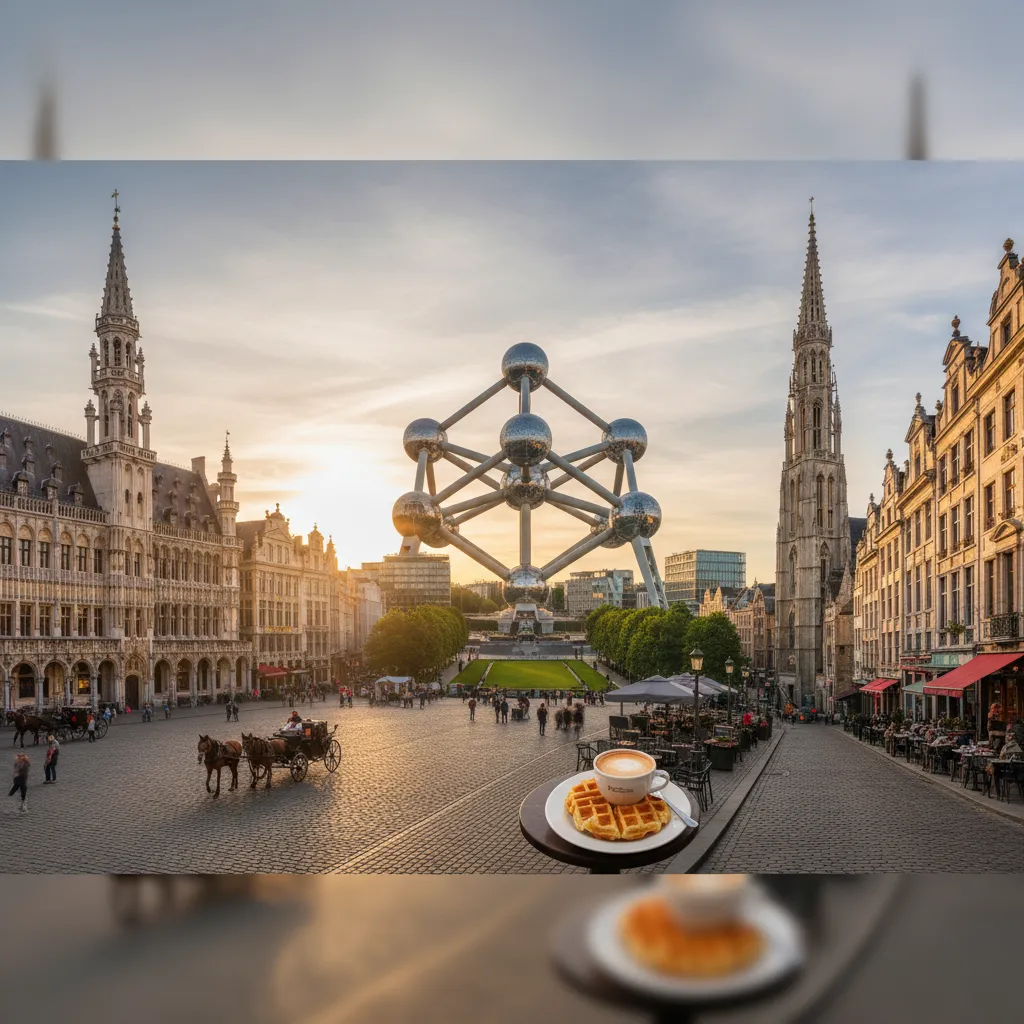
Start at the Atomium. Metro line 6 to Heysel/Heizel, 20 minutes from the centre. €18 entry for the 1958 World’s Fair steel structure, nine 18-metre spheres connected by escalators and elevators, 102 metres tall, designed to look like the iron crystal. Four spheres are open with exhibits about the 1958 Expo, modern design, and temporary art shows. The top sphere has a panoramic restaurant and a 360-degree viewing area. Budget 1.5 hours. [Source: Atomium official]
If you are visiting with kids, the Mini-Europe park right next door (€18.50 standalone, €28 combined with Atomium) shows 350 miniature versions of European landmarks. Kitschy-fun.
Return by metro to the centre for an early lunch.
Afternoon (13:00 – 18:00)
Lunch: Fin de Siècle (Rue des Chartreux 9). An unpretentious Brussels bistro with hearty Belgian classics (stoemp, carbonade flamande) at €14–22. No reservations, short wait. Or La Quincaillerie (Rue du Page 45, Ixelles) for upscale brasserie in a former 19th-century hardware store with beautiful tile work, mains €22–38.
After lunch, the Art Nouveau trail. Brussels is the birthplace of Art Nouveau, Victor Horta designed the first fully Art Nouveau house in 1893. The style spread from here to Paris, Barcelona, and Vienna.
- Horta Museum (Rue Américaine 27, Saint-Gilles, €12). Horta’s own house, preserved exactly. The curved iron-and-glass interior is the purest Art Nouveau ensemble you will see anywhere. Tickets must be booked online, walk-ups not accepted. Budget 45 minutes. [Source: Horta Museum]
- Walk the surrounding Saint-Gilles streets for 5+ other Horta houses (Hôtel Tassel, Hôtel Solvay, Hôtel van Eetvelde, all exterior-only viewing, buildings still private).
- Maison Autrique (Chaussée de Haecht 266, Schaerbeek, €7), an earlier Horta house from 1893 that is often calmer than the main museum.
Alternative afternoon: Cinquantenaire Park (metro Merode or Schuman), the 1880 Belgian independence 50-year jubilee park with a Triumphal Arch and three museums inside (Military Museum free, Art & History €10, Autoworld €15 car museum). Big open green space and the European Parliament is nearby.
Evening (19:00 – 22:30)
Dinner: Bia Mara (Rue du Marché aux Herbes 41) for fish and chips with Belgian twists (their signature is the Dutch cod with saffron-mint yogurt, €18). Or In ‘t Spinnekopke (Place du Jardin aux Fleurs 1), a 1762 tavern serving classic Brussels cuisine with 80+ Belgian beers. Mains €18–28.
After dinner, head to Place du Jeu de Balle (Marolles neighbourhood) for the flea market atmosphere even after the market closes. The surrounding streets (Rue Blaes, Rue Haute) have pop-up galleries, second-hand shops, and several of the best traditional Brussels cafés like La Brocante (Rue Blaes 170) and De Skieven Architek (Place du Jeu de Balle).
For late night, Bonnefooi (Rue des Pierres 8) is a cozy music bar with DJs after 11pm.
Day 3: Bruges Day Trip, or the Quiet Brussels
Morning (8:30 – 14:00), Option A: Bruges Day Trip
Bruges (Brugge in Flemish) is 55 minutes direct from Brussels-Centraal (€16.80 one way, every 30 min). The medieval town is the biggest day trip from Brussels for most tourists. Start early (8am train) to beat the day-trip coaches.
In Bruges: walk the Markt and Burg squares, climb the Belfry (€15, 366 steps), take a canal boat (€12), visit the Basilica of the Holy Blood (€6 for the chapel), eat moules and drink a Belgian beer. The 17th-century brewery De Halve Maan (Walplein 26, €15 tour) does a classic Bruges brewery tour with a rooftop view. Back in Brussels for a late lunch.
Morning (8:30 – 14:00), Option B: Calm Brussels
Start at Parc du Cinquantenaire for a morning walk. Continue to the Autoworld car museum (€15, 350 vintage cars from 1886) or the Royal Museum of Art and History (€10, Egyptian mummies and Belgian applied arts).
Walk through the European Quarter to see the Berlaymont (European Commission HQ), the European Parliament visitor centre (Parlamentarium, free, interactive and excellent), and the House of European History museum (free, 90 minutes).
Afternoon (14:00 – 18:00)
Lunch: Bebok (Place Jourdan 5) is a modern Belgian restaurant with seasonal menus, mains €22–32. Or the classic Maison Antoine on Place Jourdan, the fries institution since 1948 that claims to make the best frites in Brussels. A cone of frites with sauce is €5.50.
Spend the afternoon on one of:
- MIMA (Millennium Iconoclast Museum of Art), Quai du Hainaut 41, €11. Contemporary counter-culture art on the canal. 90 minutes.
- Musée des Égouts (Sewer Museum), Pavillon d’Octroi de la Porte d’Anderlecht, €8. Yes, Brussels has a sewer museum. Smaller, weirder, and genuinely fascinating. 45 minutes.
- Train World (Place Princesse Elisabeth 5, Schaerbeek, €14), converted 1887 railway depot with Belgian historic trains. Impressive interior, 2 hours.
- Choco-Story Brussels (Rue de la Tête d’Or 9–11, €12), chocolate museum with tastings. 75 minutes.
Or just walk the Quartier des Marolles, Brussels’ working-class district with flea markets, thrift shops, old cafés, and the epic Palace of Justice on the hill above (currently covered in scaffolding as it has been since 1984, the scaffolding has its own fan club).
Evening (18:30 – 22:30)
Last dinner: Comme Chez Soi (Place Rouppe 23), 2 Michelin stars, lunch menu from €75 (cheaper than dinner), dinner tasting from €180. The most historic high-end restaurant in Brussels, Art Nouveau interior. Book 3 weeks ahead.
For mortal prices, Les Brigittines (Place de la Chapelle 5) does excellent French-Belgian bistro cooking in a former church refectory at €26–42 per main. Book a week ahead.
For a real-Brussels last dinner, La Manufacture (Rue Notre Dame du Sommeil 12–20) serves modern Brussels food in a converted leather factory at €22–32 per main.
End the trip with one last beer at Moeder Lambic Fontainas (Place Fontainas 8), the best craft beer bar in Brussels with 40+ Belgian taps. A draft Saison Dupont is €5. Open until 2am.
Compare flights home on Aviasales, 200+ airlines in one search.
Brussels 3-Day Budget Breakdown
Here is what three days in Brussels actually costs per person in 2026, based on mid-range choices:
| Category | Budget | Mid-Range | Splurge |
|---|---|---|---|
| Accommodation (3 nights) | €90–165 (hostel/Airbnb) | €240–420 (3-star hotel) | €540–960 (4-star central) |
| Food & drink (3 days) | €70–110 | €130–210 | €280–480 |
| Museums & attractions | €30–55 | €70–120 | €150–260 |
| Local transport (72h pass) | €20 | €20 | €20 or taxis €60 |
| Total per person | €210–350 | €460–770 | €990–1,720 |
Brussels is 15–20% cheaper than Amsterdam or Paris. The beer at neighbourhood cafés is €3.50–6 for a quality Belgian ale. Moules-frites with unlimited fries is €19–26. The best-value city for beer-and-food tourism in Northern Europe.
Getting Around Brussels Without a Car
Do not rent a car. Brussels is walkable in the centre and the public transport covers everything else.
STIB runs 4 metro lines, 17 tram lines, and 50+ bus routes on a single ticket. Single ticket €2.60 (€2.10 if bought via the app), 24-hour pass €8, 72-hour pass €20. The metro is fast for crossing the city but the tram network handles more routes.
Buy tickets from any metro station machine, at tram stops, or via the STIB app. Contactless bank card payment also works (tap at turnstiles).
Taxi: €2.60 start + €2.15/km inside Brussels, €3.85/km outside. Uber operates. Pidge, Heetch, and Bolt all also work. A cross-city ride is €10–18.
When to Visit Brussels in 2026
April, May: 9–18°C, flower blossoms on the Grand-Place gardens, shoulder-season prices.
June, August: 16–24°C, long days, outdoor cafés, the Brussels Jazz Festival in August, and the Brussels Flower Carpet (massive flower mosaic on Grand-Place, August 15–17, 2026, a bi-annual event).
September, October: Sweet spot. 11–18°C, crowds thin, museums less busy, sunny most days through mid-September.
November, February: Cold (2–9°C), overcast, wet. Plaisirs d’Hiver / Winter Wonders Christmas market runs late November through early January across the Grand-Place, Place Sainte-Catherine, and Marché aux Poissons. Worth a visit for the atmosphere.
Book your Brussels trip on Booking.com, Flower Carpet weekend fills up 3 months ahead.
FAQ: Brussels 3-Day Itinerary
Is 3 days enough for Brussels?
Three days is the sweet spot, one day for the centre, one for museums and Art Nouveau, one for Bruges day trip or deep Brussels. If you want to add Ghent and Antwerp as their own day trips, stretch to 5 days. If you only have 24 hours, focus on Grand-Place, Atomium, Sainte-Catherine dinner, and one beer bar.
How much does a trip to Brussels cost in 2026?
A mid-range 3-day Brussels trip costs €460–770 per person including 3-star hotel, restaurant meals, museums, and transport. Budget travellers in hostels can do it for €210–350. Brussels is 20% cheaper than Amsterdam and 25% cheaper than Paris. [Source: Budget Your Trip Brussels]
Is Brussels safe for tourists in 2026?
Brussels has higher petty-crime rates than other Western European capitals, pickpocketing at Brussels-Midi station and the metro is a real issue, particularly on line 1 between the centre and the North Station. Avoid certain parts of Molenbeek and Anderlecht at night as a visitor. The Grand-Place and European Quarter are safe at all hours. Keep bags in front of you on crowded metro.
Do I need to learn French or Dutch to visit Brussels?
No. Brussels is officially bilingual (French, Dutch) but English is widely spoken in the tourist core, hotels, restaurants, and museums. Signs are often in three languages. French is dominant in practice in most central areas; basic bonjour / merci / au revoir is appreciated. Do not worry about Dutch, Brussels is roughly 80% French-speaking in usage despite being officially bilingual.
What food is Brussels known for?
Brussels’ classics are moules-frites (mussels and fries, Belgian national dish), carbonade flamande (beef stew with beer), stoemp (mashed potato with vegetable variations), waterzooi (Flemish chicken or fish stew), brusselsse wafel (Brussels waffle, rectangular and light), speculoos (spiced biscuits), and chocolate from the proper chocolatiers (Pierre Marcolini, Mary, Neuhaus). Beer is essential, Belgium has 1,500+ distinct beers, and Trappist abbey beers (Chimay, Rochefort, Westmalle, Orval) are a subset you cannot find made to the same tradition anywhere else.
Is Bruges better than Brussels?
Different, not better. Bruges is medieval and compact, a living postcard. Brussels is bigger, more urban, with better museums, food, and beer variety. A first-time Belgium visitor should do both: 2–3 days Brussels, 1–2 days Bruges. If you are 24 hours in Belgium, pick Bruges for the photos or Brussels for the food and beer, both are legitimate choices.
Is the Brussels Card worth it?
The Brussels Card (24h €36 / 48h €46 / 72h €55) covers 49 museums plus an audio guide, and add-on transport (€11 extra per day) or hop-on-hop-off bus (€10 extra). Break-even is 3 museums per day. Worth it if you plan heavy museum visits; not worth it if you lean toward walking, eating, and Art Nouveau house exteriors.
FAQ
Why trust this information?
Profiles follow a quality checklist and are updated when new verified data is available.
How do I request corrections?
Use the contact page to submit updates with supporting details.