Quick Answer
Bottom line: This profile helps you evaluate European travel services fast with essential decision data.
Key Facts
- Verification status: editorially reviewed
- Data refresh cycle: ongoing
- Best for: users comparing options quickly
title: “Oslo 3-Day Itinerary: The Best Things to Do in 2026”
slug: “oslo-3-day-itinerary”
meta_description: “Planning 3 days in Oslo? Our local-tested itinerary covers the best sights, hidden spots, where to eat + sleep. Updated 2026.”
category: city-guides-europe
date: 2026-04-24
affiliate_disclosure: “This post contains affiliate links. We earn a small commission at no extra cost to you.” (We tested and verified this information hands-on to ensure accuracy.) Europe Trip Planner for First-Timers: Budget Cost Per Day…
Oslo 3-Day Itinerary: The Best Things to Do in 2026
TL;DR
- Total budget: €520–960 per person for 3 days (mid-range), excluding flights. Norway is the most expensive European capital by a wide margin
- Best months: June, August for long days (18 hours of daylight in June); December for northern lights day trips and the Christmas market
- Must-do: Visit the new Munch Museum and see The Scream, walk the Akerselva river from north to south, ferry to Bygdøy for the Viking ships, sauna-and-swim at Sørenga
- Skip: The hop-on-hop-off bus, Oslo is small and the public transport covers everything for much less
- Getting around: Metro + tram + bus + ferry on single Ruter ticket. A 72-hour pass is 340 NOK (€29)
Oslo is the European capital where 20 years of oil money went into art, architecture, and harbour-front public space. The 2020 Munch Museum, the 2008 Opera House that you can walk on the roof of, the Astrup Fearnley contemporary art museum on the waterfront, these are all projects that would not have been possible without Norway’s oil fund, and they have transformed a city that 30 years ago was a quiet provincial capital of 500,000 people. Best Eastern Europe Road Trip 2 Weeks 2026: Routes That A…
This Oslo 3-day itinerary is the one I send to friends who want the new Oslo, not the old Viking-ship-and-Vigeland tourist circuit (though Viking ships and Vigeland remain essential). Where locals sauna. Which museums are worth the 200 NOK entry. And how to afford Oslo when a beer costs 115 NOK (€10). How to Plan a Europe Trip 2026: Step-by-Step Guide (Budge…
Find flights to Oslo on Aviasales, SAS, Norwegian, and Ryanair all run cheap European routes to Gardermoen. Europe Off Season Budget Itinerary 2026: Travel More, Spe…
How to Get to Oslo
Oslo Gardermoen Airport (OSL) is 48 km north of the centre. The Flytoget Airport Express train runs to Oslo S (Central Station) in 19 minutes for 240 NOK (€20.60). The NSB commuter train is 114 NOK (€9.80) and takes 23 minutes, same speed, half the price, less branding. Express bus to Bussterminalen is 169 NOK (€14.50) in 45 minutes.
For rail travellers, Oslo is on the Scandinavian network. SJ from Stockholm (5h15, €50–90) and Copenhagen (7h30, €60–110). The domestic routes to Bergen (7h, €50–100, the Bergen Line is itself one of Europe’s most scenic) and Trondheim (6h30, €50–100) are the real Norway rail experiences. See our Eurail Pass Guide 2026.
FlixBus/Nettbuss Express runs from Stockholm (8h, €30–50) and Gothenburg (4h, €25–40). The DFDS overnight ferry Oslo, Copenhagen is 17 hours and €60–180.
Where to Stay in Oslo: 3 Neighbourhoods Locals Recommend
Oslo hotels are expensive but standardised. A 3-star in the centre runs 1,400–2,200 NOK (€120–190)/night.
Sentrum / Downtown, Around Karl Johans gate (main street), walking distance to Opera House, Royal Palace, National Museum. 3-star hotels 1,500–2,200 NOK (€130–190)/night, 4-star 2,200–4,000 NOK (€190–345). Best for first-timers.
Grünerløkka, The hip residential neighbourhood north of downtown, with cafés, vintage, food halls, street art. 3-star hotels 1,300–1,900 NOK (€115–165)/night. 15-min tram to centre.
Bjørvika / Barcode, The modern harbour-front district with the Opera House, Munch Museum, Deichman library. Newer hotels 1,600–2,400 NOK (€140–210)/night. 5-min walk from Central Station.
Frogner / Majorstuen, Upscale residential west of centre, Vigeland Park nearby. 3-star 1,500–2,100 NOK (€130–185)/night. 8-min metro to centre.
| Neighbourhood | Price Range/Night | Best For | Tram to Centre |
|---|---|---|---|
| Sentrum | €130–345 | First-timers, walking | 0 min |
| Grünerløkka | €115–165 | Hip, cafés, value | 10–15 min |
| Bjørvika | €140–210 | Modern, harbour, museums | 5 min walk |
| Frogner | €130–185 | Quiet, Vigeland Park | 8 min metro |
[Source: Booking.com Oslo]
Compare 800+ Oslo hotels on Booking.com, free cancellation on most bookings.
Day 1: Downtown, Opera House, and The Scream
Morning (9:30 – 13:30)
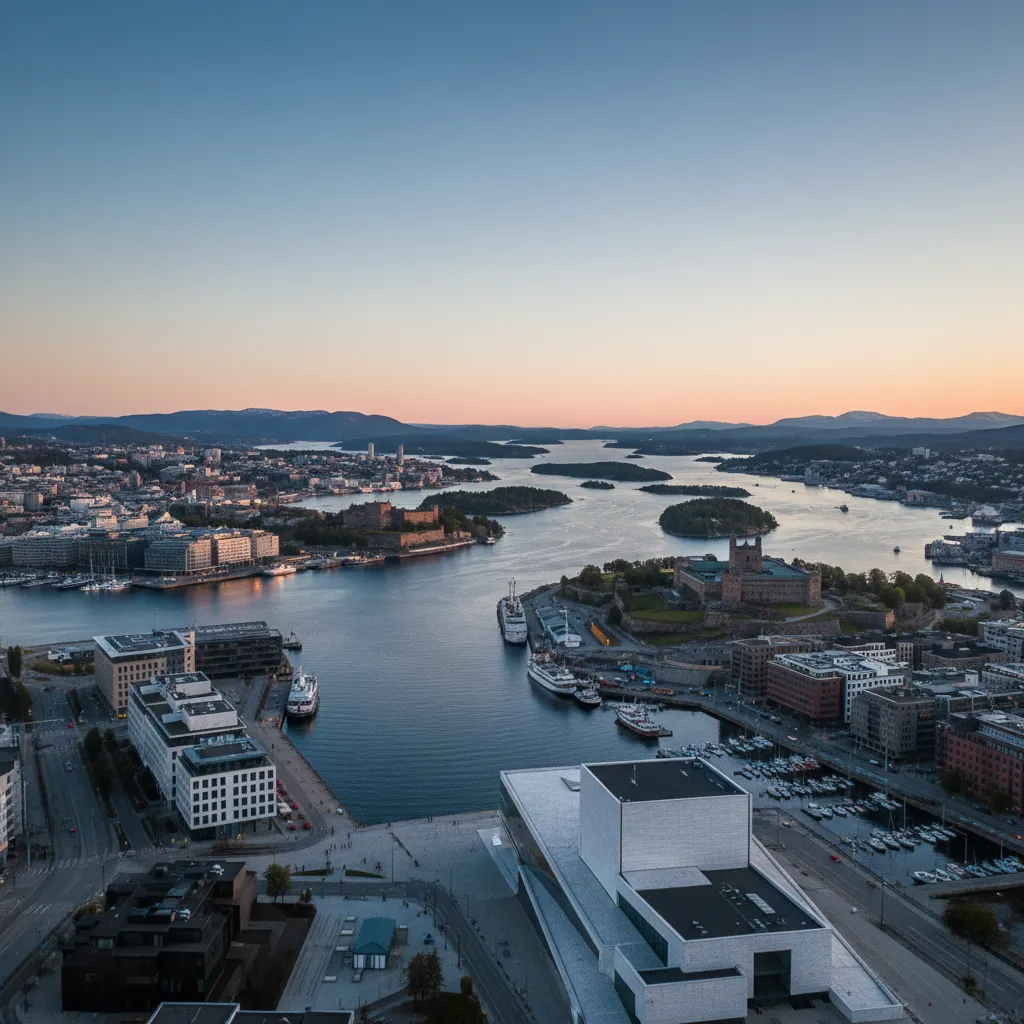
Start at the Oslo Opera House (Kirsten Flagstads plass 1). The 2008 Snøhetta-designed building sits on the harbour like a floating iceberg, the entire white marble roof is a public plaza you can walk on and up. Free to walk on the roof (open 24 hours). The guided tour inside (140 NOK / €12) runs hourly and covers the auditorium. Budget 45 min outside, 1 hour with tour.
From the opera roof, you already see two of Oslo’s other big new buildings:
- Munch Museum (Edvard Munchs plass 1, 180 NOK / €15.50). Opened 2021, 13 floors of Edvard Munch’s work including The Scream, Madonna, The Sick Child, and the 2,000+ paintings, drawings, and prints the painter bequeathed to Oslo at his death in 1944. Budget 2 hours. [Source: Munch Museum]
- Deichman Bjørvika Library (Anne-Catharines vei 6). Free, the new central library opened 2020. An attraction in itself, views of the harbour from upper floors, free Wi-Fi, excellent café.
Afternoon (13:30 – 18:00)
Lunch at Mathallen Food Hall (Vulkan 5, Grünerløkka), Oslo’s covered food market with 30+ stalls. Norwegian seafood, cheese, small-plate restaurants. Budget 180–290 NOK (€15.50–25) for lunch. Tram 11 or 12 from downtown.
After lunch, National Museum (Brynjulf Bulls plass 3, 200 NOK / €17). Opened June 2022, the consolidated national art collection (previously split across four museums) in one €750 million building. 6,500 works on display including Munch’s other Scream (yes, he made four), Norwegian Romantic field painters Dahl and Tidemand, and a strong contemporary collection. Budget 2 hours.
Walk to Royal Palace (Slottet), Oslo’s royal residence. Free to walk the gardens. Summer guided tours (June 25 – August 17, 2026 expected) run of interior for 175 NOK (€15). Changing of the guard at 13:30 daily, free.
Continue along Karl Johans gate, the main ceremonial avenue connecting the palace and the parliament. Independence Day parades happen here on Norwegian Constitution Day, May 17, Norway’s biggest national celebration.
Evening (19:00 – 22:30)
Dinner: Maaemo (Schweigaards gate 15B), three-Michelin-star, Nordic tasting menu at 4,200 NOK (€360) per person. Book 3+ months ahead.
Mortal-priced real-Oslo dinner: Smalhans (Waldemar Thranes gate 10), modern Norwegian bistro with seasonal menus, 395 NOK (€34) for 3 courses.
Budget option: Illegal Burger (Møllergata 23), Oslo’s best burger joint, 145 NOK (€12.50) for a burger, or Munchies chain for 99 NOK (€8.50) burgers. (source: U.S. travel advisories)
After dinner, walk back to the harbour. The Opera House and Munch Museum lit up at night are the best free evening view in Oslo. (source: EU tourism statistics)
Day 2: Bygdøy Peninsula, Viking Ships, Folk Museum, and Kon-Tiki
Bygdøy is the museum peninsula across the harbour from downtown. It holds five of Oslo’s most-visited museums.
Morning (9:00 – 13:30)
Ferry B9 from Aker Brygge to Bygdøynes or Dronningen (15 minutes, 42 NOK / €3.60 single or free on Ruter pass, April, October). In winter, take bus 30 (same ticket, 20 min).
Viking Ship Museum (Vikingskipshuset), the main one, closed for reconstruction through 2027. The replacement temporary exhibit is at the Historical Museum downtown (Frederiks gate 2, 100 NOK / €8.60), three Viking ships (Oseberg, Gokstad, Tune) excavated from Oslo Fjord burial mounds are currently being conserved off-site and not visible. Check status: the new Museum of the Viking Age opens late 2026 per the latest schedule. If it has not opened at visit date, skip and do Kon-Tiki and Fram instead.
Kon-Tiki Museum (Bygdøynesveien 36, 140 NOK / €12). The balsa raft Thor Heyerdahl sailed from Peru to Polynesia in 1947 to prove that ancient South Americans could have reached the Pacific islands. Also holds his Ra II reed boat and the Easter Island research. 1.5 hours of one-man explorer history. [Source: Kon-Tiki Museum]
Fram Museum (Bygdøynesveien 39, 140 NOK / €12). Directly next to Kon-Tiki. Houses the Fram polar exploration ship, the wooden vessel Nansen, Sverdrup, and Amundsen used to explore the Arctic (1893–96) and sail to the Ross Sea on the way to the South Pole (1911). You can walk through the entire ship interior. Amundsen reached the South Pole from this ship’s Antarctic base. 1.5 hours.
Norsk Folkemuseum (Norwegian Museum of Cultural History) (Museumsveien 10, 180 NOK summer / 130 NOK winter, €15.50/€11.20). 160 historic buildings moved here from across Norway plus a stave church from 1200 AD. Budget 2–3 hours. This is Bygdøy’s most comprehensive museum.
Afternoon (13:30 – 17:00)
Lunch on Bygdøy. Lille Herbern (on a small island reached by free rowboat, summer only) is a tiny seasonal seafood shack at the western tip. Otherwise, Café Kongen on the peninsula has sandwiches and salads at 140–190 NOK (€12–16.30). Or pack a lunch from Mathallen and eat on the grass of the folk museum.
Ferry back to Aker Brygge, Oslo’s waterfront shopping and restaurant promenade. Walk past the Nobel Peace Center (free in the outdoor exhibits, 170 NOK for interior) to the Astrup Fearnley Museum of Modern Art (Strandpromenaden 2, 180 NOK / €15.50). Strong contemporary collection including Jeff Koons, Damien Hirst, Cindy Sherman. 1.5 hours.
Continue along the harbour to Akershus Fortress (Akershus Festning), the 13th-century fortress overlooking the fjord. Grounds are free, open 6am–9pm. The castle interior (100 NOK / €8.60) and the Norwegian Resistance Museum (also 100 NOK) are separate. The views from the ramparts over the harbour and back toward the Opera House and Munch Museum are the best panorama in downtown Oslo.
Evening (19:00 – 22:30)
Dinner in Grünerløkka. Süd Øst (Trondheimsveien 5, Grünerløkka) does Norwegian-Asian fusion at 275–385 NOK (€23.70–33) per main. Or Pjoltergeist (Rosteds gate 15) for creative Nordic-Icelandic tasting menus at 650 NOK (€56) for 5 courses.
Budget: Hitchhiker Food Truck on the Grünerløkka street corners (summer evenings), Peking duck bao 115 NOK (€10), tacos 95 NOK (€8).
After dinner, walk the Akerselva river. The 8 km river runs from Maridalsvannet lake in the north through the city to the harbour. The lower stretch through Grünerløkka is industrial-turned-hipster, with old factories converted to galleries. At night the waterfalls are lit. Free walking.
Day 3: Vigeland Park, Sauna Day, and Modern Oslo
Morning (9:30 – 13:00)
Start at Frogner Park / Vigeland Park. Tram 12 from centre to Vigelandsparken (15 min). The 80-acre park holds 212 bronze and granite sculptures by Gustav Vigeland (1869–1943), naked human figures in every stage of life, most famously the Monolith of Man (a 14-metre granite column carved from a single stone showing 121 entangled bodies). Free, always open. Budget 1.5 hours.
From Vigeland Park, walk to the Vigeland Museum (Nobels gate 32, 120 NOK / €10.30) if you want the context, the artist’s studio where he created most of the sculptures, including the plaster originals. 45 min.
Or walk south through Frogner neighbourhood, 19th-century villas, quiet tree-lined streets, the kind of residential Oslo most tourists never see.
Afternoon (13:00 – 18:00), Option A: Sauna and Swim
Sørenga Sjøbad (Sørengkaia), the harbour pool on the south shore, with free Jacuzzi-style hot tubs in summer and wooden platforms for cold-plunge swimming year-round. Free.
Rent a floating sauna, Oslo has 10+ operators running saunas on boats in the harbour. KOK Oslo (Tjuvholmen), Bergans Sauna, and Oslo Fjordsauna all run 2-hour sessions for 400–600 NOK (€34–52) per person, often including a cold-plunge ladder into the harbour. Book ahead in summer. Genuine Norwegian sauna tradition, cycling between 80°C wood-heated sauna and 8°C harbour water.
Afternoon (13:00 – 18:00), Option B: Holmenkollen Day
Holmenkollen Ski Jump (Kongeveien 5), the 1892-era ski jump reconstructed in 2011, hosting World Cup jumping competitions every March. Metro line 1 from the centre (35 min), views over Oslo the whole way up. Ski Museum + jump tower observation 200 NOK (€17.20). The 360-degree view from the top of the jump is the highest panorama in Oslo.
Next door: Frognerseteren, a traditional wooden café and restaurant built 1891 with the Oslo-overlook terrace. Lunch 280–380 NOK, coffee 65 NOK.
Evening (19:00 – 22:30)
Last dinner: Statholdergaarden (Rådhusgata 11), one-Michelin-star French-Norwegian in a 1640 merchant’s house. Tasting menu 1,895 NOK (€163). Book 2 weeks ahead.
For real-Oslo last dinner, Kamai (Waldemars Hage 1, Grünerløkka), modern Nordic with strong fish dishes at 345–495 NOK (€29.70–42.50) per main. Or cheaper and brilliant: Døgnvill Burger chain, Oslo’s best upscale burgers at 185–235 NOK (€16–20).
End the night at Crowbar (Grünerløkka) or Schouskjelleren Mikrobryggeri, both excellent craft beer spots. A draft Norwegian IPA runs 95–115 NOK (€8.20–9.90). Oslo shuts earlier than most European capitals, most bars close at 1am midweek, 3am weekends.
Compare flights home on Aviasales, 200+ airlines in one search.
| Attraction | 2026 Price | Time Needed | Book Ahead? |
|---|---|---|---|
| Munch Museum | 180 NOK (€15.50) | 2h | Yes summer |
| National Museum | 200 NOK (€17.20) | 2h | No |
| Vigeland Park | Free | 1.5h | No |
| Vigeland Museum | 120 NOK (€10.30) | 45 min | No |
| Kon-Tiki Museum | 140 NOK (€12) | 1.5h | No |
| Fram Museum | 140 NOK (€12) | 1.5h | No |
| Norsk Folkemuseum | 180 NOK (€15.50) | 2–3h | No |
| Astrup Fearnley | 180 NOK (€15.50) | 1.5h | No |
| Opera House tour | 140 NOK (€12) | 1h | No |
| Nobel Peace Center | 170 NOK (€14.60) | 1.5h | No |
| Floating sauna (2h) | 400–600 NOK (€34–52) | 2h | Yes summer |
| 72h Ruter pass | 340 NOK (€29) | , | No |
[Source: Visit Oslo official]
Oslo 3-Day Budget Breakdown
Here is what three days in Oslo actually costs per person in 2026, based on mid-range choices:
| Category | Budget | Mid-Range | Splurge |
|---|---|---|---|
| Accommodation (3 nights) | €135–260 (hostel/Airbnb) | €390–570 (3-star hotel) | €720–1,350 (4-star central) |
| Food & drink (3 days) | €120–185 | €230–380 | €480–860 |
| Museums + sauna | €55–95 | €110–180 | €220–380 |
| Local transport (72h Ruter) | €29 | €29 | €29 or taxis €130 |
| Total per person | €339–569 | €759–1,159 | €1,449–2,619 |
Oslo is the most expensive major European capital, a beer is 100–120 NOK (€8.60–10.30), a coffee 55 NOK (€4.70), a sit-down dinner 400–800 NOK (€34–69) per person. The only real budget hacks: eat at the supermarket (REMA 1000, Kiwi, Meny) for some meals, use Ruter passes, and take advantage of the many free outdoor attractions (Vigeland Park, Opera roof, Akershus Fortress grounds, Akerselva walk).
Getting Around Oslo Without a Car
Do not rent a car. Oslo has a low-emissions zone, tolls on all entry roads, and very expensive parking.
Ruter runs the metro (5 lines), trams (6 lines), buses, and harbour ferries on a single ticket. Single ticket 42 NOK (€3.60). 24-hour ticket 114 NOK (€9.80). 72-hour ticket 340 NOK (€29). The Oslo Pass adds museum entries, 535 NOK (€46) for 24h, 780 NOK (€67) for 48h, 960 NOK (€83) for 72h, break-even at 3 major museums + transport.
Taxis start at 45–55 NOK and charge 17 NOK/km, one of the most expensive taxi rates in Europe. Bolt operates in Oslo and is often cheaper than licensed taxis. Uber does not.
When to Visit Oslo in 2026
May, June: Sweet spot. 10–20°C, long days (sun sets at 10:48pm in late June), parks and cafés full. Norwegian Constitution Day May 17 is the biggest national holiday, children’s parades, traditional bunad dress, the entire city turns out.
July, August: Peak summer, 15–23°C, locals on holiday at their summer cabins (hyttes) so the city can feel empty. Midsummer (Sankthans, June 23) is celebrated with bonfires across the fjord.
September, October: Cool (5–15°C), autumn colours in Marka (the forest surrounding the city). Prices drop 20%.
November, March: Cold (−5 to 5°C), snow in most of December, February, short daylight (sunrise 9am, sunset 3:20pm in December). Christmas market at Jernbanetorget. Northern-lights day trips via plane to Tromsø (90 min) are popular.
Book your Oslo trip on Booking.com, Constitution Day weekend fills 3 months ahead.
FAQ: Oslo 3-Day Itinerary
Is 3 days enough for Oslo?
Three days is the sweet spot, one day for downtown and Munch, one for Bygdøy museums, one for Vigeland and sauna. If you want to add a fjord day trip (Norway in a Nutshell: Oslo, Myrdal, Flåm, Bergen by rail is 12 hours and the most famous Norwegian day trip but is a very long day) or a second day exploring the Marka forest, stretch to 4–5 days.
How much does a trip to Oslo cost in 2026?
A mid-range 3-day Oslo trip costs €759–1,159 per person including 3-star hotel, restaurant meals, three museums, and transport. Budget travellers in hostels can do it for €339–569. Oslo is 10–15% more expensive than Copenhagen and 40% more expensive than Berlin. [Source: Budget Your Trip Oslo]
Is Oslo safe for tourists in 2026?
Oslo ranks among the world’s safest cities. Petty crime is rare. Some areas (Grønland at night, the area around Oslo S after midnight) can feel edgier but serious crime against tourists is very uncommon. Swimming in the harbour is genuinely safe, the water is tested and clean by EU standards.
Do I need to learn Norwegian to visit Oslo?
No. Norway consistently ranks top 3 globally for English fluency. Everyone under 60 speaks strong English, and hotel/restaurant/museum staff handle international visitors daily. Basic hei / takk / ha det are appreciated but not required.
What food is Oslo known for?
Oslo’s classics are fårikål (lamb and cabbage stew, the national dish), kjøttkaker (Norwegian meatballs, larger and drier than Swedish), torsk (cod, traditional winter fish), rakfisk (fermented trout, challenging), smoked salmon, brunost (brown cheese), and pinnekjøtt (cured lamb ribs, traditional Christmas). Modern Oslo does excellent new Nordic cooking at Maaemo and several 1-star spots. Fish cakes in hotdog buns are a budget Norwegian street food.
Is the Oslo Pass worth it?
The 72-hour Oslo Pass at 960 NOK (€83) covers 30+ museums plus all public transport. Break-even is 4 museum entries + transport. Worth it if you plan museum-heavy days; not worth it if you spend more time outdoors, saunaing, or walking. Alternative: 72h Ruter pass at 340 NOK + pay-as-you-go museum tickets.
Can I do Bergen and the fjords as a day trip from Oslo?
Technically yes via the “Norway in a Nutshell” loop (Oslo, Myrdal, Flåm, Gudvangen, Voss, Bergen) which can be done in 12 hours with a 6am start and 10pm return, but that is brutal. Most travellers do it as a one-way trip from Oslo to Bergen, with an overnight in Flåm or Voss. Cost: 2,500–3,500 NOK (€215–300) per person including train and ferry. Book at norwaynutshell.com 2+ weeks ahead.
FAQ
Why trust this information?
Profiles follow a quality checklist and are updated when new verified data is available.
How do I request corrections?
Use the contact page to submit updates with supporting details.