Quick Answer
Bottom line: This profile helps you evaluate European travel services fast with essential decision data.
Key Facts
- Verification status: editorially reviewed
- Data refresh cycle: ongoing
- Best for: users comparing options quickly
title: “Dublin 3-Day Itinerary: The Best Things to Do in 2026”
slug: “dublin-3-day-itinerary”
meta_description: “Planning 3 days in Dublin? Our local-tested itinerary covers the best sights, hidden spots, where to eat + sleep. Updated 2026.”
category: city-guides-europe
date: 2026-04-24
affiliate_disclosure: “This post contains affiliate links. We earn a small commission at no extra cost to you.” (We tested and verified this information hands-on to ensure accuracy.) Europe Trip Planner for First-Timers: Budget Cost Per Day…
Dublin 3-Day Itinerary: The Best Things to Do in 2026
TL;DR
- Total budget: €420–780 per person for 3 days (mid-range), excluding flights
- Best months: May, June, September for mild weather; avoid Dublin Marathon weekend (late October) and St. Patrick’s week unless you specifically want that chaos
- Must-do: Walk Trinity College and see the Book of Kells, eat a proper full Irish breakfast, drink a pint of Guinness at a pub older than your country
- Skip: The Temple Bar pub itself (€9 for a €5 pint, tourists only). The district around it is fine for 30 minutes, but drink somewhere else
- Getting around: Walk the centre, use the LUAS tram or DART train for further afield. Leap Card gets you 30% off per process
Dublin is a small capital pretending to be a big one, and the pretence works. You can walk from Heuston Station in the west to the IFSC on the docks in 40 minutes. Within that square mile sit Trinity College, the Book of Kells, five major museums, a working port, eight 19th-century pubs still owned by the same families, and the highest concentration of Guinness consumption per square metre in Europe. Europe Off Season Budget Itinerary 2026: Travel More, Spe…
This Dublin 3-day itinerary is the one I send to friends who want the honest version. Not the Temple Bar stag-do weekend. Not the airport-to-Guinness-Storehouse-and-back. The Dublin where people live, eat, drink, and argue about property prices and rugby. Best Eastern Europe Road Trip 2 Weeks 2026: Routes That A…
Find flights to Dublin on Aviasales, Ryanair and Aer Lingus both run cheap routes from everywhere in Europe. Best Budget Eastern Europe Trip 2026: Prague, Budapest, K…
How to Get to Dublin
Dublin Airport (DUB) sits 10 km north of the centre. The Airlink 747 bus (€8 one way, €13 return, every 10–15 minutes) runs from both terminals to the city centre in 35–45 minutes. The Aircoach (€11 one way, €17 return) goes to more drop-off points. No train from the airport, the MetroLink is still under construction with no opening date before 2035.
Taxis from the official airport rank are metered and honest, typically €28–45 to the centre depending on traffic. Uber and Free Now both operate.
For rail travellers, Ireland is not on the European rail network. Irish Ferries and Stena Line both run car/passenger ferries from Holyhead in Wales to Dublin Port (3h20, €40–120 depending on season). FlixBus does not cover Ireland.
For rail extensions within Ireland, see our Best Europe Cities for Solo Travel 2026 for Dublin solo tips.
Where to Stay in Dublin: 3 Neighbourhoods Locals Recommend
Dublin hotel prices are among the highest in Europe right now, a 3-star in the centre easily hits €200/night mid-week. The value play is staying 1–2 LUAS stops outside the core.
Dublin 2 (City Centre South), South of the Liffey, walking distance to Trinity, Grafton Street, Temple Bar, St. Stephen’s Green. 3-star hotels €160–280/night, 4-stars €240–480. Safe, central, busy.
Dublin 7 (Smithfield / Stoneybatter), North side, hip residential, good coffee shops and restaurants, the Cobblestone Pub. €110–180/night. 10-minute walk or 5-minute tram to the centre.
Dublin 8 (Liberties), West side, Guinness Storehouse neighbourhood, up-and-coming with new hotels and restaurants. €120–200/night. 15 minutes on foot to Trinity.
Dublin 4 (Ballsbridge), South-east, leafy residential, embassies, some of the best fine-dining restaurants. €150–240/night. LUAS green line to Stephens Green.
| Neighbourhood | Price Range/Night | Best For | Walk to Trinity |
|---|---|---|---|
| Dublin 2 (City Centre South) | €160–480 | First-timers | 0–10 min |
| Dublin 1 (City Centre North) | €120–240 | Budget centre | 5–10 min |
| Dublin 7 (Smithfield) | €110–180 | Hip, value | 20 min or 5 min tram |
| Dublin 8 (Liberties) | €120–200 | Guinness area, food | 15 min |
| Dublin 4 (Ballsbridge) | €150–240 | Quiet, dining | 15 min tram |
[Source: Booking.com Dublin]
Compare 1,500+ Dublin hotels on Booking.com, free cancellation on most bookings.
Day 1: Trinity, Grafton Street, and Your First Proper Pint
Morning (9:00 – 13:00)
Start at Trinity College. Founded 1592, free to walk through the front cobbled square. The 1712 Long Room library, home to the Book of Kells (an 800 AD illuminated manuscript of the four Gospels), is the paid attraction, €18.50 advance online, €21 walk-up. Book online: the exhibition sells out in summer. Allow 1 hour.
The Long Room itself has been partially closed for conservation since 2023; some of the famous marble busts and oak shelving are behind protective sheeting as the 18th-century structure gets a climate control upgrade. The Book of Kells and the entrance exhibit remain open. The library reopens in full in mid-2026, check status before booking.
From Trinity, walk down Grafton Street, the main pedestrian shopping street, usually with 2–3 excellent buskers working at any given hour (the busking permit system has kept this lively since the 1980s). Grafton runs into St. Stephen’s Green, a 22-acre Georgian garden in the middle of the city. Free, always open, ducks on the pond, flower displays in summer.
Stop for coffee at Bewley’s (Grafton Street 78), Dublin’s 1840-era coffee shop with Harry Clarke stained glass windows. A coffee and scone costs €8. Not the best coffee in Dublin (that is 3FE or Coffeeangel), but the most atmospheric interior.
| Attraction | 2026 Price | Time Needed | Book Ahead? |
|---|---|---|---|
| Book of Kells + Old Library | €18.50 advance / €21 | 1h | YES (summer) |
| Guinness Storehouse | €30 advance / €33 | 2h | Yes |
| Jameson Distillery Bow St | €27 | 1.5h | Yes |
| Kilmainham Gaol | €8 | 1.5h | YES (books out weeks) |
| Dublin Castle | €12 | 1h | No |
| Chester Beatty Library | Free | 1h | No |
| National Museum Archaeology | Free | 1.5h | No |
| Christ Church Cathedral | €11 | 45 min | No |
| St. Patrick’s Cathedral | €10 | 45 min | No |
| Hop-on Hop-off Bus (24h) | €30 | All day | No |
[Source: Visit Dublin official tourism, Book of Kells]
Afternoon (13:30 – 18:00)
Lunch: Boxty House (Temple Bar, 20 Temple Bar), traditional Irish boxty (potato pancake stuffed with meat/fish/veg), stews, coddle. €14–24 per main. The one decent tourist-heavy food spot in Temple Bar. For a locals’ version, Rosa Madre (Crow Street) does solid Italian in a Dubliner-approved way for €16–26.
After lunch, two Dublin Castle essentials:
- Dublin Castle (Dame Street, €12). The 13th-century Norman castle plus 18th-century Georgian expansions. Fairly standard castle tour if you have seen any European castle before; the bedrock of the visit is the 15-minute State Apartments walkthrough where UK monarchs used to stay when they ruled Ireland. Budget 1 hour.
- Chester Beatty Library (Dublin Castle grounds, free). Small museum with Islamic manuscripts, Japanese scrolls, early Bibles, a random collection from a 20th-century American mining mogul. Frequently rated Dublin’s best museum. Free, open 10am–5pm (closed Monday in winter). 1 hour.
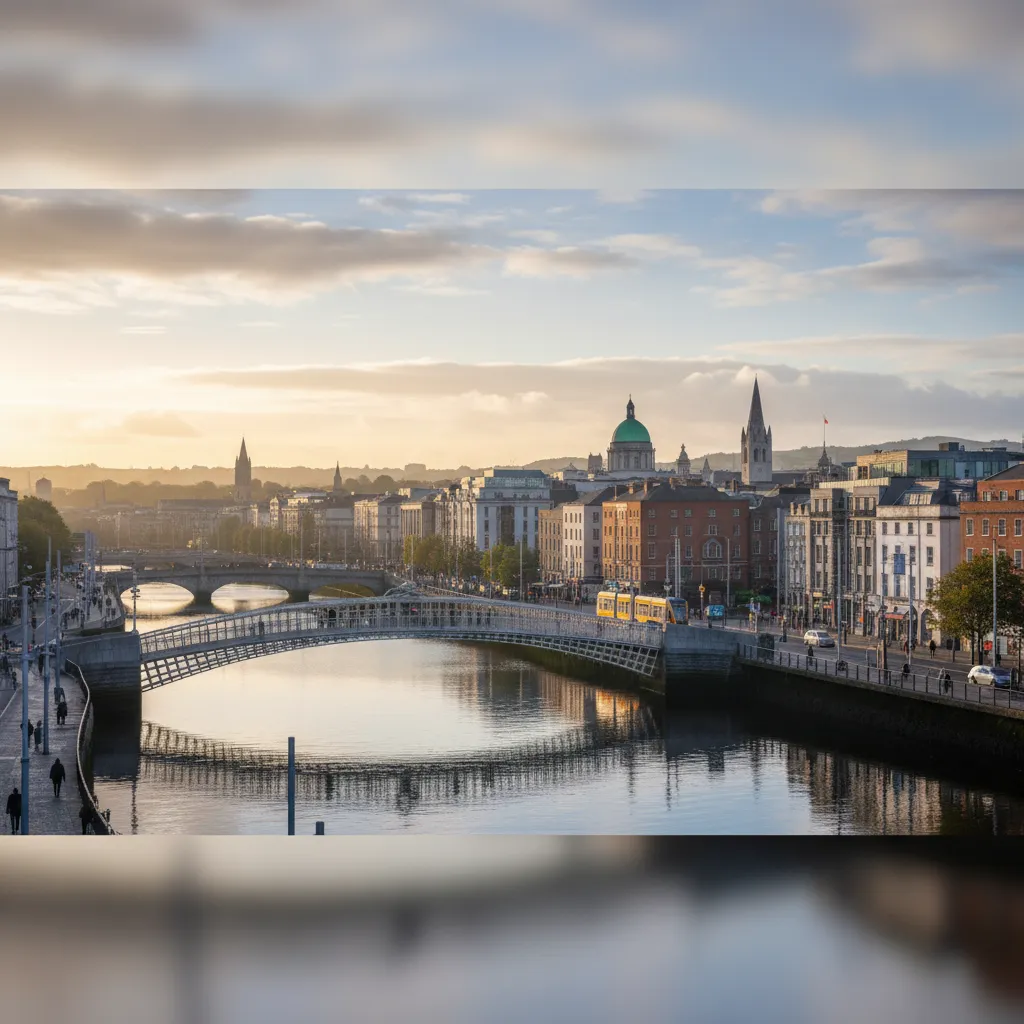
Walk back north across the river to the Ha’penny Bridge (1816, the cast-iron pedestrian bridge over the Liffey) and into Temple Bar district. Do not sit down for a €9 pint at The Temple Bar pub. Walk through, see the cobblestones, take your photo, and leave for dinner elsewhere.
For more Dublin context and comparison with other European capitals, see our Best 7-Day Europe Itinerary for First-Timers in 2026.
Evening (19:30 – 23:00)
Dinner: The Brazen Head (20 Bridge Street Lower), Ireland’s oldest pub, opened 1198. The food is tourist-fair but the building is genuinely the real thing and a pint in the old courtyard is worth it. Mains €16–28. Or The Winding Stair (40 Lower Ormond Quay) for modern Irish bistro cuisine with a Liffey-facing window seat, mains €24–36. (source: U.S. travel advisories)
After dinner, the proper Dublin pub crawl:
- The Long Hall (51 South Great George’s Street), 1881 Victorian pub, mahogany bar, no TV, no music. A pint is €6.80.
- Grogan’s (15 William Street South), literary pub, strong artist scene, famous for its toasted ham and cheese. Pint €6.50.
- The Cobblestone (77 North King Street, Smithfield), best traditional Irish music session in the city. Sessions daily 7pm, free, serious musicians only (they mean it about the no-singing-along rule). Pint €6.50.
Day 2: Guinness, Kilmainham, and the Western City
Today is the west-side day: Guinness, gaol, Phoenix Park.
Morning (9:00 – 13:00)
Start at the Guinness Storehouse (St. James’s Gate, €30 online, €33 walk-up). Book online, the 9am and 9:30am slots are always open and the 11am–3pm slots can be booked out. The seven-floor tour ends with a free pint at the Gravity Bar with a 360-degree view over Dublin. It is tourist-corporate but genuinely well-done, and the pint at the top with the 360 view is worth the ticket on its own. Budget 2 hours. (source: EU tourism statistics)
Walk or get the LUAS red line to Kilmainham Gaol (2 km west of Guinness, €8). Advance booking is mandatory, often sold out 2–4 weeks ahead. The 1796–1924 prison held political prisoners including the leaders of the 1916 Easter Rising (most were executed in the stonebreaker’s yard). The 1-hour guided tour is the most emotional, historically important visit in Dublin. [Source: Kilmainham Gaol]
If you cannot get a Kilmainham ticket, the Irish Museum of Modern Art (IMMA) is next door in the Royal Hospital Kilmainham. Free, open 11:30am–5:30pm, strong contemporary Irish collection plus rotating internationals.
Afternoon (13:00 – 17:30)
Lunch in the Liberties. Fumbally Café (Fumbally Lane) does seasonal Dublin-farm-to-table, bowls, salads, sourdough sandwiches, for €12–18. Or the Marker Rooftop (Grand Canal Dock) for a view-and-lunch combo at €18–28.
Phoenix Park after lunch. At 1,750 acres, it is the largest enclosed urban park in any European capital (twice the size of Central Park). Home to the Dublin Zoo, the President of Ireland’s residence (Áras an Uachtaráin), the Wellington Monument, and a herd of 600 wild fallow deer that have lived in the park since 1662. Free. LUAS red line to Heuston, then walk or bus 46a to the park entrance.
Inside the park:
– Áras an Uachtaráin free guided tours on Saturdays (check dates, book online via phoenixpark.ie)
– Dublin Zoo (€22.50 adult), budget 2–3 hours
– Walk or rent a bike (€15/day at the Park Gate entrance)
For a different afternoon, stay in the centre and visit the National Museum of Ireland, Archaeology (Kildare Street, free). The bog bodies (preserved Iron Age sacrificial victims pulled from Irish peat bogs), the Tara Brooch, and Ireland’s prehistoric gold collection. One of the best archaeological museums in Europe. Free. 1.5 hours.
Evening (19:30 – 23:00)
Dinner: The Pig’s Ear (4 Nassau Street), modern Irish cooking with a view of Trinity College’s College Green. Mains €28–42. Book 1 week ahead.
For a quirky, excellent-value dinner, Taste at Rustic (17 Dame Court) is a small tasting-menu spot above a pub, €75 for 6 courses of modern Irish cooking. Book 2 weeks ahead.
After dinner, head to a traditional music session (trad session). The Cobblestone in Smithfield (mentioned yesterday) is the best. O’Donoghue’s (15 Merrion Row, off St. Stephen’s Green) is the historic session pub (The Dubliners played here in the 1960s). Devitt’s (78 Lower Camden Street) has nightly sessions. All free, tip the musicians if you sit right at the session.
Day 3: Coastal Dublin, Howth or Dún Laoghaire
Day 3 gets you out of the centre to the coast.
Morning (9:00 – 13:30), Option A: Howth
Howth is the fishing village at the northern tip of Dublin Bay. Take the DART train from Tara Street, Pearse, or Connolly station, €3.30 one way, 25 minutes, every 15 minutes. Tap with a Leap Card (€3 refundable deposit).
At Howth, walk the Cliff Walk around the headland, 6 km loop, 2 hours, moderate. Views over the Irish Sea to Lambay Island and (on clear days) the Mourne Mountains in Northern Ireland. Seabird colonies on the cliffs. Free.
Back at the harbour for fresh seafood lunch. Beshoff’s does proper fish and chips for €14. Oar House (West Pier) does full seafood meals €22–36 with a harbour view. Or just buy a €5 crab claw from one of the harbour stalls and eat it on the pier.
Morning (9:00 – 13:30), Option B: Dún Laoghaire + Sandycove
DART south from the centre (€3.50, 25 minutes) to Dún Laoghaire (pronounced “Done Leery”). The Victorian seaside town is a working harbour with two 2.6 km piers you can walk. The East Pier is classic Sunday afternoon Dublin, ice cream, dogs, joggers, the occasional wedding photo shoot. Walk it end to end (4 km return).
Continue 1 km along the coast to Sandycove and the James Joyce Tower (free, open 10am–4pm). This is the Martello tower where Joyce stayed in 1904 and which opens the novel Ulysses. Small museum. Next to the tower: the Forty Foot, a men-only (until recently, now all-genders) year-round sea-swimming spot. Dubliners have swum here since the 1890s. On Christmas morning, 200 people jump in at 8°C water. You can jump in any other morning too.
Afternoon (14:00 – 17:30)
Back in the centre. Lunch at Brother Hubbard North (153 Capel Street) for Middle-Eastern-influenced Dublin lunch, bowls, wraps, flatbreads at €12–18.
Spend the afternoon on something tourists miss:
- Christ Church Cathedral (€11) and St. Patrick’s Cathedral (€10), both medieval, both still functioning (Church of Ireland, Anglican). Christ Church has the crypt with mummified cat-and-rat pair (preserved mid-chase from the 1850s). St. Patrick’s has Jonathan Swift’s grave. Either is enough; both if you like churches.
- EPIC Museum (Chq Building, Custom House Quay, €21), interactive museum about Irish emigration. Consistently voted Europe’s best tourist attraction 2019–2022. Genuinely well-done even if the name makes you cringe.
- 14 Henrietta Street (€10, tours 11am–4pm, closed Monday). A 1748 Georgian townhouse that was turned into slum tenement housing by the 1910s; the guided tour walks you through the history. Budget 75 minutes.
Evening (19:00 – 23:00)
Last dinner: Chapter One by Mickael Viljanen (18 North Parnell Square). Two-Michelin-star, Dublin’s top tasting menu. €325 set menu, book 3+ weeks ahead.
For a value-splurge, Mulberry Garden (Donnybrook) does modern Irish at €65 for two courses. Book a week ahead.
For a real-Dublin last dinner, Mr Fox (38 Parnell Square West) does excellent modern Irish in a Georgian townhouse at €32–48 per main.
End the trip the Dublin way: Mulligan’s (8 Poolbeg Street), the 1782 literary pub where JFK drank before becoming president. A pint of Guinness, a bag of crisps, and a conversation with a stranger about Irish rugby. The best final night in Europe.
Compare flights home on Aviasales, 200+ airlines in one search.
Dublin 3-Day Budget Breakdown
Here is what three days in Dublin actually costs per person in 2026, based on mid-range choices:
| Category | Budget | Mid-Range | Splurge |
|---|---|---|---|
| Accommodation (3 nights) | €120–210 (hostel/Airbnb) | €360–600 (3-star hotel) | €720–1,440 (4-star central) |
| Food & drink (3 days) | €85–130 | €160–260 | €340–560 |
| Attractions | €45–75 | €90–150 | €180–280 |
| Local transport (Leap card) | €20–25 | €20–25 | €20–25 or taxis €80 |
| Total per person | €270–440 | €630–1,035 | €1,260–2,305 |
Dublin is one of the most expensive European capitals in 2026, driven by a chronic housing shortage. A pint of Guinness in a decent pub is €6.80. A mid-range dinner is €35–50. The biggest savings are staying outside Dublin 2 and doing your drinking at small neighbourhood pubs instead of Temple Bar.
Getting Around Dublin Without a Car
Do not rent a car in Dublin, parking is €3–6/hour in the centre, streets are one-way, and everything is walkable.
Dublin Bus, LUAS (tram), and DART (commuter train) all run on the Leap Card, a reusable transport card with €3 deposit. Tap on/off. Fares are 30% cheaper with a Leap Card than with cash. A Leap Visitor Card for tourists costs €10 for 1 day / €19.50 for 3 days / €40 for 7 days, covers all modes including the Airlink 747 airport bus.
LUAS has two lines (red east-west, green north-south) that intersect at O’Connell-Abbey Street. DART runs along Dublin Bay coast, Howth to Greystones, stopping at 30+ stations. Dublin Bus covers everything else.
Free Now (formerly Mytaxi) is the preferred taxi app; Uber operates but with licensed taxi drivers only. A ride across central Dublin is €10–18.
When to Visit Dublin in 2026
March: St. Patrick’s Day (March 17). Peak parade chaos, 500,000 people in the centre for the parade. Hotels triple in price the weekend of. Worth doing once.
April, June: Sweet spot. 10–20°C, long days, pub gardens open. The Dublin Writers Festival runs late May.
July, August: Peak summer, 14–22°C (warm by Irish standards), pubs heaving, long evenings until 10:30pm. Rain is still a factor in any Irish week, always pack a light raincoat.
September, October: Still decent weather (11–18°C), fewer tourists, Dublin Theatre Festival throughout October. Dublin Marathon the last Sunday of October closes central streets.
November, February: Cold and wet but quieter. Christmas lights on Grafton Street are worth seeing. Hotels drop 30–40% outside Christmas week. The pubs come into their own in winter. Genuinely my favourite time to come.
Book your Dublin trip on Booking.com, book St. Patrick’s weekend 4+ months ahead.
FAQ: Dublin 3-Day Itinerary
Is 3 days enough for Dublin?
Three days covers central Dublin comfortably, one day for Trinity and the centre, one day for Guinness/Kilmainham/Phoenix Park, one day for the coast. If you want to add Wicklow (Glendalough), the Cliffs of Moher, Belfast, or Galway, stretch to 5–7 days and rent a car or use Railtours Ireland.
How much does a trip to Dublin cost in 2026?
A mid-range 3-day Dublin trip costs €630–1,035 per person including a 3-star hotel, restaurant meals, main attractions, and transport. Budget travellers in hostels can do it for €270–440. Dublin is currently about 15–20% more expensive than Amsterdam and 5% more expensive than London. [Source: Budget Your Trip Dublin]
Is Dublin safe for tourists in 2026?
Central Dublin is safe by day; at night, a certain level of drunkenness is standard and occasional pickpocketing happens on O’Connell Street and around Temple Bar. The main tourist trap is in taxis, always take the licensed metered ranks or use Free Now/Uber. The walk back from Temple Bar to north-side hotels after midnight can be rowdy; LUAS and buses run until 11:30pm.
Do I need to book Book of Kells tickets in advance?
In summer (June, August) and weekends year-round, yes, the Long Room exhibition sells out 1–2 days ahead. Book at tcd.ie for €18.50. Walk-up tickets at €21 are usually available on weekday mornings outside summer. The Long Room itself is under partial conservation through mid-2026; the Book of Kells exhibition remains fully open.
What food is Dublin known for?
Dublin’s classics are full Irish breakfast (rashers, sausages, black and white pudding, eggs, beans, toast), Irish stew (lamb, potatoes, carrots, onions), coddle (sausage and potato stew, specifically Dublin), boxty (potato pancake), and fish and chips from a proper chip shop. Guinness is the beer. Jameson and Redbreast are the whiskeys. The modern Dublin food scene runs well beyond this, Michelin stars, Sri Lankan, Japanese, Italian, but the traditional Irish pub menu is the tourist baseline.
Is the Guinness Storehouse worth it?
Yes, once. The 7-floor tour costs €30–33 and takes 2 hours, including a free pint at the Gravity Bar with a 360-degree view of Dublin. It is corporate-marketing, but well-done, and the Gravity Bar view is genuinely one of the best in the city. If you are Guinness-indifferent, skip the tour and go straight to the bar upstairs (same €30 ticket required for access to Gravity Bar, no bar-only ticket).
How do I do Dublin with kids?
Dublin Zoo in Phoenix Park is the easy family day. The National Museum of Natural History (the “Dead Zoo”) is free and loved by kids. EPIC Museum has interactive stations. Howth cliff walk is pram-friendly for half of the route. The Viking Splash Tour (amphibious bus into the Liffey) is touristy-fun. Avoid long museum days and too much Guinness Storehouse time.
FAQ
Why trust this information?
Profiles follow a quality checklist and are updated when new verified data is available.
How do I request corrections?
Use the contact page to submit updates with supporting details.