Quick Answer
Bottom line: This profile helps you evaluate European travel services fast with essential decision data.
Key Facts
- Verification status: editorially reviewed
- Data refresh cycle: ongoing
- Best for: users comparing options quickly
title: “Amsterdam 3-Day Itinerary: The Best Things to Do in 2026”
slug: “amsterdam-3-day-itinerary”
meta_description: “Planning 3 days in Amsterdam? Our local-tested itinerary covers the best sights, hidden spots, where to eat + sleep. Updated 2026.”
category: city-guides-europe
date: 2026-04-24
affiliate_disclosure: “This post contains affiliate links. We earn a small commission at no extra cost to you.” (We tested and verified this information hands-on to ensure accuracy.) Europe Trip Planner for First-Timers: Budget Cost Per Day…
Amsterdam 3-Day Itinerary: The Best Things to Do in 2026
TL;DR
- Total budget: €420–780 per person for 3 days (mid-range), excluding flights
- Best months: April, May (tulip season) or September; avoid late July and New Year
- Must-do: Rent a bike, visit the Anne Frank House with an advance ticket, eat at a brown café (bruin café), walk the 9 Streets
- Skip: The Red Light District as a curiosity tour, it is now genuinely uncomfortable for the residents and the city council has asked tourists to stop. Do an evening canal cruise instead
- Getting around: Bike or walk. The tram is excellent for longer trips. GVB 72-hour pass costs €24.50
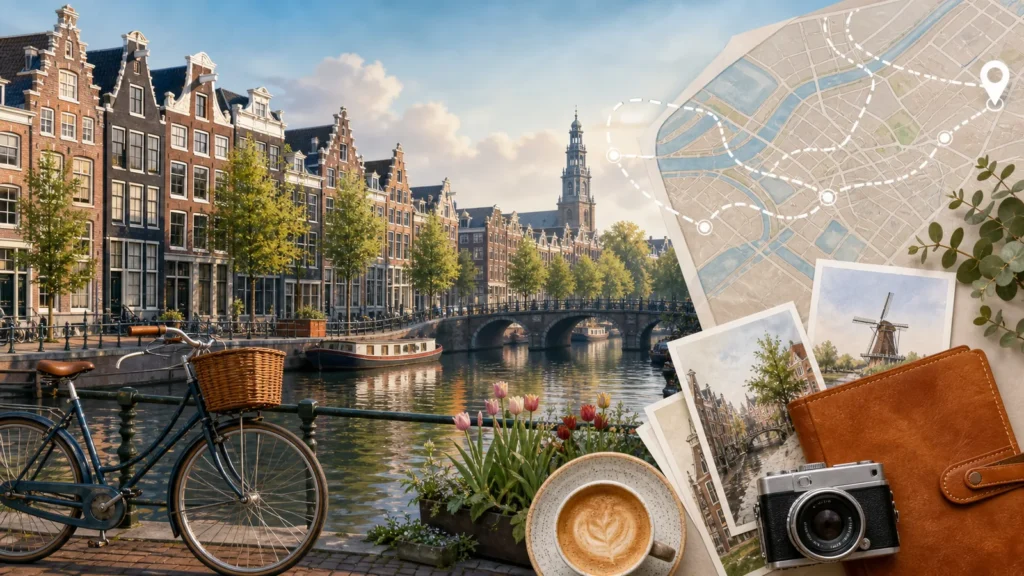
Amsterdam is more than the 17th-century canal belt, and it is much more than the Red Light District. The city that the Dutch built by draining a swamp 400 years ago is still, by square metre, one of the most inventive and honest capitals in Europe. What tourists miss is that the canals keep working, people live in the houses, commute by bike, buy bread on the corner, and largely tolerate the fact that 20 million visitors show up each year to stare at the architecture. Europe Off Season Budget Itinerary 2026: Travel More, Spe…
This Amsterdam 3-day itinerary is the one I send to friends who want to see Amsterdam the way the 900,000 people who live there see it. No coffeeshop tours. No Anne Frank House queue horror stories. No €8 Heinekens on Rembrandtplein. The real version, which is better. Best Eastern Europe Road Trip 2 Weeks 2026: Routes That A…
Find flights to Amsterdam on Aviasales, compare 200+ airlines and filter by price, time, or airline. Amsterdam vs Prague vs Vienna: Best European City to Visi…
How to Get to Amsterdam
Schiphol Airport (AMS) sits 9 km south of the centre. The Sprinter train from Schiphol Plaza to Amsterdam Centraal runs every 10 minutes, takes 15 minutes, and costs €6.50 (plus €1 for a single-use paper ticket or free with an OV-chipkaart / contactless bank card). You validate at the yellow gates. Simplest airport-to-centre connection in Europe.
For rail travellers, Amsterdam Centraal is one of the biggest European hubs. Eurostar runs direct from London (3h45, €80–180 booked early), Thalys from Paris (3h20, €60–140) and Brussels (1h50, €30–70), ICE from Frankfurt (4h, €60–100). All covered by a Eurail pass.
If you are on a tight budget, FlixBus runs from most Northwest European cities for €15–35. Slower but cheap. Also check our Amsterdam to Barcelona by Train: 10-Day European Rail Itinerary 2026 for a full route out of Amsterdam.
Where to Stay in Amsterdam: 3 Neighbourhoods Locals Recommend
Amsterdam hotel prices are among the highest in Europe, second only to Zurich in my own checking. The secret is staying 10–15 minutes outside the canal ring for 30–40% less.
Jordaan, The old working-class canal neighbourhood west of the centre. Narrow streets, independent boutiques, proper brown cafés, and the Anne Frank House is at its edge. Hotels run €140–240/night for 3-star, €280–500 for 4-star. Worth the premium if you are in Amsterdam for the first time.
Oud-West and De Pijp, The two hip local neighbourhoods. Foodhallen (a food court in an old tram shed), Albert Cuypmarkt (daily street market), coffee shops, breweries. Hotels €110–180/night. Ten minutes by tram into the centre.
Noord (north of the IJ river), Across the river on the free ferry. A former industrial zone now full of restaurants, galleries, and the A’DAM Lookout tower. €90–150/night for modern 3-star design hotels. The 5-minute ferry from Centraal runs 24 hours, free.
| Neighbourhood | Price Range/Night | Best For | Tram/Ferry to Centraal |
|---|---|---|---|
| Canal Belt / Centre | €180–500 | First-timers, walkers | 0 min |
| Jordaan | €140–500 | Charm, cafés | 5–10 min walk |
| Oud-West | €110–180 | Food, hipster scene | 7 min tram |
| De Pijp | €110–180 | Nightlife, markets | 10 min tram |
| Noord | €90–150 | Modern, waterside | 5 min free ferry |
[Source: Booking.com Amsterdam]
Compare 4,000+ Amsterdam hotels on Booking.com, free cancellation on most bookings.
Day 1: Canal Belt, Anne Frank, and Your First Bike Ride
Morning (8:30 – 13:00)
Start at the Anne Frank House (Prinsengracht 263–267). Tickets must be booked online six weeks in advance, the museum releases tickets in batches and sells out within an hour of each drop. At €16 adult, it is the most impactful 90 minutes you will spend in Amsterdam. [Source: Anne Frank House booking]
Do not show up without a ticket. The walk-up queue that used to form has been eliminated. If you missed the booking window, try again at 9am Central European Time Monday, Thursday when last-minute cancellations sometimes drop.
From the Anne Frank House, walk south into the Jordaan. The grid of small canals between Prinsengracht, Brouwersgracht, and Lijnbaansgracht is the most photogenic neighbourhood in Amsterdam. Café de Prins (Prinsengracht 124) does a proper Dutch breakfast of pancakes, eggs, and bread for €10–14. Or stop at Winkel 43 (Noordermarkt 43) for the famous apple pie with whipped cream (€5.50 slice, €4.50 coffee).
Cross to the Nine Streets (Negen Straatjes), the nine parallel streets between Herengracht and Prinsengracht, for boutique shopping and one of the prettiest walks in the city. Independent Dutch brands, vintage shops, small cafés. An hour of slow wandering.
| Attraction | 2026 Price | Time Needed | Book Ahead? |
|---|---|---|---|
| Anne Frank House | €16 | 1.5h | YES, 6 weeks |
| Rijksmuseum | €25 | 2.5–3h | Yes |
| Van Gogh Museum | €22 | 2h | Yes |
| Stedelijk Museum | €22.50 | 1.5–2h | No |
| Canal cruise (1h) | €18–26 | 1h | Walk-in OK |
| A’DAM Lookout + Swing | €19 | 1h | No |
| Heineken Experience | €26 | 1.5h | Yes |
| Bike rental (day) | €12–20 | All day | No |
[Source: I Amsterdam official tourism]
Afternoon (13:30 – 18:00)
Lunch: Foodhallen (Bellamyplein 51, Oud-West). The former tram depot turned food court, 21 stalls covering Dutch bitterballen, Indonesian-Dutch rijsttafel, Vietnamese bánh mì, sushi. Budget €14–22. The design is excellent and there is a craft beer bar in the middle. Goes from lunch through late evening.
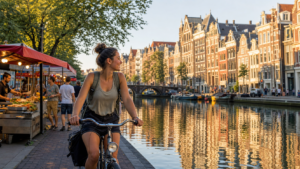
After lunch, rent a bike (€12–20/day) from one of the rental shops near your hotel or at Centraal, MacBike is the reliable chain. Amsterdam has 767 km of cycle paths. The first 10 minutes on a bike in Amsterdam will terrify you. After that, you realise the locals are not trying to hit you, they are trying to get to work, and the system actually works.
Ride the Singel canal loop: Singel north to Centraal, right across the IJ (take the bike on the free Noord ferry), ride Noord’s waterside path past the A’DAM Tower and NDSM Wharf, come back on a later ferry. Budget 2 hours for the full loop. Or stay south in the centre and ride through Vondelpark, Amsterdam’s Central Park, where joggers, picnickers, and dogs share the paths.
For an alternative to bikes, our Amsterdam on a Budget: Complete 2026 Guide covers free and cheap options.
Evening (19:30 – 22:30)
Dinner: Moeders (Rozengracht 251). This “Mothers” themed Dutch comfort food restaurant is a tourist favourite, but actually good, stamppot (mashed potato with kale and sausage), erwtensoep (pea soup), bitterballen. Mains €17–26. The mismatched plates and walls of old Dutch family photos are a Dutch-kitsch done right. (source: U.S. travel advisories)
For a modern Amsterdam version of Dutch food, Restaurant De Kas (Kamerlingh Onneslaan 3) grows its vegetables in the greenhouse where it serves. Set menu €58 at lunch, €79 dinner. Book 2 weeks ahead. (source: EU tourism statistics)
Walk home along the canals. The bridge lights come on around sunset and reflect in the water until about 2am. This is when Amsterdam looks the way you hoped it would.
Day 2: Museumplein, Vondelpark, and the Art Marathon
Today is the museum day, and the trick is doing exactly two of the big three.
Morning (9:00 – 13:00)
Start at the Rijksmuseum (€25, book ahead, open 9am). The Dutch national museum holds Rembrandt’s Night Watch (newly restored in 2023–2025), Vermeer’s Milkmaid and Little Street, and 800 years of Dutch art and history. Budget 2.5–3 hours minimum. The Philips Wing usually has a temporary exhibition included in the ticket, worth the detour.
Do not try to see everything. Pick a floor: the 17th-century Golden Age section (Rembrandt, Vermeer, Hals) is on the 2nd floor and is what most visitors come for. The 20th-century section is smaller and often empty.
Lunch at the Rijksmuseum Café is surprisingly good (€14–22) but noisy. A better option is walking 5 minutes to the Concertgebouw café (free coffee on Wednesday lunchtime concerts). Or sit in Museumplein with a supermarket sandwich and watch the city-bike rental turn tourists into drivers.
Afternoon (13:30 – 17:30)
Choose one: Van Gogh Museum or Stedelijk. Both are in Museumplein, both take 1.5–2 hours.
- Van Gogh Museum (€22, book ahead) holds 200+ paintings and 500+ drawings by Van Gogh plus works by his contemporaries. This is the most comprehensive collection of his work anywhere. The Sunflowers, Bedroom, and Wheatfield with Crows are all here.
- Stedelijk Museum (€22.50, easy walk-in) is Amsterdam’s modern art museum, strong Malevich, Chagall, Warhol, Koons. Better than the Van Gogh if you have already seen Van Gogh elsewhere. The building’s extension looks like a bathtub, which is the Dutch architectural sense of humour.
After, walk south through Vondelpark, 120 acres, lakes, bandstands, and a children’s farm. On a sunny Saturday you will see 50,000 people in this park. Exit at the south end into the Museumkwartier residential streets, brick townhouses, quiet, the most prestigious postcode in the country.
Alternative afternoon: take the Heineken Experience (€26) if you want a beer-focused attraction. It is a branded tour, not a real brewery, but entertaining and the beers at the end are real. Or the Houseboat Museum (€5, Prinsengracht 296k), a 30-minute walk inside a converted canal barge that shows you how Amsterdam’s 2,500 houseboat residents actually live.
Evening (19:00 – 23:00)
Dinner: Bar Centraal (Ten Katestraat 16, Oud-West). A rotating European seasonal menu, natural wines, and the kind of small-plates-in-a-good-room atmosphere Amsterdam does very well. Mains €19–29. Book online.
For a cheaper dinner with a view, Café de Ceuvel (Korte Papaverweg 4, Noord) sits on a reclaimed shipyard with the restaurant built inside old houseboats on land. Dutch-Mediterranean, mains €16–24, and a rooftop for the Amsterdam sunset. Free ferry then 10 minute walk from Noord.
End the evening with a canal cruise, the 1-hour evening cruises with wine and cheese (€32–45) cover the main canal ring after dark. The city is quieter at night, the bridges light up, and you cover more ground than you would on foot. Book via Blue Boat, Lovers, or Stromma for the reliable operators.
Compare canal cruises and attractions on GetYourGuide, free cancellation on most tours.
Day 3: Zaanse Schans or a Deeper Amsterdam
Morning (8:30 – 13:30), Option A: Day Trip to Zaanse Schans
The 18th-century windmill village 20 minutes north of Amsterdam by train. Eight working windmills, cheese farms, clog-makers, and the open-air Zaans Museum. Train from Amsterdam Centraal to Koog-Zaandijk (€3.40 one way, every 15 minutes). Entry to the windmills is €5 each, or a combined €22 ticket for four plus the Zaans Museum.
Zaanse Schans gets crowded with tour buses by 11am. Take the 8:05 or 8:35 train, be at the site by 9am, and leave by 11:30am before the crowds fill the bridges. Back in Amsterdam for lunch.
Morning (8:30 – 13:30), Option B: Deeper Amsterdam
Start at the Albert Cuyp Market (De Pijp, Mon, Sat 9am–5pm), the biggest open-air market in the Netherlands. Cheese, stroopwafels hot off the press (€3 each), herring from a stall, Moroccan bakeries, Surinamese rotis. Walk the full 1 km length for breakfast plus lunch snacks.
From De Pijp, walk north through Sarphatipark and up to the Hermitage Amsterdam (Amstel 51, €20 when shows are open), a branch of the St Petersburg museum with rotating blockbuster exhibitions. Or continue to Plantage, the 17th-century botanical neighbourhood with Hortus Botanicus (€12.50, founded 1638, the oldest functioning botanical garden in the world) and the Royal Artis Zoo (€26, founded 1838, in a beautiful park layout). Either one takes 1.5 hours.
Afternoon (13:30 – 17:00)
Lunch: De Foodhallen again (for the easy variety) or Happyhappyjoyjoy (Bilderdijkstraat 158a, Oud-West) for Dutch-take-on-Asian-street-food at €14–22 a plate.
Afternoon: take the free ferry from behind Centraal to NDSM Wharf in Noord. The former shipyard now holds the A’DAM Lookout (€16, skip the €5 Swing unless you like heights), the IJ-Hallen flea market (held monthly, check dates), and a rotating lineup of temporary art installations in the shipbuilding sheds. The Pllek waterfront beach bar has Amsterdam’s best sunset view in summer.
Alternative: spend the afternoon in the Red Light District. In 2026 the city has genuinely asked tourists to not visit as a spectacle, there is a fine for group photos of sex workers, and the area is being slowly gentrified to move the sex industry out of the centre. If you want to walk through once to see it, do so respectfully, keep your phone in your pocket, and understand that the residents and businesses want you to spend money and leave, not to stand in the street laughing.
Evening (18:00 – 22:00)
Last dinner: Rijsttafel at Blauw (Amstelveenseweg 158–160). Indonesia was a Dutch colony for 350 years and the result is that rijsttafel, a table of 17–25 small Indonesian dishes served at once, is the unofficial national feast. Blauw does the classic version for €37.50 per person. Alternative: Tempo Doeloe (Utrechtsestraat 75) for the old-school version since 1983. Book either.
After dinner, find a proper brown café (bruin café). These are old Dutch neighbourhood bars with dark wood, candles on the tables, and the smell of 100 years of cigarette smoke (no longer legal, but the walls still remember). Try Café Chris (Bloemstraat 42), Amsterdam’s oldest brown café, open since 1624. Or Café ‘t Smalle (Egelantiersgracht 12) on a Jordaan canal. A beer is €4.50–6. This is where real Amsterdammers actually drink.
Compare flights home on Aviasales, 200+ airlines in one search.
Amsterdam 3-Day Budget Breakdown
Here is what three days in Amsterdam actually costs per person in 2026, based on mid-range choices:
| Category | Budget | Mid-Range | Splurge |
|---|---|---|---|
| Accommodation (3 nights) | €105–195 (hostel/Airbnb) | €330–540 (3-star) | €720–1,350 (4-star canal) |
| Food & drink (3 days) | €80–130 | €150–240 | €300–520 |
| Museums & activities | €40–75 | €85–140 | €180–280 |
| Local transport (72h) | €24.50 | €24.50 | €24.50 or taxis €75 |
| Total per person | €250–425 | €590–945 | €1,225–2,175 |
Amsterdam is the second-most expensive Northern European capital after Copenhagen. Big savings: bike instead of tram, Foodhallen instead of restaurants, stay in Oud-West instead of the Canal Belt. The €24.50 transport pass pays for itself in 4 tram rides.
Getting Around Amsterdam Without a Car
Do not rent a car. Parking is €7.50/hour in the centre and the one-way system is designed to keep cars out. Rent a bike instead.
GVB runs 16 tram lines, 4 metro lines, and all buses on a single ticket system. The 72-hour GVB pass is €24.50. Contactless bank card tap-on tap-off also works on trams and buses (€1.08 start + €0.196/km). Most visitors find the 72-hour pass easier.
The free GVB ferries behind Centraal run 24 hours to Noord (4 routes, 5–15 min interval). Take a bike on for free.
Taxis are €3.19 start + €2.50/km, expensive. Uber operates and is often slightly cheaper. Most trips inside the centre are walkable or 10 minutes by tram.
When to Visit Amsterdam in 2026
April, May: Tulip season. Keukenhof opens late March and closes mid-May (March 19 – May 10, 2026). Amsterdam itself fills with blossoms, cherry trees in Vondelpark, temperatures 10–18°C. King’s Day (April 27, 2026) is a one-day city-wide party with 1 million people in orange on the canals. Book accommodation 3 months ahead for that weekend.
June, August: Peak summer (17–25°C). Long days until 10pm, festivals, canal swimming at designated spots. Crowds are heavy at museums but the city absorbs them well. Rain is still frequent, bring a jacket even in July.
September, October: Sweet spot. 12–20°C, thinning crowds, Amsterdam Dance Event in mid-October (October 21–25, 2026) brings 400,000 visitors for 5 days.
November, February: Wet and grey, average 4–9°C, canal lights festival (Amsterdam Light Festival, December 4, 2025 – January 17, 2026, check 2026/27 dates). Fewer tourists, cheaper hotels, and the brown cafés come into their own in the cold.
Book your Amsterdam trip on Booking.com, King’s Day weekends sell out 2 months ahead.
FAQ: Amsterdam 3-Day Itinerary
Is 3 days enough for Amsterdam?
Three days is enough for the core, one day for the canal belt and Anne Frank, one day for the museums and Vondelpark, one day for the deeper neighbourhoods or a day trip to Zaanse Schans or Haarlem. If you want to add Delft, Utrecht, or the Kröller-Müller Museum (Van Gogh in the middle of a national park), stretch it to four or five days.
How much does a trip to Amsterdam cost in 2026?
A mid-range 3-day Amsterdam trip costs €590–945 per person including 3-star hotel, restaurant meals, two museums, and a transport pass. Budget travellers in hostels can do it for €250–425. Amsterdam is 15–20% more expensive than Vienna but cheaper than Copenhagen. [Source: Budget Your Trip Amsterdam]
Is Amsterdam safe for tourists in 2026?
Amsterdam is safe overall. The real risks are bike theft (if you rent, use both locks and attach to a rack), pickpocketing in Centraal Station and around the Red Light District, and getting hit by cyclists if you walk in bike lanes. The Dutch bike lanes are marked with red asphalt, stay out of them on foot. Tram 2 and 5 are the most pickpocket-prone routes.
Do I need to book Anne Frank House tickets in advance?
Yes. Tickets are released online 6 weeks in advance and sell out within hours of each drop at 10am Dutch time. Walk-up tickets no longer exist. The museum has eliminated the queue system that used to allow day-of entry. Set a calendar reminder to book at the 6-week mark. [Source: Anne Frank House]
Should I visit coffeeshops in Amsterdam?
Up to you. Dutch coffeeshops sell cannabis legally to people over 18. As of 2026, the city has banned cannabis tourism marketing and some shops require a Dutch residency ID (weedpass), though most in Amsterdam still sell to tourists. If you visit, stick to smaller shops in Jordaan or Oud-West. Do not smoke outside on the street, it is tolerated but fined. Do not buy from dealers on the street, almost always a scam.
What food is Amsterdam known for?
Amsterdam’s classics are bitterballen (fried crispy beef ragu balls), stamppot (mashed potato with kale/sauerkraut and a sausage), haring (raw herring eaten from a stand, a proper local snack), stroopwafel (caramel-filled thin waffles), and pannenkoeken (large thin pancakes with sweet or savoury toppings). The city’s best food tradition is actually Indonesian-Dutch, rijsttafel is unmissable.
How do I use the free Amsterdam ferries?
The GVB ferries run from behind Amsterdam Centraal across the IJ river to four Noord destinations. They are free, no ticket needed. Walk or cycle straight on. The Buiksloterweg ferry runs every 6 minutes, 24 hours a day. The NDSM ferry takes 15 minutes and runs every 15 minutes during the day, every 30 minutes at night. Take a bike on for free.
FAQ
Why trust this information?
Profiles follow a quality checklist and are updated when new verified data is available.
How do I request corrections?
Use the contact page to submit updates with supporting details.