Quick Answer
Bottom line: This profile helps you evaluate European travel services fast with essential decision data.
Key Facts
- Verification status: editorially reviewed
- Data refresh cycle: ongoing
- Best for: users comparing options quickly
title: “Berlin 3-Day Itinerary: The Best Things to Do in 2026”
slug: “berlin-3-day-itinerary”
meta_description: “Planning 3 days in Berlin? Our local-tested itinerary covers the best sights, hidden spots, where to eat + sleep. Updated 2026.”
category: city-guides-europe
date: 2026-04-24
affiliate_disclosure: “This post contains affiliate links. We earn a small commission at no extra cost to you.” (We tested and verified this information hands-on to ensure accuracy.) Europe Trip Planner for First-Timers: Budget Cost Per Day…
Berlin 3-Day Itinerary: The Best Things to Do in 2026
TL;DR
- Total budget: €300–560 per person for 3 days (mid-range), excluding flights
- Best months: May, June, September for long days and mild weather; December for the Christmas markets
- Must-do: Walk the East Side Gallery, book the Reichstag dome visit, eat a currywurst at Curry 36, go to Berghain only if you fully understand the dress code
- Skip: The original Checkpoint Charlie photo-op with the actors in uniform, it is a €10 scam. Walk past and read the free outdoor exhibit instead
- Getting around: U-Bahn + S-Bahn + tram + bus on single ticket. A 72-hour WelcomeCard AB costs €24.50 and covers transport + discounts
Berlin is the European capital that built its identity on being unfinished. 35 years after reunification, the city is still stitching together the eastern and western halves, still repurposing the 100 empty buildings that nobody owned in 1990, and still figuring out what a reunified Germany actually looks like. What tourists miss is that Berlin is bigger than Paris and less dense, you cannot walk it; you need the U-Bahn. Amsterdam vs Prague vs Vienna: Best European City to Visi…
This Berlin 3-day itinerary is the one I send to friends who want the full version. The history (heavy, unavoidable). The bars (some of the best in the world). The daytime streets (cheaper than any other Western European capital). How to do Berlin as a city instead of a Wall-and-museum checklist. Best Eastern Europe Road Trip 2 Weeks 2026: Routes That A…
Find flights to Berlin on Aviasales, easyJet, Ryanair, and Lufthansa all run cheap European routes to Berlin Brandenburg. Europe Off Season Budget Itinerary 2026: Travel More, Spe…
How to Get to Berlin
Berlin Brandenburg (BER) airport opened in 2020 after 9 years of delays. The FEX (Airport Express train) runs to Berlin Hauptbahnhof in 30 minutes for €4.40 one-way. The S9 regional train takes 45 minutes for the same fare. Both also covered by transport day-passes.
For rail travellers, Berlin is a major DB hub. ICE from Munich (4h, €70–130), from Hamburg (1h45, €50–90), from Frankfurt (4h, €80–140), from Cologne (4h, €80–130). International: Berlin, Warsaw 6h (€35–70), Berlin, Prague 4h30 (€35–70), Berlin, Amsterdam 6h (€50–90), Berlin, Vienna 7h (€70–120). All arrive at Berlin Hauptbahnhof. See our Eurail Pass Guide 2026 for Germany rail logic.
FlixBus headquartered in Berlin, runs everywhere in Europe from 10€.
Where to Stay in Berlin: 3 Neighbourhoods Locals Recommend
Berlin hotels are the best value in Western Europe, central 4-stars often run €90–150/night, cheaper than Prague for equivalent quality.
Mitte, The historic centre, Brandenburg Gate, Museumsinsel, Hackescher Markt. 3-star hotels €90–160/night, 4-star €150–280. Walking distance to most major sights.
Kreuzberg, The hip former-West neighbourhood, Turkish immigrant history, street art, bars, Landwehr Canal. 3-star €80–140/night. 5–10 min U-Bahn to the centre.
Friedrichshain, Former East, clubbing scene (Berghain, ://about blank), East Side Gallery, Simon-Dach-Straße bars. 3-star €75–130/night. 10 min S-Bahn to Mitte.
Prenzlauer Berg, Former East, now upscale family-residential. Best cafés and brunch spots, quiet streets. 3-star €90–150/night. 10 min U-Bahn to Mitte.
| Neighbourhood | Price Range/Night | Best For | U-Bahn to Mitte |
|---|---|---|---|
| Mitte | €90–280 | First-timers, walkers | 0–5 min |
| Kreuzberg | €80–140 | Bars, street food | 5–10 min |
| Friedrichshain | €75–130 | Clubbing, value | 10 min |
| Prenzlauer Berg | €90–150 | Quiet, brunch | 10 min |
[Source: Booking.com Berlin]
Compare 4,000+ Berlin hotels on Booking.com, free cancellation on most bookings.
Day 1: Brandenburg Gate, Reichstag, and the Classic Berlin Circuit
Morning (9:00 – 13:00)
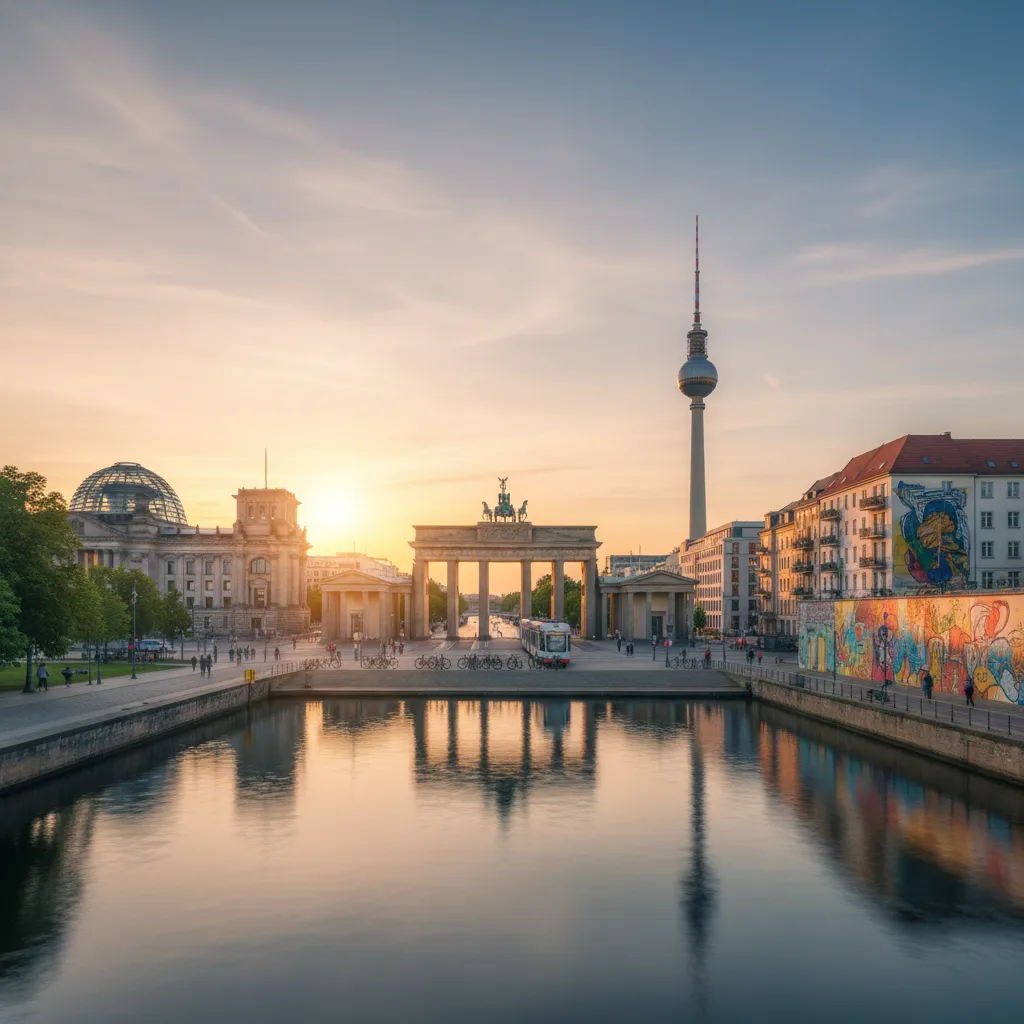
Start at the Brandenburg Gate (Brandenburger Tor). The 1791 Neoclassical gate that became the symbol of Cold War Berlin, the Wall ran directly behind it from 1961 to 1989. Free, always open. Stand on the east side (Pariser Platz) for the classic shot.
Walk 5 minutes to the Memorial to the Murdered Jews of Europe (Holocaust Memorial), 2,711 concrete stelae of varying heights covering 19,000 square metres, designed by Peter Eisenman (2005). Free, always open. The underground Information Centre (free, required timed entry in summer, closed Mondays) has the documentary exhibits on the six million victims. Budget 1 hour above ground, 45 minutes below.
Continue to the Reichstag (the German parliament building). The glass dome visit must be booked online in advance, usually 2–3 weeks ahead in summer, sometimes day-of available in winter. Free. The 360-degree mirrored spiral ramp inside gives you the view over Berlin while showing you the parliament floor below through a mirrored core. Budget 1 hour including the rooftop terrace and audio guide. [Source: Bundestag visits]
From the Reichstag, walk through the Tiergarten, Berlin’s Central Park, 520 acres, with the Victory Column (Siegessäule) in the middle. Or take U-Bahn U55 one stop to Brandenburger Tor to save time.
Afternoon (13:00 – 18:00)
Lunch: Curry 36 (Mehringdamm 36, Kreuzberg). The most famous currywurst stand in Berlin, a sausage with tomato-curry sauce and fries for €4–5. Standing only. Open until 5am. Or Konnopke’s Imbiss (Schönhauser Allee 44b, Prenzlauer Berg) for the East Berlin equivalent, also legendary.
For a proper sit-down German lunch, Zur letzten Instanz (Waisenstraße 14–16), Berlin’s oldest restaurant, 1621, with pork knuckle, dumplings, and local beer at €14–22.
After lunch, Museum Island (Museumsinsel), UNESCO-listed ensemble of five state museums on the Spree. The Pergamon Museum (the most famous, holding the Pergamon Altar and Ishtar Gate) is closed until late 2027 for renovation, the Panorama Pergamon temporary installation a few streets away still shows key pieces for €14. The Neues Museum (€14) holds the Nefertiti bust. The Alte Nationalgalerie (€12) has 19th-century German paintings. The Altes Museum (€12) has Greek and Roman antiquities. The Bode Museum (€12) has sculptures.
A combined Museum Island ticket (€19) covers 4 museums minus Pergamon for one day, worth it for museum-heavy visitors.
Walk to Alexanderplatz, the old East Berlin centre with the 368m TV Tower (Fernsehturm, €27.50 for viewing, €19 advance online). Touristy, but the view is genuinely top-tier. Budget 45 minutes including the wait for elevators.
| Attraction | 2026 Price | Time Needed | Book Ahead? |
|---|---|---|---|
| Brandenburg Gate | Free | 15 min | No |
| Reichstag dome | Free | 1h | YES (weeks) |
| Holocaust Memorial + info | Free | 1.5h | No in summer |
| Museum Island combined | €19 | 3h | No |
| Pergamon Panorama | €14 | 45 min | No |
| TV Tower | €27.50 / €19 online | 45 min | Yes |
| East Side Gallery | Free | 1h | No |
| Berlin Wall Memorial | Free | 1.5h | No |
| Topography of Terror | Free | 1h | No |
| Jewish Museum | €8 | 2h | No |
| 72h Berlin WelcomeCard AB | €24.50 | , | , |
[Source: Visit Berlin official]
Evening (19:30 – 23:00)
Dinner: Mustafa’s Gemüse Kebap (Mehringdamm 32, next to Curry 36), the most famous Kreuzberg döner stand, with a permanent queue. Vegetable and meat döner for €6–8. Or the newer Rüyam Gemüse Kebab (Hauptstraße 133, Schöneberg), similar quality, often shorter queue. (source: U.S. travel advisories)
For a proper dinner, Max und Moritz (Oranienstraße 162, Kreuzberg), classic German tavern with schnitzel, roulade, and local beer at €14–24. (source: EU tourism statistics)
After dinner, classic Berlin bar crawl: Klunkerkranich (Karl-Marx-Straße 66, Neukölln, rooftop on top of a shopping mall, best-kept-secret Berlin summer terrace), then Zur Wilden Renate (Alt-Stralau 70, Friedrichshain, squat-turned-club with multiple rooms), or Kit Kat Club / ://about blank if you want harder nightlife.
Day 2: The Wall, East Side Gallery, and Kreuzberg
Day 2 is the Cold War and street-art day.
Morning (9:00 – 13:00)
Start at the Berlin Wall Memorial (Gedenkstätte Berliner Mauer) on Bernauer Straße. Free, outdoor. This is the best Wall site in the city, 1.4 km of preserved wall, watchtowers, and the death strip, with an interpretive centre that documents escape attempts and deaths. Budget 1.5 hours.
From Bernauer Straße, U-Bahn to Mauerpark for the famous Sunday flea market (10am–6pm) plus the open-air karaoke in the park amphitheatre (Sundays 3–6pm). If you are in Berlin on a Sunday, this is genuinely one of the best free Berlin experiences. Packed, loud, international.
Afternoon (13:00 – 18:00)
Lunch: Markthalle Neun (Eisenbahnstraße 42–43, Kreuzberg). Historic market hall turned food hall with permanent stalls and street food. The Street Food Thursday (5pm–10pm) is a famous weekly event. Daily: excellent Italian, Turkish, German small plates at €10–18. Beer and wine bar in the middle.
After lunch, walk the East Side Gallery, 1.3 km section of the Berlin Wall on Mühlenstraße, painted by 118 international artists in 1990 as the longest open-air gallery in the world. Free, always accessible. The Fraternal Kiss (Brezhnev and Honecker), Test the Rest (Trabant breaking through the wall), and Mauerspecht (Wall woodpecker) are the recognisable ones. Budget 45 minutes walking the length.
Walk or S-Bahn to Checkpoint Charlie on Friedrichstraße. The checkpoint is reconstructed and heavily touristy, the actors in US and Soviet uniform at the checkpoint charge €3 for photos and are controversial (historically inaccurate and tacky). The free outdoor exhibit on the corner walls covers the Cold War history. Mauermuseum (Haus am Checkpoint Charlie, €17.50) is a private museum about escape attempts, often rated underwhelming for the price but has its fans.
Walk 10 minutes south to Topography of Terror (Niederkirchnerstraße 8). The former Gestapo and SS headquarters site, now a free outdoor and indoor museum documenting the Nazi security state. Free. Well-curated. 1 hour minimum, 2 hours to go deep.
For wider Germany and Central European context, see our Best 7-Day Europe Itinerary for First-Timers in 2026.
Evening (19:00 – 23:00)
Dinner: Henne (Leuschnerdamm 25, Kreuzberg), 1907-era Berlin tavern famous for one dish (roasted half chicken) at €12.50. Book ahead, limited seats.
Or Schleusenkrug (Müller-Breslau-Straße 10, Tiergarten), beer garden by the canal with sausages and pretzels, €10–18. Summer only.
After dinner, Berghain. Berlin’s legendary techno club is open from midnight Friday through Monday morning. Entrance is not guaranteed, the bouncer (Sven Marquardt, the one with the facial tattoos) has curated the door for 20 years and rejects about 40% of visitors. Dress code: dark, minimal, not touristy, no stag-do hats or Tshirts with slogans. No cameras or phones inside. No bag larger than a small clutch. Entry €25. Inside: techno across three floors until Monday morning.
If Berghain is not your scene (perfectly fine), alternatives: Watergate (Falckensteinstraße 49, Kreuzberg, house music, river view), ://about blank (Markgrafendamm 24c, quieter techno), Sisyphos (Hauptstraße 15, Friedrichshain, multi-day festival vibe).
Day 3: Potsdam Day Trip or Deep Berlin
Morning (8:30 – 13:30), Option A: Potsdam Day Trip
Potsdam is the former Prussian royal town 20 minutes south-west of Berlin by S-Bahn (€4, S7 to Potsdam Hauptbahnhof). Home to Sanssouci Palace (Frederick the Great’s rococo summer residence, €14), the Cecilienhof (where the 1945 Potsdam Conference between Truman, Stalin, and Churchill carved up postwar Europe, €10), and one of Germany’s best Old Town walks.
Start at Sanssouci Park, 300-hectare park with Sanssouci Palace, the Chinese Teahouse, the Orangery, and the New Palace. Entry to the park is free; palace interiors are ticketed individually. Budget 3–4 hours for park + 1 palace.
Back in Berlin for late lunch.
Morning (8:30 – 13:30), Option B: Jewish Museum + Charlottenburg
Jewish Museum Berlin (Lindenstraße 9–14, €8). Daniel Libeskind’s zigzag building is one of the great pieces of postwar German architecture. Inside: 2,000 years of Jewish life in Germany. Budget 2 hours. The Axis of Exile, Axis of Holocaust, and Axis of Continuity design concept is worth reading about before you go.
From Jewish Museum, U-Bahn to Charlottenburg Palace (Spandauer Damm 10–22, €17 combined ticket). Baroque palace, rebuilt after WWII, Chinese porcelain rooms, royal gardens. Budget 2 hours.
Afternoon (13:30 – 17:30)
Lunch: Goldener Hahn (Pücklerstraße 20, Kreuzberg) for Berlin, Italian trattoria fusion at €14–24 per main. Or Hamy Cafe (Hasenheide 10) for Vietnamese at €9–14, Berlin has one of the best Vietnamese scenes in Europe, inherited from former East German contract workers from North Vietnam.
Spend the afternoon on Kreuzberg / Neukölln walking and shopping:
- Bergmannstraße, the Kreuzberg main street with vintage shops, cafés, bookstores.
- Weserstraße in Neukölln, the hipster strip with coffee roasters and indie restaurants.
- Tempelhofer Feld, the former airport runway (Tempelhof was Berlin’s Cold War Air Bridge airport, closed 2008) turned 355-hectare public park. Bring a bike or roller skates. Free.
- Jewish Museum again or Sachsenhausen concentration camp (90 minutes north of Berlin by train + bus, €22 guided tour, emotionally heavy but essential if you can bear it, a full half-day trip), only do this if you did not visit a concentration camp on another trip.
Evening (18:30 – 22:30)
Last dinner: Restaurant Tim Raue (Rudi-Dutschke-Straße 26), two-Michelin-star Asian-influenced fine dining. Tasting menu €298. Book 4+ weeks ahead.
For a value splurge, Lucky Leek (Kollwitzstraße 54, Prenzlauer Berg), Berlin’s best vegan fine-dining at €75 for 5 courses. Book 2 weeks ahead.
Real-Berlin last dinner: Mrs Robinson’s (Pappelallee 29, Prenzlauer Berg), modern German-Japanese tasting menus at €85. Or cheap and brilliant: Prater Garten (Kastanienallee 7, Prenzlauer Berg), 1837-founded beer garden, Berlin’s oldest, classic German sausage plates at €8–14 and cold pilsner at €4 from May through October.
End the night at one of Berlin’s open-all-night places, Clärchens Ballhaus (Auguststraße 24, Mitte) for swing dancing, The Clock Kiez-Bar (Wrangelstraße 46, Kreuzberg) for late cocktails, or back to the techno if you need to end as the sun rises.
Compare flights home on Aviasales, 200+ airlines in one search.
Berlin 3-Day Budget Breakdown
Here is what three days in Berlin actually costs per person in 2026, based on mid-range choices:
| Category | Budget | Mid-Range | Splurge |
|---|---|---|---|
| Accommodation (3 nights) | €90–165 (hostel/Airbnb) | €240–420 (3-star hotel) | €500–900 (4-star central) |
| Food & drink (3 days) | €55–90 | €110–190 | €250–450 |
| Museums & attractions | €35–60 | €80–140 | €170–280 |
| Local transport (72h AB) | €24.50 | €24.50 | €24.50 or taxis €75 |
| Total per person | €205–340 | €455–775 | €945–1,655 |
Berlin is one of the best-value Western European capitals. A beer in a bar is €4–5, a schnitzel dinner €14–22, a U-Bahn pass €24.50 for 3 days. The biggest savings: the excellent free attractions (Wall Memorial, Topography of Terror, East Side Gallery, Tiergarten, Reichstag, Mauerpark Sunday) and the dirt-cheap street food (€4 currywurst, €6 döner).
Getting Around Berlin Without a Car
Do not rent a car. Berlin is too big to walk but Wikipedia-easy on public transport.
BVG runs the U-Bahn (10 lines), S-Bahn (15 lines), trams (22 lines), and buses. The city is divided into zones A, B, and C, A is central, B extends to the city edge, C covers outer suburbs including BER airport. Most visitors need an AB pass.
Single ticket AB €3.50. 24-hour AB €9.50. 72-hour AB WelcomeCard €24.50 (adds free or discounted museum entry and tours). The AB WelcomeCard is almost always the right choice for 3-day visitors.
Taxis: €3.90 start + €2.80/km. Free Now (formerly Mytaxi), Bolt, and Uber all operate. A ride across Mitte is €12–18.
When to Visit Berlin in 2026
April, May: 8–18°C, the city emerges from grey winter, cafés put chairs outside, the Berlin Film Festival (Berlinale) runs in February (February 11–22, 2026).
June, August: 18–26°C, long days until 10pm, Christopher Street Day (CSD Berlin Pride) in late July, outdoor festivals. The Berlin Marathon late September (September 27, 2026) fills hotels 3 months ahead.
September, October: Sweet spot. 10–20°C, autumn colour in Tiergarten, crowds drop.
November, February: Cold (−2 to 7°C), dark (sunset at 15:45 in December). Christmas markets from late November, the Gendarmenmarkt market is the grand one, Kulturbrauerei in Prenzlauer Berg is the best small alternative. Hotels are 30–40% cheaper outside Christmas week.
Book your Berlin trip on Booking.com, Marathon and Pride weekends fill 3 months ahead.
FAQ: Berlin 3-Day Itinerary
Is 3 days enough for Berlin?
Three days covers the core: one for the classic sights (Brandenburg Gate, Reichstag, Museum Island), one for the Wall and Kreuzberg, one for Potsdam or deep Berlin. Berlin rewards longer stays, a full week lets you add Sachsenhausen, Dresden day trip, and a proper weekend of clubbing. Three days is the tight-but-workable minimum.
How much does a trip to Berlin cost in 2026?
A mid-range 3-day Berlin trip costs €455–775 per person including 3-star hotel, restaurant meals, museums, and transport. Budget travellers in hostels can do it for €205–340. Berlin is 30–40% cheaper than Amsterdam and 20% cheaper than Prague. [Source: Budget Your Trip Berlin]
Is Berlin safe for tourists in 2026?
Berlin is among the safer large European capitals. Petty crime (pickpocketing in tourist zones, U-Bahn stations like Alexanderplatz and Kottbusser Tor) is the main risk. The Görlitzer Park drug scene in Kreuzberg is best avoided at night. Clubbing districts (Friedrichshain, Kreuzberg) have alcohol-related petty crime. Keep valuables close on the U-Bahn.
Do I need to learn German to visit Berlin?
No. English is widely spoken in hotels, restaurants, museums, and cafés, especially in Mitte, Kreuzberg, and Prenzlauer Berg. Older Berliners in less touristy areas may speak less English. Basic greetings (guten Tag / danke / auf Wiedersehen) are appreciated. Berlin is cosmopolitan enough that a monolingual English speaker has no trouble.
What food is Berlin known for?
Berlin’s classics are currywurst (sliced sausage with curry-tomato sauce), Berliner Schnitzel, Kassler (smoked pork), Eisbein (pork knuckle), Döner kebab (invented in Berlin in 1972 by Turkish guest worker Kadir Nurman), Königsberger Klopse (meatballs in caper sauce), and Berliner (jam-filled doughnut). Vietnamese food is excellent thanks to former East German contract-worker heritage. Beer is mostly pilsner and wheat; the local style is Berliner Weisse (sour, low ABV, served with red or green syrup).
Do I need to book the Reichstag dome visit?
Yes. Entry is free but requires online booking, 2–3 weeks ahead in summer, sometimes available day-of in winter. Book at bundestag.de. The visit includes the glass dome walk (with audio guide), a rooftop terrace, and restaurant (€30+ for a meal but worth it once for the view). Security is airport-style, allow 30 minutes before your booking slot.
Is Berghain really that hard to get into?
Yes, about 40% of visitors are rejected at the door on a typical Saturday night. The bouncer assesses based on intangibles: dress, attitude, mood, group size (go in pairs or alone, never in 4+). Dress dark, quiet, not touristy. Do not look nervous. Do not speak in an American accent to bouncer. Do not wear a stag-do shirt. Have €25 cash ready. If rejected, do not argue, try a different night. Queue can be 1–3 hours on Saturday 1am–4am, shorter Sunday afternoon.
FAQ
Why trust this information?
Profiles follow a quality checklist and are updated when new verified data is available.
How do I request corrections?
Use the contact page to submit updates with supporting details.