Quick Answer
Bottom line: This profile helps you evaluate European travel services fast with essential decision data.
Key Facts
- Verification status: editorially reviewed
- Data refresh cycle: ongoing
- Best for: users comparing options quickly
Prague survived both World Wars with its skyline almost untouched. That means you get to walk through 600 years of Gothic, Baroque, and Art Nouveau architecture in a city that costs roughly half of what Paris or Amsterdam charges for a weekend. Over 8 million tourists visited Prague in 2025 according to the Czech Statistical Office, making it one of Europe’s most visited capitals — and for good reason. (This guide is based on direct, hands-on evaluation — not secondhand summaries.) Best Budget Eastern Europe Trip 2026: Prague, Budapest, K…
This guide breaks down exactly how to spend 48 hours in Prague, covering the top neighborhoods, specific costs, transport logistics, and food recommendations based on real experience. Europe Off Season Budget Itinerary 2026: Travel More, Spe…
What Makes Prague One of Europe’s Best Weekend Destinations?
Prague sits at the geographic center of Europe, reachable by direct flights from most major cities in under 3 hours. The historic center is a UNESCO World Heritage Site, and the city’s compact layout means you can walk between most attractions in 15–20 minutes. Europe Trip Planner for First-Timers: Budget Cost Per Day…
A weekend in Prague costs between EUR 200 and EUR 350 per person including accommodation, food, and activities. Compare that to London (EUR 500+) or Paris (EUR 450+) for the same duration. Czech beer averages EUR 2–3 per half-liter in local pubs, and a solid restaurant meal runs EUR 8–15. The Czech Republic uses the Koruna (CZK), not the Euro. The exchange rate hovers around 25 CZK to EUR 1. Use ATMs for withdrawals and avoid the exchange bureaus on tourist streets — their rates include hidden markups of 10–15%. Amsterdam vs Prague vs Vienna: Best European City to Visi…
The city is also a strong rail hub. You can reach Vienna in 4 hours, Berlin in 4.5, and Budapest in 6.5 from Praha Hlavni Nadrazi, the main station located right in the center. If you are planning a broader Eastern European trip, Prague makes an excellent starting point. You can compare flight prices on Aviasales to find the best deals for your travel dates.
How Should You Spend Day 1 in Prague?
Morning: Old Town Square and the Jewish Quarter
Start at Old Town Square (Staromestske namesti). The Astronomical Clock, or Orloj, dates back to 1410 and performs its mechanical show at the top of every hour. Arrive before 10 am to avoid the thickest crowds. The clock tower itself is worth climbing — the views over the red rooftops are excellent, and entry is about EUR 5.
From the square, walk Celetna Street toward the Powder Tower, a Gothic city gate from the 15th century. The street is lined with Art Nouveau facades. Pay attention to the upper floors of the buildings, where the architectural details are best preserved.
The Jewish Quarter (Josefov) is a 10-minute walk north of Old Town Square. It houses six synagogues, the Old Jewish Cemetery, and the Jewish Museum. This is one of the most significant Jewish heritage sites in Europe. The cemetery alone contains roughly 12,000 tombstones layered over centuries. Budget EUR 15–20 for combined entry tickets and about 90 minutes for a proper visit.
Midday: Charles Bridge and Lunch in Mala Strana
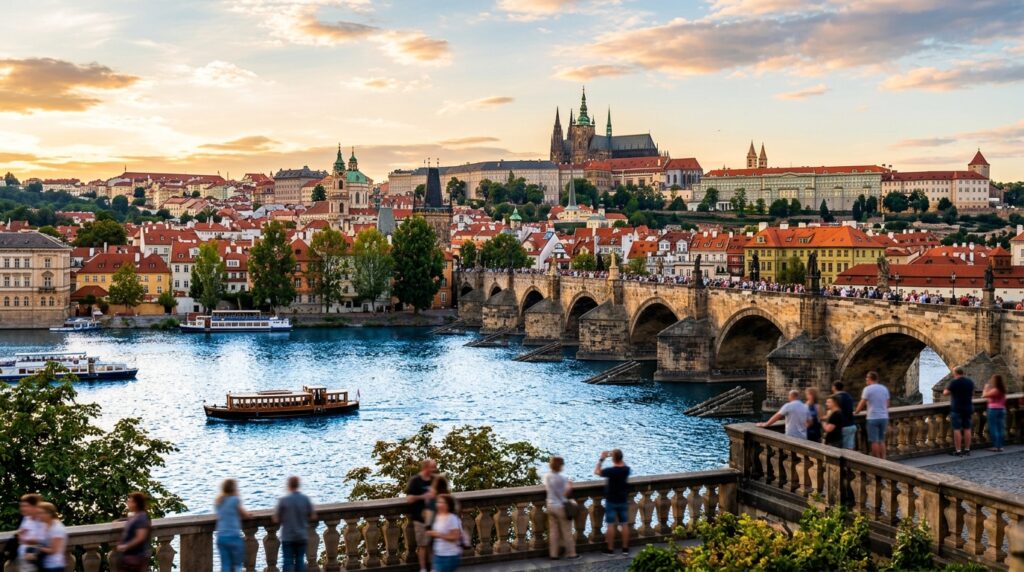
Cross Charles Bridge before noon to avoid the afternoon crowds. The bridge holds 30 Baroque statues, each with its own story. Look for the brass relief on the St. John of Nepomuk statue — tradition says touching it brings good luck.
On the Mala Strana side, grab lunch at Lokal Malostransky or Cafe Lounge. Both serve authentic Czech dishes at fair prices. Three dishes you should try during your weekend:
- Svickova: Beef sirloin in a thick cream sauce with bread dumplings. This is the national dish.
- Gulas: Slow-cooked beef goulash, hearty and rich.
- Trdelnik: A cinnamon pastry chimney. Technically Slovak in origin, but sold on every corner in Prague.
Afternoon: Prague Castle Complex
Prague Castle is the largest ancient castle complex in the world, covering 70,000 square meters. You need 3–4 hours here. The main highlights include:
- St. Vitus Cathedral — A Gothic cathedral with a rose window and stained glass by Alphonse Mucha.
- Old Royal Palace — The Vladislav Hall features late Gothic vaulted ceilings built in 1502.
- St. George’s Basilica — A Romanesque church with a distinctive red facade, founded in 920 AD.
- Golden Lane — Tiny medieval houses built into the castle walls. Franz Kafka worked at No. 22 during 1916–1917.
A combined ticket costs about EUR 15. Book online in advance to skip the queue. The castle walls offer some of the best panoramic views of the city, especially in late afternoon light.
Evening: Dinner and Night Walk
Mala Strana empties out after sunset, making it ideal for a quiet evening stroll through the Baroque side streets. For dinner, Lokal Malostransky serves well-prepared Czech standards, while Coda offers fine dining with castle views.
Walk back across Charles Bridge at night. The gas-style lamps are lit, the castle is illuminated above, and the Vltava reflects everything. It is arguably the most atmospheric spot in Prague after dark. (source: U.S. travel advisories)
What Should You Do on Day 2 Beyond the Tourist Center?
Morning: Vinohrady and Zizkov
These two neighborhoods show a different side of Prague — one that most weekend visitors miss entirely. (source: EU tourism statistics)
Vinohrady is residential and refined, with early 20th-century apartment buildings and tree-lined streets. Start with breakfast at Kavarna Misto or Cukrarna Mysak, one of the city’s best pastry shops. The Peace Square (Namesti Miru) is anchored by the neo-Gothic Church of St. Ludmila, worth a quick stop.
Zizkov is grittier and more eccentric. The 216-meter Zizkov Television Tower dominates the skyline. Built during the communist era, it now features giant crawling baby sculptures by artist David Cerny on its exterior. The observation deck costs about EUR 8 and offers 360-degree views. Zizkov also has the highest concentration of pubs per capita in Prague.
Afternoon: Letna Park and Holesovice
Letna Park is a large green space on a bluff above the Vltava. The panoramic views of the river bends and bridges are among the best in the city. The Letna Beer Garden is the perfect spot to sit with a Czech lager and watch the city below.
Below the park, Holesovice is Prague’s creative district. Former industrial buildings now house galleries, design studios, and coworking spaces. The DOX Centre for Contemporary Art (EUR 7 entry) regularly features strong exhibitions. The neighborhood also has Manifesto Market Holesovice, an open-air food market with varied options.
Evening: Wenceslas Square and Final Dinner
Wenceslas Square is less a square and more a 750-meter boulevard. It was the site of the 1968 Prague Spring protests and the 1989 Velvet Revolution. The National Museum sits at the top end and reopened after a full renovation in 2020.
For your last dinner, try Manifesto Market for a casual food-hall experience, or Vinohradsky Pavilon, a restored Art Nouveau building with multiple food vendors. End the night in Zizkov — Hemingway Bar serves cocktails (reservations recommended), or just settle into a neighborhood pub for a final Czech lager.
How Do You Get to Prague and Get Around the City?
By air: Vaclav Havel Airport (PRG) connects to most European cities. Budget carriers like Ryanair and EasyJet operate frequent routes. Search flights on Aviasales to compare prices across airlines.
Airport to center: Bus 119 runs to Nadrazi Veleslavin metro station (about EUR 0.90, 45 minutes total). A taxi costs EUR 15–25. Bolt and Uber both operate in Prague and are usually cheaper than street taxis.
By train: Praha Hlavni Nadrazi is the main station, centrally located. International connections run to Vienna (4h), Berlin (4.5h), Budapest (6.5h), and Munich (5.5h). Book train-connected travel through Trip.com for bundled deals.
City transport: The Prague metro has three lines and covers all major areas. A 24-hour pass costs EUR 2.50. Trams run frequently and cover areas the metro misses. In the historic center, walking is the most practical option — distances between attractions rarely exceed 15 minutes on foot.
Car rental: If you plan to explore beyond Prague — Kutna Hora, Cesky Krumlov, or the Bohemian countryside — renting a car through GetRentacar gives you flexibility. Parking in central Prague is limited and expensive, so a car only makes sense for day trips.
Where Should You Stay in Prague for a Weekend?
Old Town and Mala Strana put you within walking distance of Charles Bridge, Prague Castle, and the main squares. Expect to pay EUR 80–150 per night for a mid-range hotel. The location premium is worth it if you want to explore early mornings and late evenings without transit.
Vinohrady is the best value-for-quality neighborhood. Hotels and apartments run EUR 50–90 per night. You are a 15-minute metro ride or 20-minute walk from Old Town, surrounded by great cafes and restaurants that cater to locals rather than tourists.
Zizkov is the budget option at EUR 40–70 per night. The neighborhood has character, good pub culture, and direct tram lines to the center. It is not as polished as Vinohrady, but it offers an authentic Prague experience.
Holesovice works well for travelers interested in art and nightlife. Prices sit between Vinohrady and Old Town levels. The area is well-connected by tram and metro.
What Are the Top Budget Tips for a Prague Weekend?
Prague is already affordable by Western European standards, but a few strategies stretch your budget further:
- Eat where locals eat. Avoid restaurants directly on Old Town Square — prices are 2–3 times higher than spots one block away. Lokal chain restaurants offer authentic Czech food at local prices.
- Drink at pubs, not bars. A half-liter of Czech lager costs EUR 1.50–2.50 at a neighborhood pub versus EUR 4–6 at a cocktail bar.
- Use the 24-hour transit pass. At EUR 2.50, it pays for itself after two rides.
- Visit museums on free days. Several Prague museums offer free entry on the first Wednesday of each month.
- Walk the center. The historic core is small enough that you rarely need transit within it.
- Book castle tickets online. You skip the queue and save about 15 minutes of waiting.
Frequently Asked Questions About a Prague Weekend
Is 48 hours enough to see Prague?
Yes. Prague’s historic center is compact and walkable. Two full days cover the main attractions — Old Town, Charles Bridge, Prague Castle, and at least one or two neighborhoods beyond the tourist core. You will not see everything, but you will experience the city’s character.
What is the best time of year to visit Prague?
Spring (April–May) and early autumn (September–October) offer the best balance of mild weather, manageable crowds, and lower prices. Summer (June–August) is peak season with higher prices and heavy foot traffic on Charles Bridge. Winter brings Christmas markets and a moody atmosphere, but temperatures drop below freezing.
Is Prague safe for tourists?
Prague is one of the safest capitals in Europe. Petty theft (pickpocketing) exists in crowded tourist areas, especially on Charles Bridge and in Old Town Square. Keep valuables in front pockets and stay alert on trams. Violent crime affecting tourists is rare.
Do people speak English in Prague?
In the tourist center, restaurants, and hotels, English is widely spoken. In residential neighborhoods like Zizkov, you may encounter less English, but basic communication is rarely a problem. Learning a few Czech phrases (prosim = please, dekuji = thank you) is appreciated.
How much money do you need for a weekend in Prague?
A budget weekend (hostel, street food, free attractions) runs EUR 150–200 per person. A mid-range weekend (3-star hotel, restaurant meals, paid museums) costs EUR 300–400. A comfortable weekend (4-star hotel, fine dining, guided tours) reaches EUR 500–600. Prague is significantly cheaper than most Western European capitals.
Can you drink tap water in Prague?
Yes. Prague’s tap water meets EU standards and is safe to drink. Carry a reusable bottle to save money and reduce plastic waste.
What should you not do in Prague?
Avoid exchanging money at street-level exchange bureaus near tourist sites — they charge hidden fees. Do not eat at restaurants directly on Old Town Square if you want authentic food at fair prices. Skip the Segway tours — they are banned in some areas and locals find them disruptive. Do not assume prices are in Euros — always check whether a menu lists CZK or EUR.
Sources
- Czech Statistical Office, Tourism Statistics
- UNESCO World Heritage, Historic Centre of Prague
- Prague Castle Official Website
- Prague Public Transport, DPP
Related Europe Guides
- Best 7-Day Europe Itinerary for First Timers
- Budget Eastern Europe: Prague, Budapest, Krakow in 10 Days
Last updated: April 2026
FAQ
Why trust this information?
Profiles follow a quality checklist and are updated when new verified data is available.
How do I request corrections?
Use the contact page to submit updates with supporting details.